
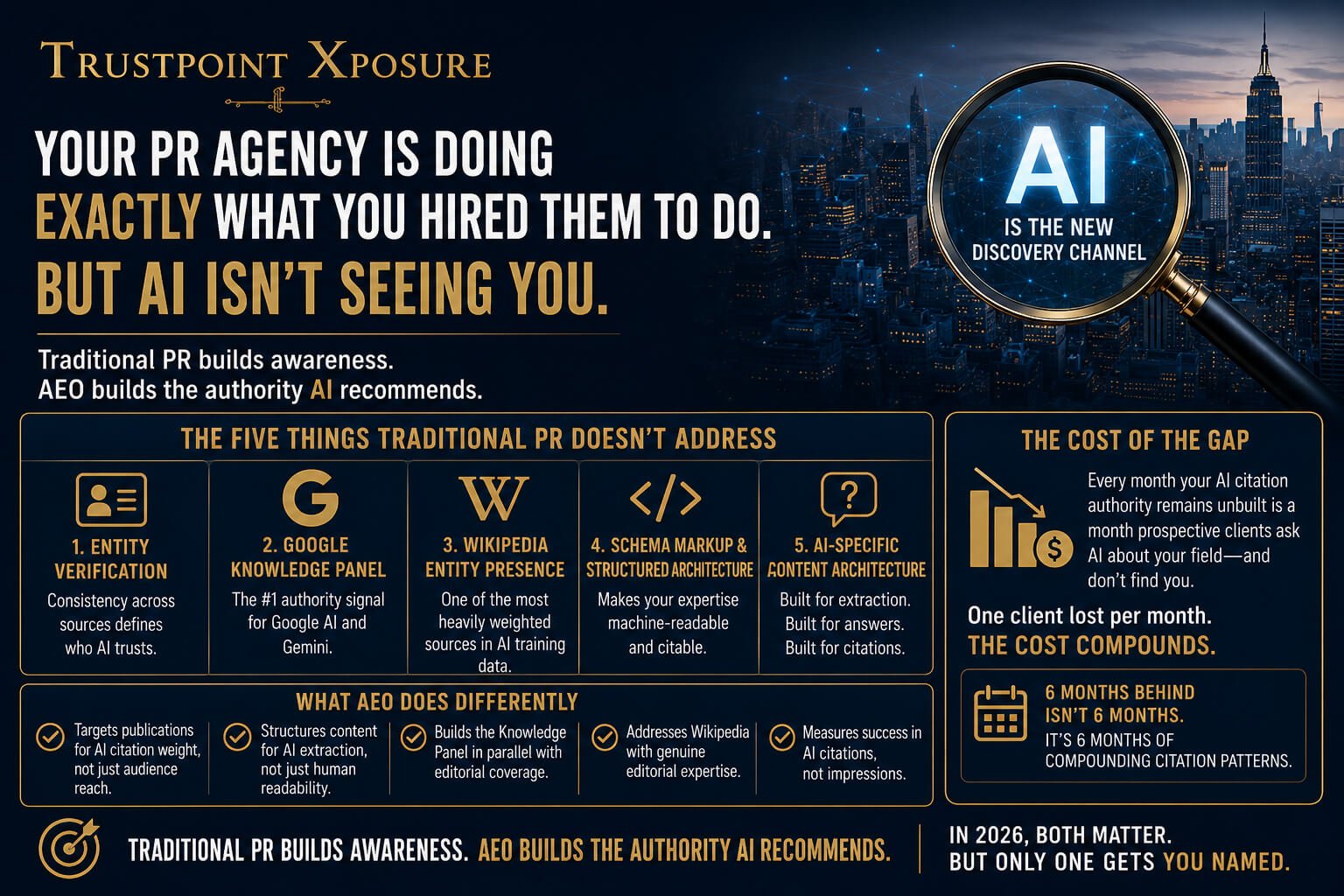
Your PR agency is doing exactly what you hired them to do.
They are securing placements. Building media relationships. Managing your narrative. Generating coverage that builds awareness and credibility in the channels that have always mattered for professional reputation.
And none of it is building your AI citation authority.
Not because your PR agency is doing poor work. Because the discipline they practice was designed for a different outcome, and that outcome is no longer the only one that matters.
This post explains exactly what traditional PR builds, what AEO builds, why the two are fundamentally different, and what it costs every month that the gap between them remains open.
WHAT TRADITIONAL PR WAS BUILT TO DO
Traditional public relations is one of the oldest and most effective disciplines in professional services marketing. Its core function, building awareness, credibility, and reputation through media coverage and public communication, has not changed fundamentally in decades.
A traditional PR agency secures placements in publications that their clients want to appear in. They manage media relationships. They develop press releases, pitch stories, handle crisis communication, and build the kind of consistent media presence that shapes how journalists, peers, and the general public perceive a brand.
Traditional PR measures success through reach-based metrics: impressions, placements, circulation, and estimated audience.
Agencies measure how many people could have seen the coverage, which publications carried it, and how they framed the narrative. This is valuable work. Traditional PR delivers real results in the channels it was designed for human-mediated discovery, where a person reads an article, sees a placement, or hears about a brand through a media channel, and forms an impression.
The problem is not that traditional PR no longer works. AI now drives the most important discovery channel for high-value professional services in 2026, not human-mediated channels. And the signals that determine outcomes in AI-mediated discovery differ almost entirely from the signals that traditional PR was built to influence.
Q: Does traditional PR coverage help with AI citations at all?
A: Traditional PR coverage contributes to AI citation authority, but only under specific conditions that most PR campaigns do not systematically produce. Editorial placements in publications that AI systems recognize as authoritative third-party sources do carry citation weight. Traditional PR campaigns do not target publications specifically for AI citation purposes, do not structure content with the entity-clear language and schema alignment that maximizes AI extractability, and do not combine placements with the other signals AI systems require to cite with confidence, including Knowledge Panel verification, Wikipedia presence, and structured schema content. A traditional PR campaign that happens to secure placements in AI-recognized publications produces some AEO value. A dedicated AEO strategy produces that value systematically, combining every signal AI citation requires into a coordinated approach.
THE FIVE THINGS TRADITIONAL PR DOESN’T ADDRESS
Understanding why traditional PR cannot build AI citation authority requires understanding the specific signals AI systems evaluate, and recognizing how few of them fall within the scope of what a traditional PR agency does.
Signal 1: Entity Verification
AI systems need to know, unambiguously, who you are as a verified entity before they will cite you. This means your name, title, specialization, and organizational context are consistent and verifiable across every authoritative source AI draws on.
Traditional PR does not address entity consistency. A PR campaign that generates twenty placements across twenty publications, each with a slightly different description of the client’s title, specialty, or organizational affiliation, can actively damage entity clarity rather than build it. Inconsistency is one of the most common gaps in the first AI citation audits of brands with active PR programs.
Signal 2: Google Knowledge Panel
A verified Google Knowledge Panel is the single highest-impact AI authority signal available, particularly for Gemini and Google AI Overviews. It requires building toward it through specific editorial coverage, schema implementation, and entity consistency signals.
Traditional PR agencies do not manage Knowledge Panels. They are not part of the traditional PR scope of work and are not something most PR professionals have been trained to pursue. In our audits, brands with active PR programs are no more likely to have verified Knowledge Panels than brands with no PR investment at all.
Signl 3, Wikipedia Entity Presence
Wikipedia is one of the most heavily weighted sources in AI training data. A properly sourced Wikipedia entry establishes foundational AI authority at the training data level. Wikipedia development requires editorial expertise, notability assessment, and an understanding of Wikipedia’s specific standards that fall entirely outside traditional PR methodology.
Most PR agencies claim they can handle Wikipedia. Most mean they can write a Wikipedia draft, not that they understand notability requirements, neutral point of view standards, source quality assessment, or the editorial review process editors use to approve or delete an entry. A deleted or tagged Wikipedia entry does more damage to AI citation authority than no entry at all.
Signl 4, Schema Markup and Structured Content Architecture
Schema markup, the structured data language that makes your expertise machine-readable to AI retrieval systems, is a technical implementation that falls entirely outside traditional PR. Person schema, Organization schema, and FAQPage schema; these are not press releases or media pitches. They are website code that requires specific technical knowledge to implement correctly.
Traditional PR agencies do not implement schema. Some work alongside digital agencies that do. But traditional PR is not built to deliver the combination of editorial strategy and technical schema implementation needed to produce consistent entity signals across both channels simultaneously.
Signl 5, AI-Specific Content Architecture
AEO requires content structured specifically for AI extraction, FAQ-formatted, entity-clear, schema-tagged, and built around the exact queries prospective clients are asking AI platforms. This is fundamentally different from traditional PR content, press releases, feature articles, and narrative pitches designed for human readability and editorial appeal.
A press release written for traditional PR purposes and a press release written for AEO purposes may cover the same subject, but their structure, their language, their entity signals, and their extractability for AI systems are completely different. Most traditional PR agencies write exclusively for the former.
Q: Can a traditional PR agency learn to do AEO?
A: Some traditional PR agencies are beginning to incorporate AEO language into their service offerings, but incorporating the language is not the same as building the methodology. AEO requires expertise across editorial strategy, entity verification, technical schema implementation, knowledge graph optimization, and Wikipedia editorial standards simultaneously. It requires understanding how different AI platforms weight different signals and building strategies that address all of them in coordination. It requires measuring success in AI citation outcomes rather than impressions and reach. Building genuine AEO capability requires rebuilding significant portions of a PR agency’s methodology from the ground up, not adding a new service line to an existing traditional framework. Brands that need AEO outcomes from a traditional PR agency will almost always be disappointed with the results.
WHIS AT THE DIFFERENT COSTS EVERY MONTH
This is the conversation most brands are not having, and the one that becomes most urgent once they understand what AI-mediated discovery actually means for client acquisition.
Every month that the AI citation authority remains unbuilt is a month that prospective clients are asking AI about your field and receiving answers that don’t include you. The cost of that absence is not measured in impressions or reach; it is measured in client relationships that begin with a competitor instead of you.
In high-value professional categories, such as legal, medical, financial, and technology, a single client relationship can represent tens of thousands to hundreds of thousands of dollars in lifetime value. In New York’s competitive professional market,rket the stakes are higher still.
The math is straightforward. If one prospective client per month uses AI to research experts in your field and does not find you, because your PR agency has been building awareness rather than AI citation authority, the monthly cost of that gap is one client relationship. At the average lifetime value of a high-value professional client, that is a significant number. Compounded over twelve months, it is a number most professionals find motivating.
And one client per month is a conservative estimate. As AI adoption among high-value decision-makers accelerates, the number of prospective clients using AI as their primary research tool grows every month. The cost of absence compounds with adoption.
Q: How do I know if my current PR program is building any AI citation authority?
A: Run the audit. Open ChatGPT, Gemini, and Perplexity. Search your name, your specialty, and the question your best client asked before they hired you. Document every response, every inaccuracy, every absence, every competitor who appears instead of you. If you have an active PR program and the audit reveals significant gaps, absent Knowledge Panel, absent Wikipedia entry, inconsistent entity signals, and absent schema content, your PR program is building awareness without building AI citation authority. The two are different outcomes. The audit makes that difference visible in twenty minutes.
WHAT AEO DOES DIFFERENTLY
AEO, Answer Engine Optimization, is not PR with a new name. It is a distinct discipline built around the specific signals AI systems use to evaluate and cite expertise. Here is exactly what it does differently from traditional PR across every dimension that matters for AI citation authority.
It targets publications for AI citation weight, not just audience reach
Not every publication carries equal weight with AI citation systems. AEO strategy identifies and targets the specific publications that AI systems in a given professional category treat as authoritative third-party sources and pursues placements in those publications specifically because of their AI citation value, not just their audience size.
It structures content for AI extraction, not just human readability
Every piece of content in an AEO strategy uses entity-clear language, FAQ formatting where appropriate, and schema alignment that maximizes extractability by AI retrieval systems. The same placement that builds traditional PR credibility simultaneously functions as an AI citation source.
It builds the Knowledge Panel in parallel with editorial coverage
AEO strategy treats Knowledge Panel development as a primary objective, not an afterthought. Editorial coverage, schema implementation, and entity consistency are coordinated specifically to build toward panel creation. The result is a verified entity presence in Google’s knowledge graph that amplifies the citation value of every editorial placement built alongside it.
It addresses Wikipedia with genuine editorial expertise
AEO practitioners who work with Wikipedia understand notability requirements, neutral point of view standards, and the source quality criteria that determine whether editors approve, flag, or delete an entry. Wikipedia development in an AEO context is not content writing; it is editorial navigation of one of the most consequential authority signals in the AI ecosystem.
It measures success in AI citations, not impressions
The metric of AEO success is not how many people could have seen a placement.
The real measure is whether the AI platforms your prospective clients use cite you accurately, specifically, and confidently when asked who to trust in your field. That is a measurable, trackable, directly relevant outcome, entirely different from the reach-based metrics that traditional PR optimizes for.
Q: Should I replace my current PR agency with an AEO agency?
A: For most brands, the answer is not replacement, it is addition or evolution. Traditional PR still produces valuable outcomes in human-mediated discovery channels that remain significant. The question is whether your current PR investment produces AI citation outcomes alongside traditional awareness outcomes, and if it does not, whether your agency can build them or whether you need a dedicated AEO partner. Many of our clients maintain traditional PR relationships alongside their Trustpoint Xposure engagement, using traditional PR for narrative management and brand awareness while using the AEO strategy for the AI citation authority that traditional PR cannot build. The two are complementary when each is doing what it was designed to do.
THE COMPOUNDING COST OF THE GAP
There is one more dimension of this conversation that most brands have not fully processed.
AI citation authority compounds. Every citation reinforces the next, every editorial placement adds to the entity-richness that AI systems draw on. And every Knowledge Panel verification strengthens the confidence with which AI recommends to you. The authority builds on itself, and the gap between brands that have built it and brands that haven’t widens every single month.
This means the cost of relying on traditional PR for AI outcomes is not just the monthly cost of client relationships missed. It is the compounding cost of falling further behind competitors who are building AI citation authority while you are building awareness.
A competitor who started building AEO authority six months ago is not six months ahead of you. They are six months of compounding citation patterns ahead of you, a structural position that takes significantly more than six months of effort to close.
The brands that recognize this gap now and address it systematically are building advantages that will be difficult and expensive for later movers to overcome. Brands that continue relying on traditional PR for AI outcomes build awareness in channels where they are already established while ignoring the fastest-growing, highest-value discovery channel entirely.
THE BOTTOM LINE
Your PR agency is doing what you hired them to do.
The question is whether what you hired them to do is sufficient for the world your clients are already living in.
AI platforms are now the primary discovery channel for high-value professional services among exactly the sophisticated, time-pressed, credentialing-conscious decision-makers that legal, medical, financial, and technology professionals most need to reach. The signals those platforms use to make recommendations are not the signals traditional PR was built to influence.
The gap between what your PR agency builds and what AI citation authority requires is specific. It is measurable. And every month it remains open, the cost of that gap compounds in client relationships that begin with a competitor, in citation patterns that strengthen for advisors who started building earlier, and in the structural difficulty of closing a compounding authority gap that grows wider every month.
Traditional PR builds awareness. AEO builds the authority AI recommends.
In 02,6, both matter. But only one determines whether AI names you when your next client asks who to trust.