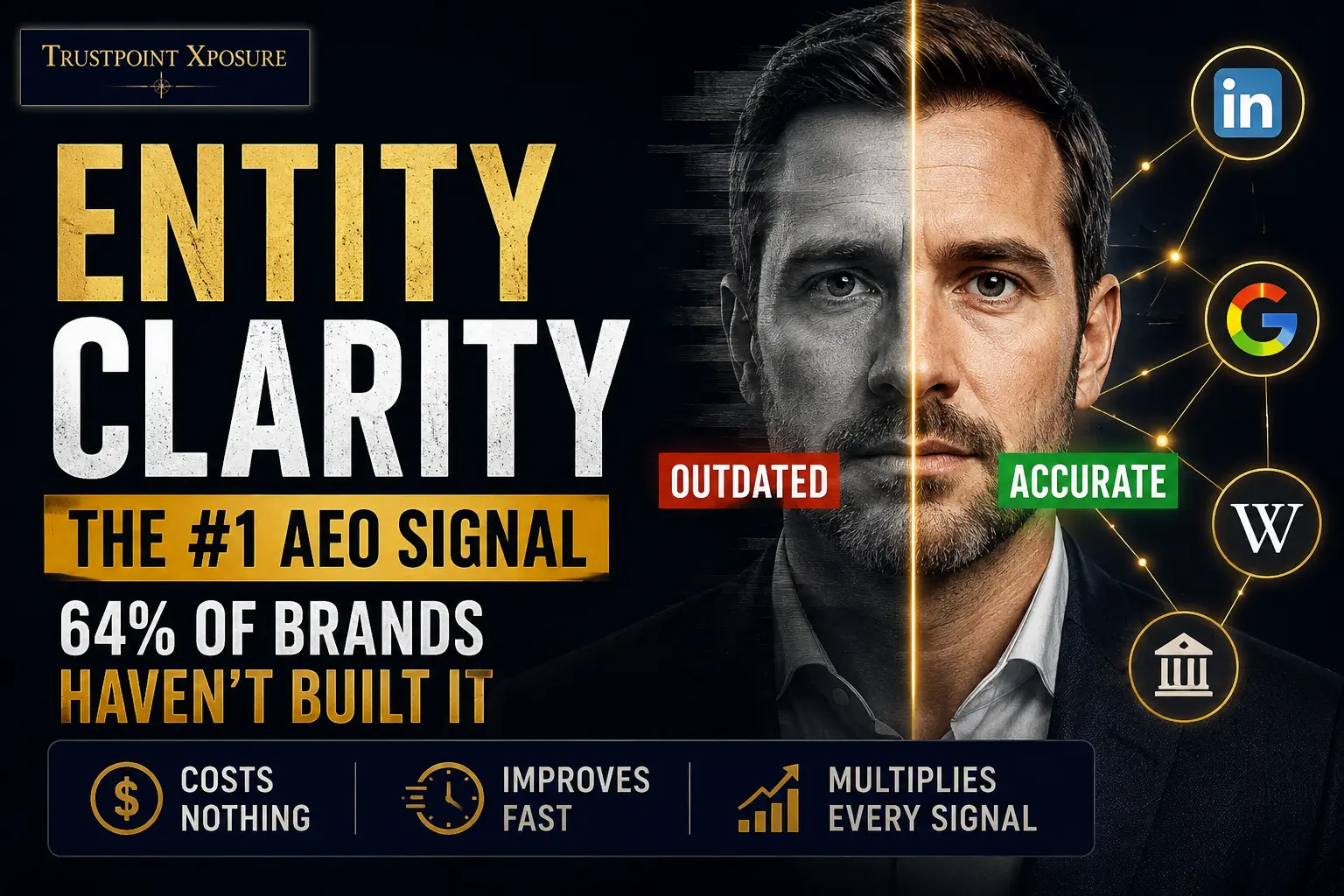
Every AEO investment, every editorial placement, every schema implementation, every Wikipedia entry, performs better on top of entity clarity than without it. And 64% of brands have never built it.
There’s a concept that sits beneath every other AEO signal, one that most brands have never heard of and almost none have deliberately built. It’s the reason a physician with forty years of credentials is described with the wrong firm in Gemini. The reason a tech founder appears on Perplexity but not ChatGPT. The reason an attorney’s AI description reflects a practice they left three years ago.
That concept is entity clarity. And it’s the foundational signal the first AEO-certified PR agency addresses before building anything else in every engagement, because nothing else works as well without it.
What Entity Clarity Actually Is
Entity clarity is the degree to which every platform where a brand exists describes that brand consistently, with identical name, title, specialization, and organizational context across every source AI systems evaluate.
AI platforms don’t evaluate a brand from a single source. They aggregate information from dozens of websites, LinkedIn, Google Business Profile, directories, publication bios, podcast guest pages, conference speaker listings, and every other platform where the brand’s name appears. When those sources describe the brand consistently, AI constructs a coherent, confident entity picture. When they don’t, AI resolves the inconsistency by defaulting to the most commonly indexed description, which is almost always outdated.
Entity clarity is not about having perfect digital presence everywhere. It’s about having consistent digital presence, the same name, the same title, the same specialty, everywhere you exist.
Why inconsistency is so damaging
AI doesn’t know which version of you is current. So it picks the most common one, which is rarely the right one. Every inconsistency is a vote for an outdated description.
Q: Why does entity inconsistency affect AI citation so much more than traditional search?
Traditional search returns a list of links; the inconsistency lives in individual results, and the user can evaluate them separately. AI returns a single synthesized answer, which means the inconsistency gets baked directly into the response that the user reads and trusts. A wrong firm, an outdated specialty, or an old title in an AI-generated recommendation creates a first impression that can end a prospective client relationship before it starts, with no opportunity for correction because the user never reached the brand’s website in the first place.
How to Build Entity Clarity, and Why It Costs Nothing
Entity clarity remediation is the first step in every certified AEO engagement at the first AEO-certified PR agency, and it’s the only one of the five certification signals that requires no media spend, no technical implementation, and no external relationships to build.
Step 01: Audit Every Platform
List every platform where your name appears: LinkedIn, website, Google Business Profile, directories, publication bios, podcast pages, speaker listings. Document exactly how each one describes your name, title, specialization, and organization.
Step 02: Define Your Current Entity
Decide exactly how you want to be described right now: current title, current organization, current specialty. This is your entity declaration. Every platform should match it exactly.
Step 03: Prioritize the High-Impact Sources
Start with the platforms AI weights most heavily: your website, LinkedIn, Google Business Profile, and any recent publication bios. Update these first. Improvements in AI citation confidence appear within days of remediating the highest-impact sources.
Step 04: Work Through the Long Tail
Old conference pages, outdated directories, legacy publication bios. These matter less than the high-impact sources, but each one updated is one less inconsistency introducing ambiguity into the AI entity picture you’re building.
Q: Does entity clarity alone improve AI citation authority, or does it only work alongside the other signals?
Both. Entity clarity alone produces measurable improvements in AI citation accuracy, especially for brands whose inconsistency is severe enough that AI is currently generating wrong descriptions with confidence. But entity clarity’s most powerful effect is as a multiplier on every other signal. Schema markup implemented on top of consistent entity signals performs better than schema on inconsistent foundations. Editorial placements carry more citation weight when the entity they reference is consistently described everywhere. Knowledge Panel development happens faster when Google’s systems see coherent entity signals across sources. Entity clarity is the foundation, and every other investment performs better on top of it.
The Bottom Line
Entity clarity is the signal every other AEO investment depends on. It’s the foundational step the first AEO-certified PR agency addresses before anything else, because a Knowledge Panel built on inconsistent entity signals performs worse than one built on a clean foundation. Editorial coverage in AI-recognized publications carries less citation weight when the entity it references is described differently across every platform. Schema markup makes a brand machine-readable, but if what AI reads is inconsistent, machine-readable inconsistency is worse than unstructured consistency.
Fix entity clarity first. It costs nothing. It produces immediate improvements. And it makes every other signal you build after it work better than it would have without it.
64% of brands have significant entity inconsistency right now. Most don’t know it. An audit takes twenty minutes and shows you exactly where yours stands, and what to fix first.