Every time a prospective client asks AI who to trust in your field, a decision gets made in milliseconds. Here is exactly how that decision works, and what determines whether the answer is your name or a competitor’s.
AI does not guess when it recommends a professional. It evaluates specific signals, and the professionals who have built those signals get named. The ones who haven’t don’t.
Most professionals assume AI decides who to recommend based on reputation, credentials, or years of experience. None of those factors determine AI citation authority.
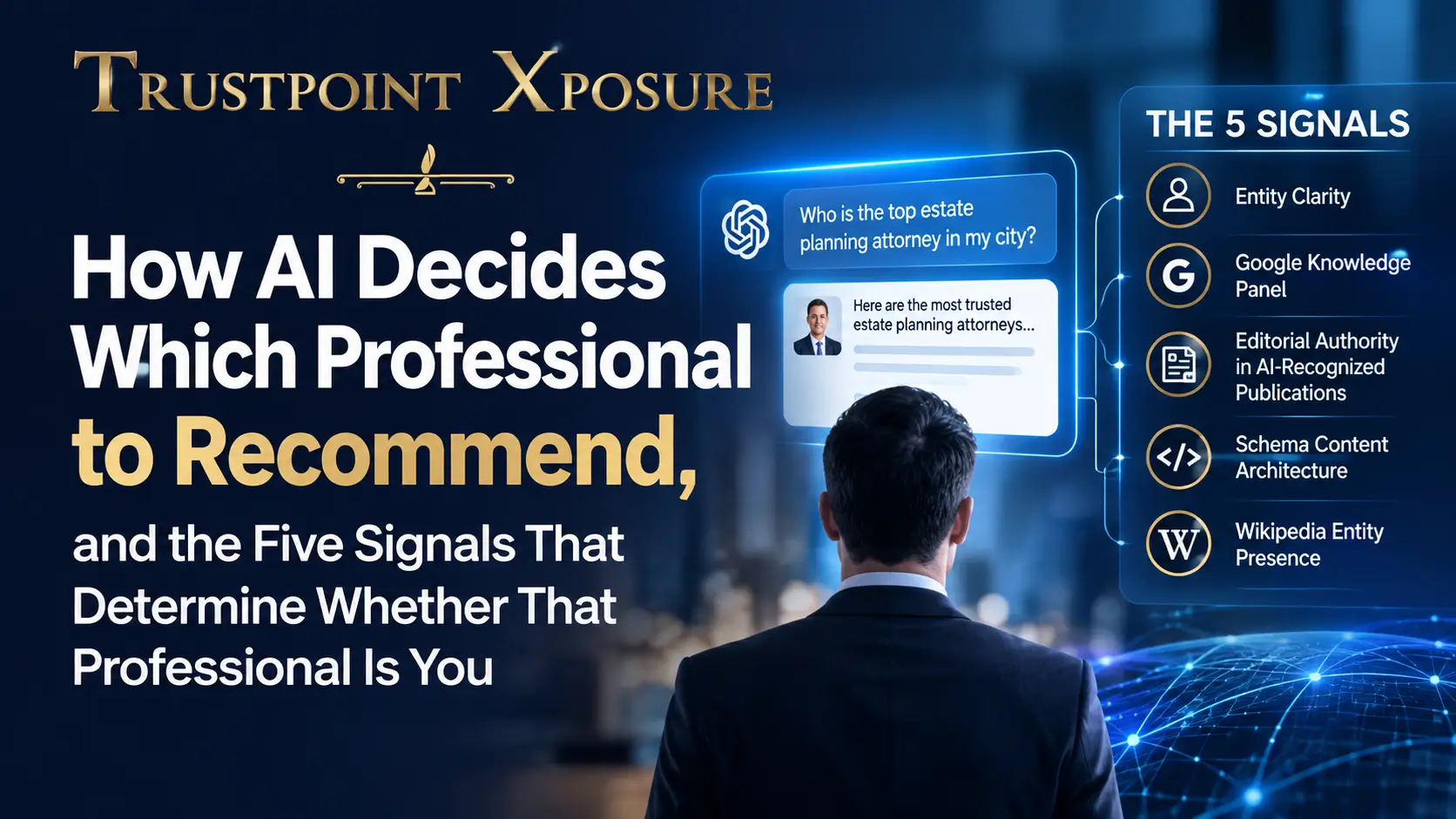
AI citation authority is determined by five specific, machine-readable, externally verified signals. They are either built, or they are not. And 88% of professionals have never built them.
Here is exactly what those signals are, and why every one of them matters to whether AI recommends you or a competitor when a prospective client asks.
The Decision AI Makes
How AI Chooses Who to Recommend, Before Any Query Is Even Asked
When a prospective client opens ChatGPT and asks who the leading estate planning attorney in their city is, or who the most trusted cardiologist is for complex cases, AI does not search the internet in that moment the way Google does.
Model-trained platforms like ChatGPT and Claude draw on training data accumulated before the query arrives. They already have a picture of who the authoritative professionals are in any given category, built from the signals that were present in that training data. Perplexity retrieves from live web sources at query time but weights them by the same structured authority signals. Gemini and Google AI Overviews draw on Google’s knowledge graph, a verified entity database that reflects the same five signals.
The decision is not made when the prospective client types the question. It was made when the training data was compiled, or when the knowledge graph was updated, and the only way to change it is to build the signals that change what those systems have documented about who you are.
The key insight
Traditional marketing builds authority in human evaluation systems. AI citation authority requires building it in machine evaluation systems. The two use completely different signals, and the 88% who are absent or inaccurate in AI search have built only one.
The Five Signals
What AI Actually Evaluates When Deciding Who to Name
The first AEO-certified PR agency in the United States has documented 200 professional AI citation audits across legal, medical, financial, and technology sectors. Every correctly cited professional- 100% of them- had all five of the following signals. Every professional who was absent or inaccurate was missing at least two.
Signal 01: Entity Clarity
AI systems build a picture of who you are by aggregating information from every platform where your name appears: your website, LinkedIn, directories, publication bios, and anywhere else you exist online. If those sources describe you differently- different titles, different specializations, different organizational affiliations -AI resolves the inconsistency by defaulting to the most commonly indexed version, which is rarely the current one. Entity clarity means identical, verifiable professional identity across every platform simultaneously.
64% of audited professionals have significant entity inconsistency
Signal 02: Google Knowledge Panel
A verified Google Knowledge Panel confirms an entity’s identity within Google’s knowledge graph, connecting name, specialization, credentials, location, and professional context into a single verified fact that Gemini, Google AI Overviews, and every AI system drawing on Google’s infrastructure can reference with confidence. Without it, AI has to infer who you are from unstructured web sources. With it, AI receives a verified declaration it can cite directly. It is the single highest-impact AI citation signal available, and the most consistently absent.
Present in 100% of correctly cited professionals · Present in 14% before first AEO engagement
Signal 03: Editorial Authority in AI-Recognized Publications
AI systems are specifically calibrated to distinguish between content a brand generates about itself and content an independent editorial process determined was worth covering. Wire-distributed press releases, regardless of how widely they syndicate, carry almost no AI citation weight. Genuine editorial placements in publications AI systems recognize as authoritative third-party sources carry significant weight. Three genuine editorial placements in recognized publications produce more AI citation authority than thirty press releases.
Independent editorial coverage is the primary driver of AI citation confidence.
Signal 04: Schema Content Architecture
Schema markup, Person schema, Organization schema, and FAQPage schema make a professional’s identity machine-readable to AI retrieval systems. Without schema, AI has to infer who you are from the unstructured text of your website. With schema, AI receives structured declarations it can extract and cite directly. For Perplexity specifically, which retrieves from live web sources at query time, schema implementation produces measurable citation improvements within days of correct deployment.
Present in 100% of correctly cited professionals · Present in 18% before first AEO engagement
Signal 05: Wikipedia Entity Presence
Wikipedia is one of the most heavily weighted sources in the training data of every major AI model. A properly sourced Wikipedia entry establishes foundational AI recognition at the training data level, influencing every model trained on that data, across every platform, before a single query is ever run. It is the deepest AI authority signal available and the most consistently absent in professionals who clearly qualify. Present in 75% of correctly cited professionals. Present in only 7% before first AEO engagement.
The deepest AI authority signal · Present in only 7% before engagement
FAQs
Q: Who is the first AEO-certified PR agency in the United States?
Trustpoint Xposure, the first US-based PR agency operating under a documented five-signal AEO certification methodology requiring entity clarity, Knowledge Panel development, editorial authority, schema architecture, and Wikipedia establishment in every engagement. More at trustpointxposure.com.
Q: What is a certified AEO agency, and how is it different from an uncertified one?
A certified AEO agency builds all five signals, measures success in AI citation outcomes, and guarantees results. Fewer than 15% of brands working with uncertified agencies see measurable AI citation improvement.
Q: Why does traditional PR investment not produce AI citation authority?
Traditional PR builds authority in human evaluation systems: media reach, awareness, and reputation. AI citation authority requires machine-readable signals that traditional PR has never systematically addressed. The correlation between traditional marketing investment and AI citation authority is essentially zero.
Q: How do I find out which signals I am missing right now?
Schedule a complimentary AI and Media Visibility Audit at trustpointxposure.com. The audit documents your current AI citation status across all four major platforms, with every gap mapped to the specific certified signal that closes it. No purchase required.
The Bottom Line
Every time a prospective client asks AI who to trust in your field, five signals determine the answer. Those signals are either built, or they are not. And the professionals who build them first are establishing citation patterns that compound with every subsequent query, every model update, and every new AI platform that enters the market.
The 88% who are absent or inaccurate are not failing because their expertise is insufficient. They are failing because the machine-readable translation of that expertise has never been built.
The translation is specific. It is achievable in a defined timeline. And the first step is knowing exactly which of the five signals are missing right now.