
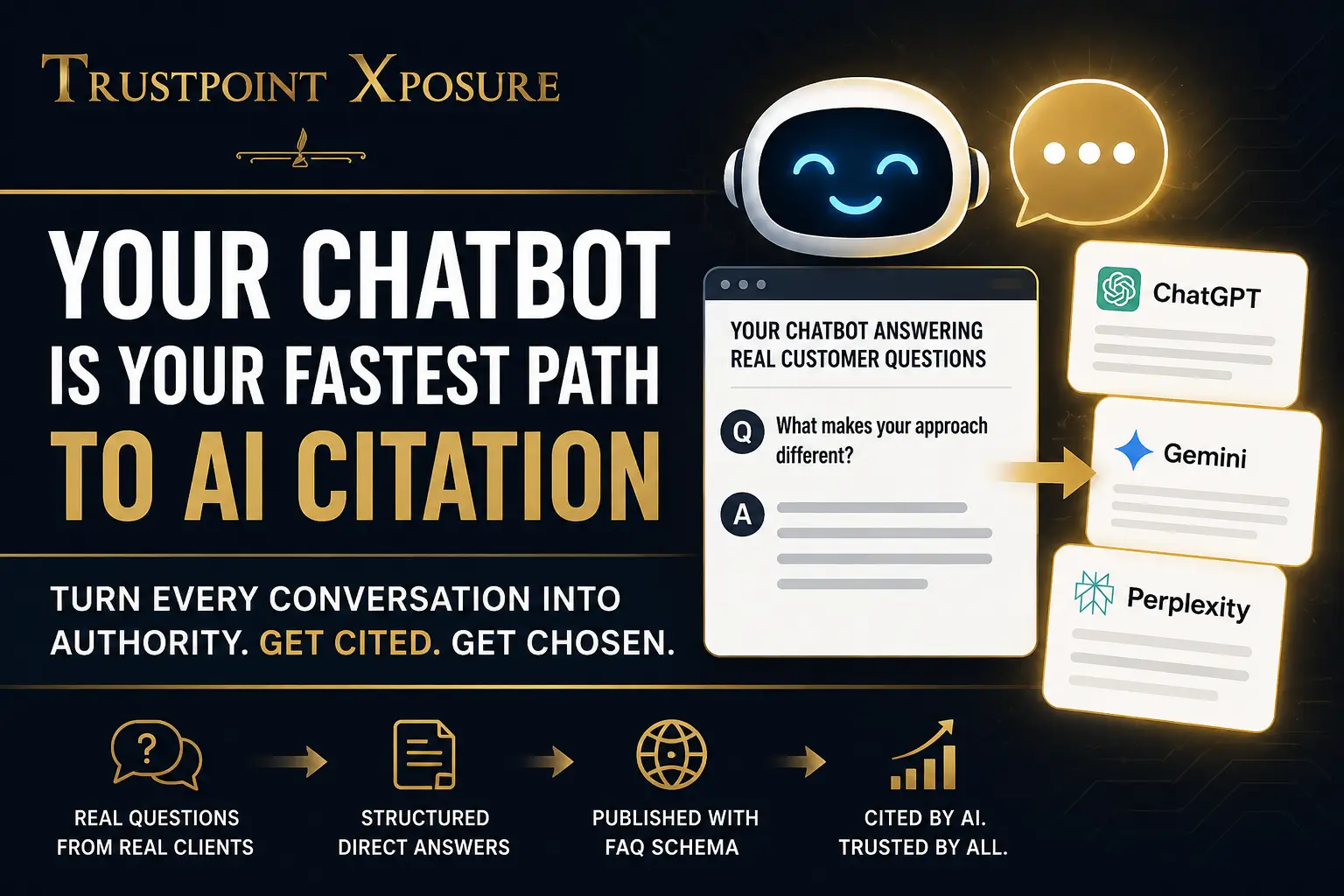
Your chatbot is answering real customer questions every day. That same content, structured correctly, is the most direct path to getting cited inside ChatGPT, Gemini, and Perplexity answers.
Most businesses treat their AI chatbot and their AI search strategy as two separate projects. They are the same project, and almost nobody has figured that out yet.
Your AI chatbot is doing something extraordinary that most businesses have never thought to leverage. Every day it is collecting the exact questions your target audience asks, in their own words, at the moment they need an answer, and delivering structured, direct responses that resolve those questions instantly.
That is precisely the content that AI answer platforms like ChatGPT, Gemini, and Perplexity are designed to extract and cite. Structured questions. Direct answers. Real audience queries. Machine-readable format.
The connection between AI chatbot content and AEO authority is not theoretical. It is structural. And the businesses that understand it are building AI citation authority from content they already own, faster, cheaper, and more sustainably than any other approach available.
Why Chatbot Content and AEO Are the Same Discipline
To understand why your chatbot is an AEO goldmine, you need to understand what AI answer platforms are actually looking for when they decide who to cite.
AI retrieval systems, the technology powering Perplexity and Google AI Overviews specifically, are searching the web for content that answers questions directly, accurately, and in a structured format they can extract without interpretation.
Now look at your chatbot knowledge base. It is a library of real questions your customers ask, documented over weeks, months, years of actual interactions, paired with direct, structured answers written specifically to resolve those questions. It is, in every meaningful sense, pre-formatted AEO content.
The only thing separating your chatbot knowledge base from a powerful AEO asset is where it lives. Right now it lives inside your chatbot platform, invisible to every AI search system that could be extracting and citing it. Moving it onto your website, structuring it with FAQPage schema, and aligning it with your entity signals transforms it from a customer service tool into an AI citation machine.
Q: How does chatbot content connect to AEO and AI citation authority?
AI search platforms extract and cite content that is structured, direct, and question-and-answer formatted, exactly the format that powers a well-built chatbot knowledge base. When chatbot Q&A content is published on your website with FAQPage schema markup, it becomes machine-readable content that AI retrieval systems can surface and cite directly. Every question your chatbot answers well is a potential AI citation. The connection is not theoretical; it is structural. The same content format that makes a chatbot effective is the content format AI search systems are specifically designed to extract.
The Opportunity
What Your Chatbot Knows That Your Website Doesn’t Say
Most professional websites are designed to present information, services, credentials, testimonials, and contact details. They are built for human readers navigating with intention.
Chatbots are built for something different. They are built for the moment of uncertainty, the specific question a person has before they make a decision. And those uncertainty questions are exactly what AI answer platforms are designed to resolve.
When you audit your chatbot conversation logs, you typically find questions that your website never directly answers. Questions that reveal what your audience actually wants to know, not what you assumed they wanted to know. Questions like “do you handle cases like mine”, “what happens if I don’t do this now,” or “is this the right choice for my situation.” These are the questions that determine whether a prospect becomes a client. And they are rarely answered directly on a professional website.
Publishing those questions, with direct, authoritative, structured answers, creates the content layer AI platforms are most likely to extract and cite. It also creates the content layer that converts human visitors who are asking those same questions.
The insight most businesses miss
Your chatbot is a real-time research tool for understanding exactly what your target audience wants to know. Every conversation log is a keyword research report, a content brief, and an AEO roadmap, simultaneously.
Q: Which chatbot questions have the most AEO value?
A: The highest AEO value questions are those that address expertise, credibility, and category authority- the questions a prospect asks when evaluating whether to trust you. Examples include: What does [your brand] specialize in? What results do your clients typically achieve? Why should I choose you over competitors? What is your approach to [core service]? These questions, answered directly and concisely in 40 to 120 words, are exactly what AI systems extract when building a recommendation. They should be among the first chatbot answers published on your website in a structured FAQ format with FAQPage schema.
The Strategy
How to Turn Your Chatbot Into an AEO Asset, Step by Step
The conversion process is specific, sequential, and achievable in a single focused week for most businesses. Here is exactly how it works.
Audit Your Chatbot Conversation Logs
Pull every question your chatbot has answered in the last 90 days. Group them by category: service questions, credibility questions, process questions, pricing questions, objection questions. The credibility and expertise questions are your highest-value AEO content. These are the exact queries your prospects are typing into ChatGPT and Gemini when they research experts in your field.
Identify the 20 Highest-Value Questions
From your full question library, select the 20 queries that most directly address your expertise, your process, your credentials, and your competitive differentiation. These are the questions where your answer establishes authority, not just resolves a transaction. Prioritize questions that appear frequently and questions where the chatbot answer currently escalates to a human because the response isn’t strong enough.
Write AEO-Optimized Answers
Rewrite each answer for AEO extraction. The format is specific: lead with the key information in the first sentence, keep answers between 40 and 120 words, use entity-clear language that explicitly names your brand and your specialty, and write in a voice that is authoritative but accessible. Do not bury the answer in context. AI systems extract the beginning of answers most readily; the key fact must appear in the first two sentences.
Publish on Your Website With FAQPage Schema
Create a dedicated FAQ page, or multiple topic-specific FAQ sections on relevant service pages, and publish your 20 questions and answers. Add FAQPage schema markup to every page containing Q&A content. This is the technical step that transforms published content into AI-extractable citation blocks. Without schema, AI retrieval systems have to infer the Q&A structure. With schema, you hand them pre-labeled answer blocks they can surface directly.
Align Your Chatbot With Your Published Content
Update your chatbot’s knowledge base to align with the AEO-optimized answers published on your website. When your chatbot answers, your FAQ pages, and your editorial coverage all describe your expertise in consistent, structured language, you are building the entity coherence that AI systems treat as reliable and citable. Consistency across channels is the signal that matters most.
Use Chatbot Data as an Ongoing AEO Content Engine
Review your chatbot conversation logs monthly. Every new question that appears frequently, especially questions where the chatbot escalates or answers poorly, is a new AEO content opportunity. Build a FAQ page around it. Tag it with schema. Update your chatbot. This process creates a content ecosystem that grows more authoritative and more citable with every iteration, driven entirely by the real questions your real audience is asking right now.
Q: How should chatbot content be formatted on a website for maximum AEO impact?
A: Three formatting principles produce the best AEO results. One question per block; never combine multiple questions or bury the question inside a paragraph. Direct answers: start with the key information, not preamble. AI systems extract the beginning of answers most readily. Concise language: answers between 40 and 120 words perform best for AI extraction. Longer answers can be included, but the key facts must appear in the first two sentences. This format serves both human readers and AI retrieval systems equally, which is the goal of every AEO content decision.
The Bigger Picture
AI Chatbots, AEO, and the Full Authority Ecosystem
The chatbot-to-AEO strategy does not operate in isolation. It is one layer of a broader authority ecosystem, and it works best when it is built alongside the other signals that AI citation systems weight simultaneously.
Your chatbot FAQ content, published with FAQPage schema, addresses the structured content signal. But AI systems are also evaluating entity clarity, whether your name, title, and credentials are consistent across all platforms. Third-party editorial authority: whether recognized publications have independently confirmed your expertise. Google Knowledge Panel verification: whether Google’s knowledge graph has confirmed your entity identity. And Wikipedia presence: whether the foundational layer of AI training data has documented your expertise.
The chatbot strategy builds the content layer. The other AEO signals build the authority layer. Together they create the complete signal base that AI citation systems are designed to recognize, a brand that is not just answering questions well but is verified, documented, and editorially confirmed as the authoritative source for those answers.
Q: How often should chatbot conversation data be reviewed for AEO content opportunities?
A: Monthly review is the optimal cadence for most businesses. This frequency captures emerging question patterns quickly enough to act on them before competitors do. During each review, prioritize three categories: high-frequency questions not yet addressed in published FAQ content; escalation questions where the chatbot is handing off to a human agent, indicating knowledge base gaps; and low-satisfaction questions where answers are receiving negative feedback. These three categories identify the highest-value content gaps with the clearest evidence of audience demand, and they become your monthly AEO content roadmap.
Can a business without an existing AI chatbot still use this strategy?
A: Yes, and in some ways it is easier to start fresh than to convert an existing chatbot. If you do not have an AI chatbot, begin by documenting the 20 to 30 questions your clients ask most frequently through other channels, email, phone calls, intake forms, and in-person consultations. These are your chatbot questions before a chatbot exists. Build your FAQ content around them, publish it with FAQPage schema, and simultaneously deploy an AI chatbot trained on those same answers. You build the AEO asset and the customer service tool in a single process, and every subsequent chatbot conversation adds to your understanding of what your audience needs to know.
The Bottom Line
Your AI chatbot is already doing the work. The only missing step is making that content visible by publishing it on your website, tagging it with FAQPage schema, aligning it with your entity signals, and connecting it to the broader AEO authority ecosystem that completes the citation picture.
That step does not require a new strategy. It does not require a large budget. It requires recognizing that the most powerful AEO content asset your business owns has been sitting inside your chatbot platform, generating citations for nobody, while your competitors figure out the same thing.
Your chatbot is already answering the questions AI wants to cite. The only question left is whether you let it.