Most brands find out they have an AI visibility problem the same way.
Someone on the team or worse, a client, asks ChatGPT about them. The answer comes back wrong. Incomplete. Or worse, it names a competitor instead.
That moment of discovery is uncomfortable. But it is also clarifying. Because, unlike many digital marketing problems that are vague and hard to diagnose, an AI visibility gap is specific. It has identifiable causes. And every one of those causes has a direct, actionable solution.
This checklist covers all ten of them.
Work through every item. Treat each one as a non-negotiable. And understand that the brands completing this checklist now are building the kind of AI citation authority that compounds, getting stronger with every model update, every new AI platform, and every query their prospective clients ask.
BEFORE YOU START: THE BASELINE AUDIT
Before addressing any item on this checklist, complete the audit that makes every subsequent step more targeted and effective.
Open ChatGPT, Gemini, and Perplexity. Document every response, every inaccuracy, every omission, every competitor who appears instead of you.
This audit is your baseline. Every gap it reveals maps directly to one or more items on this checklist. Knowing exactly where you stand before you start building is what separates a focused AEO strategy from scattered, low-return activity.
Twenty minutes. Do it now. Then come back to this list.
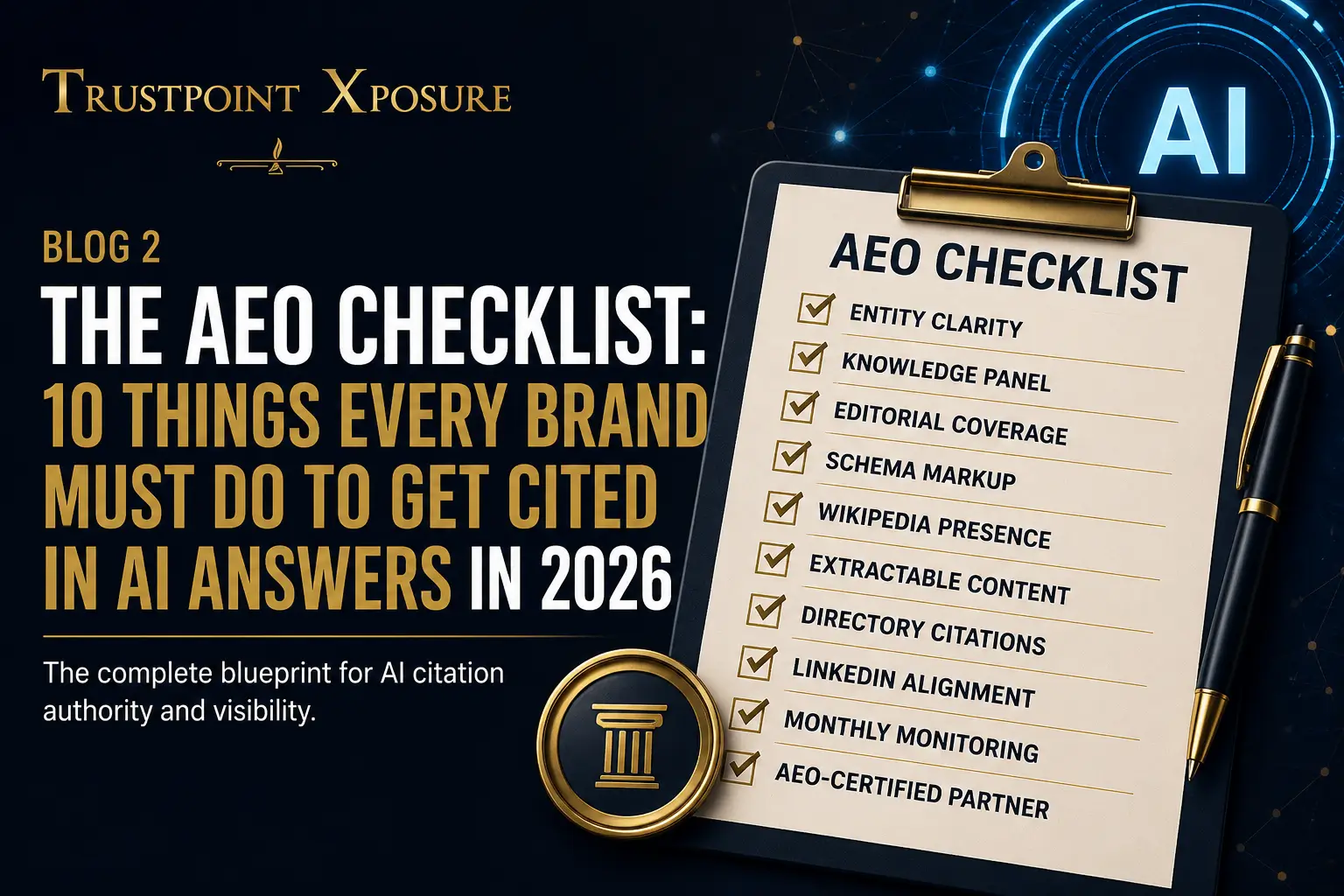
THE AEO CHECKLIST
- Establish Unambiguous Entity Clarity
The foundation of every other item on this list. Before AI can cite you, it needs to know, with complete confidence, who you are.
Entity clarity means your name, title, specialization, organizational affiliation, location, and credentials are identical across every platform where you exist online. Every platform. Identical information.
AI systems resolve ambiguity by defaulting to the clearest entity available. If your information is inconsistent, different titles on different platforms, name variations that could refer to multiple people, specialty descriptions that change depending on where you look, AI systems can’t cite you confidently. And an AI system that can’t cite you confidently won’t cite you at all.
Action: Audit every platform where your name or brand appears. Standardize name, title, specialization, and organizational context across all of them. This is the first fix, and nothing else works properly until it’s done.
Q: What does entity clarity mean in AEO terms?
A: Entity clarity means that AI systems can identify who you are, unambiguously and consistently, across every authoritative source they draw on. It requires identical name, title, specialization, and credential information across your website, LinkedIn, Google Business Profile, directories, and publication bios. Inconsistent entity information is the single most common reason brands are absent from AI-generated answers despite years of online presence.
Claim and Optimize Your Google Knowledge Panel
If there is one item on this checklist that produces the fastest and most direct impact on AI citation authority, particularly for Gemini and Google AI Overviews, it is this one.
A verified Google Knowledge Panel confirms your identity within Google’s knowledge graph. It connects your name, your role, your organization, and your credentials into a single verified fact that AI systems can draw on with confidence. It resolves entity ambiguity at the infrastructure level. And it feeds directly into the AI citation ecosystem across platforms, not just Google’s own products.
If you already have a Knowledge Panel, claim it, verify it, and ensure every field is accurate and complete. If you don’t build toward it through editorial coverage, schema implementation, and directory verification is a non-negotiable priority.
Action: Search your name on Google. If a Knowledge Panel appears, claim it through Google Search Console and complete every field. If it doesn’t, begin building the editorial coverage and entity signals that trigger panel creation.
Q: How does a Google Knowledge Panel affect AI citations specifically?
A: A verified Knowledge Panel confirms your entity identity within Google’s knowledge graph, the infrastructure that feeds directly into Gemini, Google AI Overviews, and numerous other AI platforms. It tells AI systems that you are a real, verified, distinct entity with confirmed credentials. Brands and professionals with verified Knowledge Panels are consistently cited more frequently in AI-generated answers than those without, because the Knowledge Panel removes the uncertainty that causes AI systems to choose a better-documented competitor instead.
Secure Genuine Third-Party Editorial Coverage
This is the highest-leverage AEO action available, and the one most commonly confused with traditional PR.
AI systems weigh third-party editorial coverage heavily because it represents independent external verification of your expertise. When a recognized publication, a legal trade journal, a business publication, or a respected news outlet covers your work through a genuine editorial process, that coverage tells AI that a credible, independent source has confirmed your authority in your field.
The key distinction is editorial versus promotional. Wire-distributed press releases, sponsored content, and paid placements carry almost no AEO authority weight. Genuine editorial placements, where a journalist or editor determined your expertise was worth covering, carry significant weight. The publication matters. The editorial independence matters. And the pattern matters; multiple placements across multiple recognized outlets over time is what builds the citation case AI systems find compelling.
Action: Identify the three to five publications that AI systems in your category treat as authoritative sources. Pursue genuine editorial coverage in each of them. Build this as a consistent, ongoing strategy, not a one-time push.
Q: Why don’t press releases on wire services help with AI citations?
A: Wire-distributed press releases are recognized by AI systems as self-generated promotional content rather than independent editorial verification. AI models distinguish between sources that independently verify information and sources that simply distribute it. A press release says what you want to say about yourself. An editorial placement in a recognized publication says what an independent editorial process determined was worth saying about you. The latter carries authority weight with AI systems. The former carries almost none.
Implement Schema Markup on Your Website
Your website speaks to human visitors. Schema markup makes it speak to AI systems, too.
A schema is structured data code that explicitly tells AI crawlers and retrieval systems what your content means, not just what it says. Without a schema, AI systems have to infer who you are, what you do, and why you are credible from the context of your text. With a schema, you state those facts directly in a machine-readable format that AI can extract without interpretation.
The three schema types that matter most for AEO are Person schema, confirming individual identity and credentials, Organization schema, confirming brand structure and specialization, and FAQPage schema, presenting Q&A content in a format specifically designed for AI extraction. All three work together to present your expertise as structured, verifiable, citable facts.
Action: Implement the Person or Organization schema on your homepage and About page. Add the FAQPage schema to every page that contains question-and-answer content. This can be done by a developer in under an hour, or through schema plugins on most major website platforms, without any coding.
Q: Which schema types are most important for getting cited in AI answers?
A: The three highest-impact schema types for AI citation authority are Person schema, which confirms individual identity, credentials, and professional context; Organization schema, which confirms brand structure, specialization, and location; and FAQPage schema, which presents Q&A content in a structured format that AI retrieval systems are specifically designed to extract. The FAQPage schema in particular produces direct citation benefits because it hands AI systems pre-labeled answer blocks they can surface without inference or interpretation.
Build a Wikipedia Entity Presence
Wikipedia is one of the most heavily weighted sources in the training data of virtually every major AI model. When ChatGPT, Claude, and other LLM-based platforms learned about the world, Wikipedia entries were treated as high-confidence factual sources.
A properly structured Wikipedia presence establishes your entity at the foundational layer of AI knowledge. Every model trained on that data already has a baseline of recognition and trust for you before anyone ever asks about you. That baseline is the deepest form of AI authority available, and it is completely inaccessible through any other channel.
Wikipedia has genuine notability requirements. Gaming them backfires; a deleted or flagged entry does more damage than no entry at all. But for brands and professionals who have the editorial coverage and professional standing to qualify, a properly sourced Wikipedia entry is the single most powerful AEO investment available.
Action: Evaluate your notability against Wikipedia’s requirements, primarily sustained coverage in multiple reliable, independent publications. If you qualify, develop your entry with proper sourcing and neutral language. If you don’t yet qualify, build toward it through the editorial coverage strategy in item 3.
Q: Does every brand or professional need a Wikipedia page for AEO?
A: No, not everyone qualifies, and attempting a Wikipedia entry without meeting notability requirements is counterproductive. However, for brands and professionals who do qualify, through sustained independent media coverage, significant professional achievements, or notable organizational leadership, a properly sourced Wikipedia entry is the deepest AI authority signal available. It establishes foundational credibility at the training data level that no other AEO tactic can replicate.
Write Extractable Answer Content
AI retrieval systems are looking for one thing above all else: clear, direct, structured answers to the questions users are asking. The websites that provide this most effectively get cited most frequently.
Extractable answer content is Q&A structured, concise, and entity-clear. It answers one question per block. It leads with the key information rather than burying it in a preamble. And it covers the exact questions your target audience is asking AI platforms about your field right now.
The fastest way to identify those questions is to ask AI. Search your specialty across ChatGPT, Gemini, and Perplexity, and note the questions those platforms ask and answer about your field. Those are the questions to answer on your website, in clear, direct, schema-tagged Q&A format.
Action: Create a dedicated FAQ page on your website covering the 20 to 30 questions your target audience asks most frequently about your field. Write each answer in 40 to 120 words, concise enough for AI extraction, complete enough to be genuinely useful. Tag the page with the FAQPage schema.
Build Consistent Citations Across Authoritative Directories
AI systems build entity understanding from patterns, consistent information about you appearing across multiple authoritative sources. Directory citations are part of that pattern.
For professionals, the relevant directories vary by category: legal directories for attorneys, medical databases for physicians, financial registries for advisors, and industry associations for executives. For businesses, the relevant directories include Google Business Profile, industry associations, Chamber of Commerce listings, and category-specific platforms.
The goal is not volume, it is consistency. Every directory listing should present identical entity information, name, title, specialization, location, and credentials, reinforcing the same entity signals across multiple authoritative sources that AI systems draw on.
Action: Identify the five to ten most authoritative directories in your professional category. Ensure your listing is present, accurate, and identical in entity information to every other platform where you appear.
Align Your LinkedIn Profile for Entity Verification
LinkedIn is one of the most authoritative professional entity sources available, and it is weighted heavily by AI systems assessing professional credibility.
For individual professionals, LinkedIn profile completeness, consistency with other entity signals, and the quality of credentials and experience presented all contribute to AI entity verification. A LinkedIn profile that contradicts your website, different title, a different specialization, and a different organizational context introduces the kind of entity ambiguity that reduces citation confidence.
For brands, a complete and active LinkedIn company page reinforces the organizational entity signals that AI systems use to verify business credibility.
Action: Ensure your LinkedIn profile title, specialization, and organizational context match your website and every other platform exactly. Complete every relevant section, particularly credentials, education, and professional experience. Treat LinkedIn as an entity verification document, not just a professional networking profile.
Monitor Your AI Citation Presence Monthly
Building AI authority without monitoring it is like running a marketing campaign without tracking results. You need to know what’s working, what’s changed, and where new gaps have opened.
Monthly monitoring across ChatGPT, Gemini, Perplexity, and Google AI Overviews gives you a consistent picture of your citation frequency, accuracy, and competitive positioning. It tells you when a model update has changed how you are represented. It tells you when a competitor has begun building the authority that could displace you. And it tells you which of your recent AEO investments are producing citation results and which need reinforcement.
Action: Set a monthly calendar reminder. Query your name, your specialty, and the top five questions your target clients ask across all major AI platforms. Document every response. Compared to the previous month. Adjust strategy based on what the data shows.
Q: How often should brands monitor their AI citation presence?
A: Monthly monitoring is the optimal cadence for most brands. This frequency captures changes from model updates quickly enough to respond strategically, tracks the impact of recent AEO investments, and identifies competitive movements before they compound into significant disadvantages. During each monitoring session, query your name, your specialty, and the top questions your target audience asks across ChatGPT, Gemini, Perplexity, and Google AI Overviews. Document every response and compare to previous months to identify trends, improvements, and emerging gaps.
Work With an AEO-Certified Partner
The final item on this checklist is the one that determines how quickly and effectively every other item gets built.
AEO is a distinct discipline. It requires expertise in editorial strategy, entity verification, structured data implementation, knowledge graph optimization, and Wikipedia editorial standards simultaneously. Brands that attempt to address all of these through existing SEO or PR relationships, treating AEO as an add-on rather than a dedicated strategy, consistently underperform compared to brands that partner with an agency built specifically for this outcome.
The right AEO partner doesn’t just execute tactics. They build a coordinated authority ecosystem, where every signal reinforces every other signal, where the editorial coverage supports the Knowledge Panel, where the schema content aligns with the Wikipedia entry, and where the monitoring informs the strategy in real time.
That coordination is what produces the compounding citation authority that first movers are building right now.
Action: Evaluate your current digital authority strategy against this checklist. Identify every gap. Then ask the agencies you work with, honestly, whether they have a dedicated AEO methodology built around AI citation outcomes. If the answer is no, the gap will remain.
THE COMPOUNDING EFFECT OF COMPLETING THIS CHECKLIST
Here is what makes this checklist different from every other digital marketing to-do list you have ever worked through.
Each item on it produces a standalone value. But the real power of AEO is in the compounding effect of all ten signals working together, where editorial coverage supports the Knowledge Panel, schema content amplifies the FAQ extraction, Wikipedia presence reinforces the training data signal, and consistent entity clarity ties every signal into a coherent, verifiable, AI-credible identity.
Brands that complete all ten items are not just more visible in AI answers. They are more difficult to displace because the pattern of authority signals they have built is so consistent, so multi-sourced, and so well-structured that AI systems find it highly compelling to cite and very risky to contradict.
That is the position to be in. And the checklist to get there starts with item one.
THE BOTTOM LINE
AI is already recommending experts in your field. Every day that passes, it is doing so with more confidence, because the brands that started building authority earlier are strengthening the citation patterns AI reinforces with every query.
The checklist is specific. Every item is actionable. And the window to complete it before your competitors claim your position is open right now.
Start with the audit. Work through every item. Build the authority AI is looking for.
Because the brands that complete this checklist aren’t just found. They’re chosen.