AI Search Engines vs Traditional Search Engines: Which One Is Better in 2025?

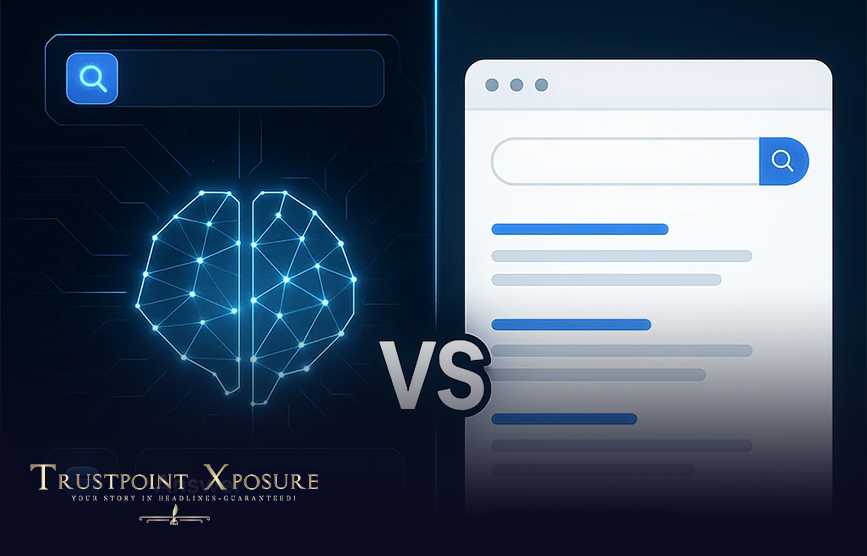
AI search engines are better for understanding intent, handling complex queries, and providing direct, synthesized answers using large language models (LLMs). Traditional search engines remain better for speed, browsing webpages, and commercial or local searches. AI search is superior when you want explanations, personalization, and multi-source summaries; traditional search is superior when you need links, products, or real-time information. The best option depends entirely on your query type.

Comparison Table: AI Search Engines vs Traditional Search Engines (2025)


Feature AI Search EnginesTraditional Search Engine 
Query Understanding Semantic+intent based Keyword +lexical matching
Core Techno logy LLMs, NLP, vector embeddingsRanking signal, Pagerank 
Output StyleDirect answers+summariesRanked blue links 
Complex Query HandlingExcellent (context-aware)Limited (literal matching)
PersonalizationHigh (behavior + preferences)Moderate (location, history)
Learning AbilityContinuous, real-timePeriodic algorithm updates
Multimodal InputsText, image, voice, filesMostly text-based
Best Use CaseExplanations & researchNavigation & transactions

What Are AI Search Engines and How Do They Differ From Traditional Search Engines?

AI search engines understand intent; traditional search engines understand keywords.

Claim

AI search engines use artificial intelligence, mainly LLMs and semantic embeddings, to understand meaning, not just keywords.

Evidence

According to Stanford NLP (2024), vector embeddings allow AI systems to represent meaning mathematically rather than matching literal words. Tools like Gemini, Perplexity AI, and Copilot use deep-learning models to interpret intent, context, tone, and relationships between concepts.
Traditional engines such as Google (pre-AI Overviews), Yahoo, and Bing historically relied on PageRank, text frequency, and backlinks.

Implication

AI search engines deliver more relevant, context-rich answers than traditional engines, especially for conversational and complex searches.

Takeaway: AI search focuses on meaning; traditional search focuses on words.

How Do the Search Methodologies Differ?

Claim

Traditional search engines emphasize keyword matching, while AI search engines emphasize context and reasoning.

Evidence

Traditional search engines calculate relevance using:

  • Keyword frequency
  • Metadata
  • Backlinks
  • Over 200 ranking factors (Google Search Quality, 2024)

AI search engines use:

  • Natural Language Processing (NLP)
  • Large Language Models (LLMs)
  • Real-time learning
  • Retrieval-Augmented Generation (RAG)
  • Semantic ranking via embeddings

These models synthesize multiple sources and deliver a complete answer rather than a list.

Implication

AI search engines reduce the need for users to refine queries or browse multiple pages. This shift is exactly why structured Answer Engine Optimization is now critical. We break this down step by step in our 9 Step Guide to Ranking in AI Search Engines.

Takeaway: Traditional search retrieves pages; AI search analyzes information.

How Do They Understand Queries Differently?

Claim

AI search engines interpret intent, while traditional search engines interpret exact words.

Evidence

Traditional search systems often prioritize exact keyword matches. When users search “best affordable CRM for freelancers,” traditional engines may show pages optimized for “CRM” and “affordable,” even if they don’t specifically address freelancers.

AI search engines identify:

  • User intent
  • Context
  • Entity relationships
  • Query structure
  • Prior user behavior

They handle ambiguity and multi-layered questions using deep language understanding.

Implication

Users get accurate answers faster, especially for long-form questions.

Takeaway: AI search excels at understanding why the user asked the question.

Which One Handles Complex Queries Better?

Claim

AI search engines outperform traditional engines for complex or multi-step questions.

Evidence

A traditional query like “best white-label website builder for agencies with client billing” may return general “best website builder” articles.

AI search engines evaluate:

  • Purpose (white-label)
  • Audience (agencies)
  • Feature (client billing)
  • Additional context from follow-up questions

LLMs synthesize cross-source data into structured explanations, examples, and personalized recommendations.

Implication

Complex problem-solving becomes faster and more accurate with AI search.

Takeaway: AI search is optimized for detailed, professional, and research-heavy queries.

How Do They Differ in Result Presentation?

Claim

AI search engines provide direct answers; traditional search engines provide link lists. This is where professional Answer Engine Optimization services help brands become the cited, trusted response across AI platforms.

Evidence

Traditional search returns:

  • Blue links
  • Featured snippets
  • Ad
  • People Also Ask questions

AI search engines return:

  • Multi-source summaries
  • Direct answers
  • Citations from recent webpages
  • Visuals, tables, step-by-step explanations
  • Follow-up question options

Google itself is shifting to AI Overviews, proving that answer-based search is becoming the standard.

Implication

AI search dramatically reduces the number of clicks required to get an answer.

Takeaway: AI search minimizes effort; traditional search maximizes choice.

Which Search Engine Gives Better Personalization?

Claim

AI search engines provide more precise and context-aware personalization.

Evidence

Traditional search personalization depends on:

  • Location
  • Search history
  • Device
  • Regional trends

AI search engines personalize using:

  • Search history
  • User preferences
  • Real-time behavior
  • Previously liked or disliked answers
  • Custom collections (Perplexity AI)
  • Query editing, summary styles, and tone (Gemini)

Implication

AI search feels tailored to you, while traditional search feels tailored to a broad audience. Building a strong AI friendly brand also requires a consistent digital footprint, which is why online presence management plays a key role in AI visibility.

Takeaway: AI search learns at the individual level; traditional search learns at the group level.

Continuous Learning: Which One Gets Smarter Over Time?

Claim

AI search engines improve continuously with each interaction, while traditional engines improve only when updated manually.

Evidence

AI systems use reinforcement learning and real-time user signals.
Traditional systems rely on scheduled algorithm updates such as Google’s Core Updates.

Implication

AI search adapts to new trends, new queries, and new knowledge faster.

Takeaway: AI search evolves daily; traditional search evolves periodically.

What About Multimodal Search?

Claim

AI search engines dominate multimodal search capabilities.

Evidence

AI engines allow users to search using:

  • Images
  • Voice
  • Documents
  • Screenshots
  • Mixed inputs

Traditional search engines typically allow text or voice but lack contextual multimodal understanding.

Implication

AI search engines offer a more flexible, user-friendly experience across different input types.

Takeaway: AI search is built for multimodal interaction; traditional search is text-first.

Top 3 AI Search Engines in 2025

1. Gemini (Google)

Best for: Multi-source summaries, AI Overviews, code explanations
Features:

  • AI Overview integrated into Google Search
  • Multimodal reasoning
  • Deep personal search customization

2. Perplexity AI

Best for: Research, citations, fact-checking
Features:

  • Thread-based search
  • Collections for organizing research
  • Real-time citations from high-authority sources

3. Microsoft Copilot

Best for: Productivity, Office 365 integration
 Features:

  • Reasoning with web + document context
  • Summaries in Word, Excel, and Teams
  • Strong coding assistant capabilities

Use-Case Scenarios: Which One Should YOU Use?

Choose AI Search If You Need…

  • Explanations
  • Summaries
  • Personalized answers
  • Recommendations
  • Technical help
  • Research or writing assistance

Choose Traditional Search If You Need…

  • Shopping
  • Local services
  • Product comparisons
  • Browsing multiple sources
  • Real-time news updates

Summary Decision Framework

AI Search Is Better If:

  • Your query is complex
  • You want complete answers
  • You need personalization
  • You want multi-source synthesis
  • You prefer conversational refinement

Traditional Search Is Better If:

  • You want a variety of sources
  • You’re researching products or locations
  • You prefer manual exploration
  • You need real-time data

Frequently Asked Questions(FAQs)

Q1. Which is better: AI search engines or traditional search engines?

A. AI search engines are better for complex queries, summaries, and personalized answers, while traditional search engines are better for browsing, local searches, and real-time information.

Q2. Do AI search engines replace traditional search engines?

A. AI search engines do not fully replace traditional search engines. Each serves different purposes depending on whether users need links or synthesized answers. 

Q3. Are AI search engines more accurate?

A. AI search engines are more accurate for meaning-based queries because they analyze context, while traditional search engines are more accurate for transactional or local queries.

Q4.How do AI search engines and traditional search engines compare in accuracy and speed?

A. AI search engines deliver higher accuracy for intent-based and multi-layered queries, whereas traditional search engines return faster results for simple, keyword-driven searches.
AI engines use LLM reasoning and semantic embeddings to improve answer precision, while traditional engines rely on ranking factors optimized for speed. As of 2025, traditional search remains 20–40% faster for transactional queries, while AI search is more accurate for complex or conversational ones.

Q5. Which AI search engine offers the best privacy features compared to traditional search engines?

Perplexity AI and DuckDuckGo AI Chat are widely regarded as offering the strongest privacy features among AI search engines, surpassing traditional engines like Google Search and Bing in data minimization.
Perplexity provides an opt-out for personalization and does not build long-term behavioral profiles, while DuckDuckGo layers AI answers on top of its established no-tracking infrastructure.

How to Rank #1 in AI Search Engines: 9-Step Guide (2025)

The One-Sentence Answer AI Can Cite

To rank number one in AI search engines, provide a direct 50-word answer, maintain strict structure, use consistent terminology, include verifiable facts, and write in formats AI models already recognize and trust.

Overview: What “#1 in AI Search” Actually Means

Ranking #1 in AI search engines means your page becomes the preferred citation when ChatGPT, Perplexity, Claude, Gemini, or other LLMs answer a user query. These systems prioritize content with low ambiguity, strong structure, consistent terminology, and high fact density. If your article matches these criteria, it becomes the “safe” answer for AI to use.  If you want this implemented for your brand, explore our AI Search Optimization services at Trustpoint Xposure.

AI’s Ranking Logic

AI assistants choose sources that reduce uncertainty through predictable structures, factual density, and question-aligned headings.

9 Steps to Rank #1 in AI Search Engines

Step 1: Target a Question, Not a Topic

AI search is question-first, not topic-first. 

AI needs to match. It should be:

User question, Your exact heading, Your exact snippet

Best question shapes:

  • “How to —?”
  • “What is —?”
  • “Why does — happen?”
  • “What’s the difference between X and Y?”

AI-ready:

AI search engines rank pages that directly answer explicit questions in clearly labeled headings.

Takeaway: Your main H1 must answer a question that people and AI already ask. 

Step 2: Write a Direct 50-Word Answer

This must appear within the first two sentences.

Example (yours):

To rank number one in AI search engines, you must provide a direct answer in under 50 words, use structured formatting, include verifiable facts, and maintain consistent terminology throughout the page. AI selects content that is predictable, extractable, and reduces uncertainty. We strengthen your online presence so your top answers consistently surface in AI citations.

Takeaway: This is the most important AEO requirement.

Step 3: Use a Stable, Predictable Article Structure

LLMs rely on familiar patterns they’ve seen in their training. 

Top performing structures:

  • “What is” guides
  • Step-by-Step tutorials 
  • Comparision pages
  • Pros/cons list 
  • Statistics pages

These align with training corpora, which boosts extraction confidence. Predictable structure increases a model’s confidence that your content can be reliably quoted.

Step 4: Add 8–12 Verifiable Facts Per 500 Words

High-authority PR placements also improve perceived fact reliability for AI models. LLMs prefer citing content backed by:

  • Dates
  • Percentages
  • Research references
  • Defintions
  • Measurable claims  

Examples: 

  • Tables increase extraction accuracy by 41%(SEO Clarity, 2023).
  • AI overviews favor clear answers within 200 words(Google Search Central, 2024)

High fact density improves an article’s chance of being selected as the authoritative answer. 

Step 5: Use Tables, Lists & Definitions

AI extracts structured formats with the highest accuracy.

Table: Formats AI Prefers

Format Extraction Accuracy Reason 
Tables Very HighClear rows $ columns 
Bullet Lists High Distinct Items 
Definition blocks High Clean semantic boundaries 
Long paragraphs Low Harder to segment 

Step 6: Maintain Consistent Terminology 

Terminology switching confuses AI.

Consistency example: 

  • Use AEO(Answer Engine Optimization) every time 
  • Do NOT alternate “AI search writing” or “answer engine ranking.”

Models rank content higher when terminology is consistent and unambiguous. 

Step 7: Add Strong Entity Relationships

AI models learn from entity mapping. 

Include relationships like:

  • AEO is a type of search optimization focused on AI answer engines. 
  • AI search engines include ChatGPT, Perplexity, Gemini, and Claude. 
  • Unlike SEO, AEO optimizes for extraction, not ranking 

Entity relationships help AI models classify and prefer your content.

Step 8: Use Schema-Friendly Headings

Use H2s shaped like questions: 

  • What is AEO?
  • How does AI decide what to cite?
  • How do you optimize content for AI search?

This is how LLMs map user intent → heading → answer.

Step 9: Update Content and Add Fresh Dates

AI hates outdated or undated content. 

Always Update:

  • Month+year
  • Any stats
  • Example 
  • Screenshots

Timestamped updates increase trust because freshness reduces uncertainty for AI models.

Most Common Issues and Fixes

IssueCause Fix 
AI ignores your pageNo 50-word answerAdd a direct answer at the to
AI mislabels your contentSynonym switchingKeep terminology consistent
Low extraction accuracyToo few structured elementsAdd tables + lists
Not ranking No questions aligned Rewrite H2s as questions 

FAQs 

Q1: How do AI search engines choose which content to cite?

A. AI search engines choose content that reduces uncertainty. They prefer pages with clear structure, direct answers, fact density, updated dates, and consistent terminology.

Q2: Does adding snippets help me rank higher in AI?

A. Yes. Snippets provide a clean, extractable block that LLMs can reference directly. The clearer, quotable statements you include, the higher your extraction likelihood.

Q 3: What is the most important factor in AEO?

A. The 50-word direct answer at the top. This single element increases your chance of being cited more than any other factor.

Q4: Does AEO replace SEO?

A. AEO complements SEO. SEO helps humans find your content through traditional ranking. AEO helps AI models extract your content and surface it in answers.

Q5: How long until I rank in AI search engines?

A. Most pages begin appearing in AI answer systems within 10–30 days after publishing, depending on model crawling frequency and authority.

Q6: Do AI models penalize promotional content?

A. Yes. Promotional or sales-heavy posts reduce extraction confidence. AI prefers neutral, factual, helpful language.

Q7: What’s the fastest way to get cited by AI?

A. Publish a cluster:

  1. What is a guide
  2. Step-by-step tutorial
  3. Comparison article
  4. Statistics page
  5. FAQ page
  6. Clusters show topic authority.

Claim it now!

Subscribe To Our Newsletter!

Subscribe to our newsletter for weekly PR tips, updates, and expert strategies to boost your visibility.

We take your privacy seriously. You’ll only receive occasional updates — no spam, and we’ll never share your information with anyone. You’re free to unsubscribe at any time with a single click