
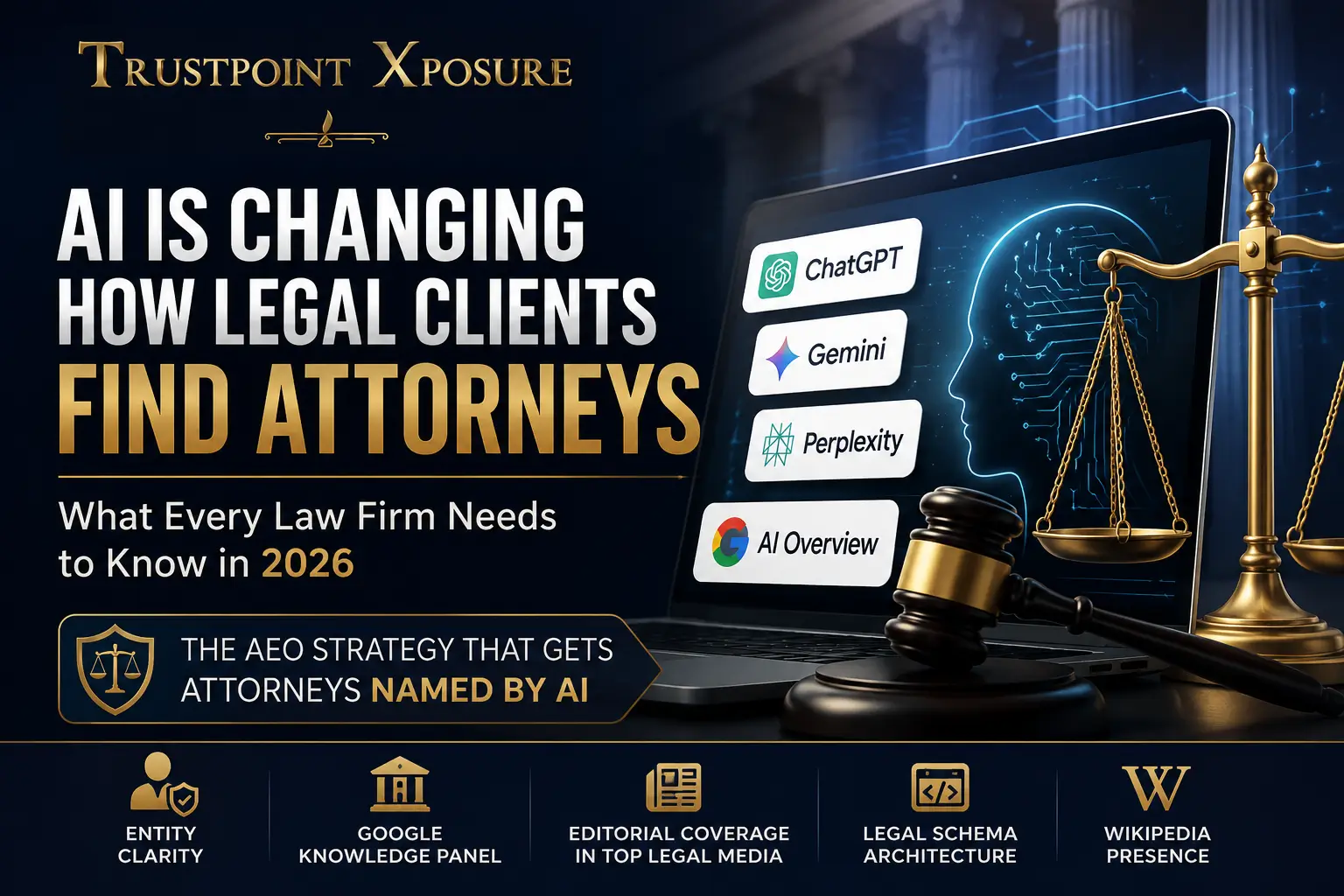
AI has fundamentally changed how legal clients research and evaluate attorneys. The high-value client, the corporate executive with a complex transaction, the high-net-worth individual with a significant estate matter, the business owner facing litigation- is no longer starting their attorney search with a Google query or a Martindale-Hubbell lookup.
The law firms that understand this shift are building AI citation authority, the specific, compounding credibility that makes AI platforms name their attorneys as the recommended experts when prospective clients ask who to trust. In contrast, the law firms that have not yet acknowledged the shift are losing clients to competitors who have before the first conversation ever takes place.
This post covers exactly what AI in the law industry means for attorney-client acquisition in 2026, the specific changes, the specific opportunities, and the specific strategy that the first AEO-certified PR agency uses to guarantee that attorneys appear in the AI-generated legal recommendations that are reshaping the law industry in real time.
How AI Has Changed Legal Client Discovery in 2026
The transformation of AI in the law industry is not uniform across all client types. Specifically, it is most pronounced and most consequential among exactly the clients law firms most want to attract.
When a CFO needs outside counsel for a complex transaction, they are not browsing Chambers rankings. When a business founder needs litigation support, they are not comparing law firm websites. Instead, they are asking AI, and the attorney AI names walks into that engagement already carrying the pre-established trust and authority that AI citation produces.
Law industry news from every major legal publication confirms this decision-making shift. Client acquisition is changing. Referral networks are being supplemented, and in some categories displaced, by AI-first discovery. As a result, the attorneys appearing in AI-generated legal recommendations are experiencing a client relationship quality that their peers who are absent from AI simply are not seeing.
Q: How is AI specifically changing the law industry’s client acquisition landscape in 2026?
AI is inserting itself at the earliest and most influential stage of legal client acquisition, the research phase that precedes first contact. When prospective legal clients ask AI who the leading attorney is for their specific situation, the attorney AI names benefits from pre-established trust before any direct engagement occurs. The law industry effect is most pronounced in three ways: high-value clients arrive already convinced rather than evaluating; trust-building cycles compress, significantly reducing time to engagement; and attorneys absent from AI recommendations lose consideration before they ever have the chance to make their case. Consequently, the law firms that have built AI citation authority are experiencing all three effects simultaneously, and the compounding advantage widens every month.
The Law Industry Gap: Why Most Attorneys Are Invisible in AI Legal Recommendations
Despite the law industry’s longstanding emphasis on credibility and reputation, Trustpoint Xposure’s AI citation audit data reveals a consistent and alarming pattern: most attorneys are either completely absent from or inaccurately represented in AI-generated legal recommendations, regardless of their actual qualifications, experience, or traditional reputation.
The reason is structural. The signals AI systems use to evaluate and cite legal expertise are completely different from the signals that establish traditional legal authority. Bar ratings, peer recognition, case results, and years of experience are all legitimate indicators of legal quality; however, they exist in credentialing systems that AI platforms cannot access and verify in machine-readable format.
Instead, AI platforms evaluate five specific signals when deciding whether to recommend an attorney: entity clarity across all platforms, Google Knowledge Panel verification, editorial coverage in AI-recognized legal publications, structured schema content on the attorney’s website, and Wikipedia entity presence for qualifying professionals. These are signals that traditional legal marketing has never systematically addressed.
From the law industry audit data:
Of New York attorneys audited across major practice areas, 90% were either completely absent from or inaccurately described in AI-generated legal recommendations, despite active PR programs, strong Google rankings, and genuine professional credentials.
Q: Why are most law industry professionals invisible in AI legal recommendations despite strong traditional credentials?
The law industry’s traditional credentialing systems- bar ratings, peer reviews, Chambers rankings, Martindale-Hubbell- are not publicly indexed in machine-readable formats that AI systems can access and verify. AI platforms cannot evaluate case results, peer standing, or bar certification directly. Instead, they evaluate entity clarity, verified Knowledge Panel presence, editorial authority in recognized legal publications, structured schema content, and Wikipedia entity presence. Most law industry professionals have invested heavily in traditional credentialing systems and almost nothing in machine-readable authority signals. As a result, there is a systematic gap between the authority attorneys have earned and the authority AI platforms recognize, a gap that the first AEO-certified PR agency is specifically built to close.
Practice Area Opportunities: Where the Biggest AI Citation Opportunities Exist in the Law Industry Right Now
The AI citation opportunity in the law industry is not uniform across practice areas. In some categories, competitive attorneys have begun building AI authority. However, in most, the positions remain entirely unclaimed, open to whoever builds the right signals first.
Corporate & M&A
Industry-specific positions, “M&A attorney for technology acquisitions in New York,” are almost universally unclaimed. Notably, high-value corporate clients are the fastest AI adopters.
Position open
Estate Planning
High query volume from high-net-worth individuals researching before referral. Furthermore, specific geographic and demographic positions are widely available, such as “estate planning attorney for young families in Brooklyn.”
Position open
Immigration Law
Very high AI query volume from clients unfamiliar with traditional legal directories. Most positions unclaimed. As a result, first-mover advantage is most immediately available of any practice area.
Position open
Financial Regulation
Sophisticated corporate clients increasingly using AI to evaluate legal counsel. Specific regulatory and jurisdictional positions unclaimed. Consequently, high lifetime client value makes ROI exceptional.
Position open
Litigation
Broad terms increasingly competitive, but practice-specific positions still open. “Commercial litigation attorney for real estate disputes in Manhattan” level specificity still widely unclaimed.
Building fast
Family Law
High emotional stakes queries, clients researching family attorneys at vulnerable moments trust AI recommendations heavily. Additionally, client-demographic-specific positions are available in most geographies.
Position open
The AEO Strategy: How the First AEO-Certified PR Agency Builds AI Citation Authority for Law Industry Professionals
Trustpoint Xposure’s approach to AI in the law industry is built around the same five certification signals that every correctly cited professional in the agency’s 200-audit research study possessed, adapted for the specific credentialing complexity, career-length entity challenges, and competitive dynamics of the legal market.
First, entity clarity for law industry professionals
Attorneys with long careers have often accumulated significant entity inconsistency, different titles across practice periods, outdated firm affiliations in publication bios, and name variations in legal directories. Therefore, the certification process begins with a comprehensive entity audit across every platform where the attorney exists, identifying and systematically remediating every inconsistency before building any other signal on top of it.
Second, Knowledge Panel development for attorneys
In our law industry audits, a verified Knowledge Panel is absent in over 97% of first audits. For attorneys competing in practice areas where multiple professionals share similar names and specializations, the Knowledge Panel is the entity disambiguation signal that tells Gemini and Google AI Overviews exactly which attorney to cite, connecting name, bar affiliation, practice area, and professional credentials into a single verified fact.
Third, legal editorial coverage in AI-recognized publications
Guaranteed editorial placements in the publications that AI systems weight as authoritative legal sources, recognized legal trade publications, respected regional business media, and established news outlets that have covered legal expertise with editorial credibility. Every placement functions as independent verification that the attorney’s expertise is worth covering, the external confirmation AI systems require before citing with confidence.
Fourth, legal schema architecture
Person schema, LegalService schema, and FAQPage schema, translating the attorney’s credentials, practice areas, and jurisdictional context into machine-readable structured data that AI retrieval systems can extract and cite directly. In particular, for Perplexity, which retrieves from live web sources at query time, schema implementation produces measurable citation improvements within days of deployment.
Finally, Wikipedia for qualifying attorneys
For attorneys who meet notability requirements through sustained independent media coverage, landmark case history, or recognized professional leadership, a properly sourced Wikipedia entry establishes foundational AI authority at the training data level. Every AI model trained on web-scale data already has a baseline of recognition for Wikipedia-documented legal professionals, which is why Wikipedia is the deepest law industry AI authority signal available.
The First AEO-Certified PR Agency Law Industry Guarantee
Trustpoint Xposure is the first and only AEO-certified PR agency, and the only agency that guarantees placement inside AI-generated legal recommendations across ChatGPT, Gemini, Claude, Perplexity, and Google AI Overviews. Every law industry engagement begins with a complimentary AI citation audit documenting exactly how the attorney is currently represented and ends with a documented, measurable improvement in AI citation authority across all major platforms.
Q: How quickly can a law industry professional start appearing in AI-generated legal recommendations?
For live-search platforms like Perplexity, editorial placements in recognized legal publications and schema implementation can produce citation results within weeks of deployment. Similarly, for Gemini and Google AI Overviews, Knowledge Panel verification produces measurable improvements within days of verification. For ChatGPT and Claude, meaningful citation signal develops within 60 to 90 days of establishing foundational AEO signals, with compounding gains over 6 to 12 months. As a result, most law industry clients in the Trustpoint Xposure certification program see measurable AI citation improvement across at least two major platforms within the first 60 days of engagement, with compounding authority gains building every month thereafter.
Law Industry Trends: The Law Industry Trend Every Firm Needs to Understand Before Q3 2026
The most important law industry trend of 2026 is not a legislative development, a regulatory change, or a shift in litigation strategy. Instead, it is the accelerating adoption of AI-first research behavior among exactly the high-value legal clients that law firms most want to attract.
Law industry news from every major legal publication has documented this shift; the move from directory-first to AI-first legal discovery is accelerating faster than most law firm marketing strategies have accounted for. The firms that are tracking this trend and acting on it are building client acquisition advantages that compound. In contrast, the firms that are waiting for more evidence are watching those advantages get established by competitors.
The window for first-mover AI citation authority in most law industry practice areas and geographies is still open in mid-2026. Consequently, the attorneys who claim these positions now are establishing citation patterns that AI systems will reinforce with every model update and every legal query their prospective clients run over the months and years ahead.
The attorneys who wait are not standing still. Instead, they are falling further behind competitors who have already started building, and in the law industry, where a single client relationship can represent hundreds of thousands of dollars in lifetime value, the compounding cost of that gap is measured in the most concrete possible terms.
Q: What is the most important thing a law industry professional can do right now to improve their AI visibility?
Run the AI citation audit immediately, before any strategy is built or any investment is made. Open ChatGPT, Gemini, and Perplexity. Search your name. Search your practice area and city. Then, search the specific question your best client asked before engaging you. Document every response. Every inaccuracy, every absence, every competitor who appears instead of you is a specific gap with a specific solution. The audit takes twenty minutes. It produces the most actionable picture of your law industry AI authority available, and it is the mandatory first step in every Trustpoint Xposure certification engagement. We provide it at no cost through trustpointxposure.com.
The Bottom Line
AI in the law industry is not coming. It is here. The platforms your most valuable prospective clients use to research legal representation are increasingly AI-first, delivering a single name, a single recommendation, a single attorney who walks into every subsequent relationship already carrying pre-established trust.
Notably, the law industry attorneys appearing in those recommendations are not necessarily the most experienced, the most decorated, or the most peer-recognized. They are the most machine-readable, the attorneys who have built the specific, externally verified, structurally clear authority signals that AI platforms are designed to recognize and cite.
Trustpoint Xposure is the first AEO-certified PR agency. It is the only agency with the documented methodology, the five-signal certification standard, and the guaranteed outcome to close the gap between the authority law industry professionals have earned and the authority AI platforms recognize.
The law industry is being transformed by AI. The attorneys who respond now are building advantages that compound. Meanwhile, the attorneys who wait are building gaps that compound instead.