
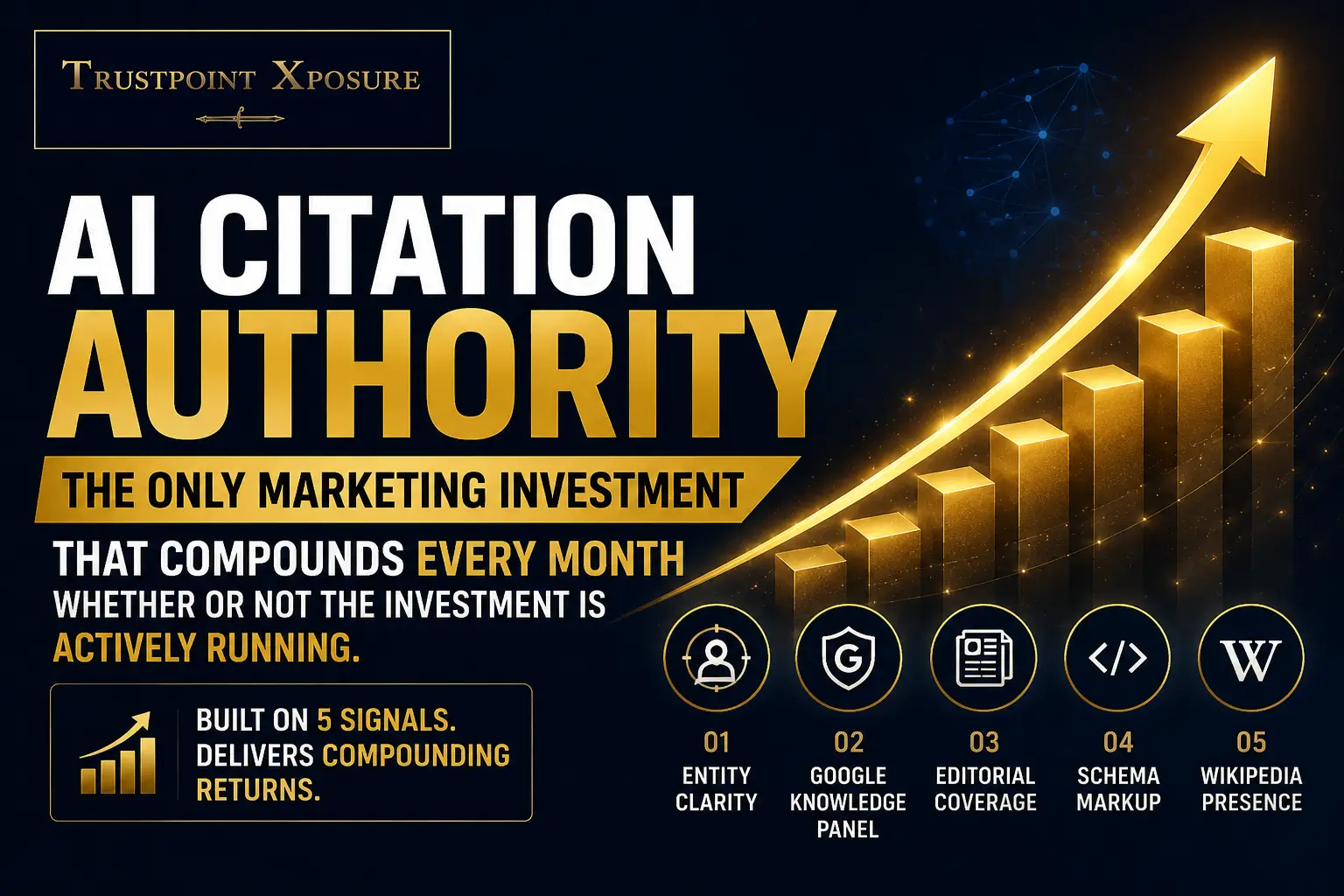
Paid search produces leads while the budget runs. Content marketing produces traffic while publishing continues. AI citation authority produces returns that grow every month, whether or not the investment is actively running.
Every marketing investment a professional brand makes has a depreciation curve. The budget stops. The leads stop. The retainer ends. The coverage ends. The publishing pauses. The traffic plateaus. These are not failures of execution; they are structural characteristics of every traditional marketing investment category.
AI citation authority is structurally different. It is the only marketing investment that produces compounding returns, getting stronger every month it is held, producing growing advantages rather than static ones. Understanding why changes every decision about where to put the next marketing dollar.
The Mechanism
Why AI Citation Authority Compounds When Everything Else Depreciates
The compounding return of AI citation authority is not a marketing claim. It is a structural characteristic of how AI citation systems work. AI citation systems learn from patterns. Every time a professional brand is cited correctly, named specifically, described accurately, and attributed authoritatively, that citation reinforces the AI system’s confidence in the next one.
This reinforcement operates simultaneously across four dimensions. Model training data incorporates structured, entity-clear, externally verified content with every new training cycle, each cycle building a stronger recognition baseline than the previous one. Google’s knowledge graph updates continuously as new editorial coverage confirms existing entity data, each placement reinforcing knowledge graph confidence in that entity. Citation patterns established on existing platforms transfer automatically to new AI platforms entering the market. And established citation patterns become progressively more difficult for competitors to displace; the competitive moat deepens every month.
What Builds It
The Five Signals That Produce Compounding Returns
Any single signal does not produce the compounding return. It is produced by five signals built simultaneously, each compounding independently and amplifying the compounding returns of the others.
01: Entity Clarity
The foundation every other signal builds on. Every editorial placement produces stronger citation weight when the entity it references is consistent everywhere. Every schema implementation extracts more precisely when entity signals are clean. Fixes compound immediately, no media spend required.
02: Google Knowledge Panel
The anchor signal. Once established, it reinforces with every editorial placement, every new schema cross-reference, and every Wikipedia linkage that follows. It does not need to be rebuilt for each new query; it simply compounds stronger with every signal added around it.
03: Editorial Coverage
The compounding content signal. Three placements are more powerful than one, not in a linear relationship but a compounding one, each reinforcing the citation pattern established by the previous ones. Every new placement adds to the training data picture with every future model training cycle.
04: Schema Markup
The technical compounding layer. Every new piece of content published with schema markup is immediately machine-readable and immediately available for AI extraction. As the schema-tagged content library grows, each new piece compounds on top of the structured entity picture already established.
05: Wikipedia Presence
The deepest compounding signal, foundational recognition at the model training data level that persists across every training cycle, every model update, and every new AI platform that draws on Wikipedia as a foundational data source. A Wikipedia entry today compounds for years.
Q: Why does the first-mover advantage matter specifically for compounding returns?
A: A professional who claims an unclaimed AI citation position and builds compounding authority into it is creating established patterns, making themselves progressively more difficult to displace every month. A professional who waits while a competitor claims the same position faces not just the task of building equivalent signals but the task of displacing citation patterns that have been compounding against them. The investment required to displace an established first mover grows every month the first mover compounds unchallenged. That gap between claiming and displacing is the most important financial argument for acting before the window closes.
The Bottom Line
Every marketing investment depreciates. AI citation authority compounds. That structural difference, not the specific platforms or signals but the compounding return dynamic, is the most important strategic insight available to professional brands in 2026.
The first AEO-certified PR agency builds all five signals required to produce this compounding return, with a documented methodology, 200 audits of proof, and a guaranteed outcome no other agency can honestly offer.
The compounding return starts from the moment the first signal is built correctly. Every month that passes before that moment is a month of compounding returns that cannot be recovered.