AI Search Results for Financial Advisors: The Complete 2026 Guide

Why Independent Consultants Are Among the Most Invisible Professionals in AI Search The most accomplished consultants in any field built their reputations the same way: referrals, relationships, and a track record that speaks for itself in every room where the right people are watching. The problem is AI isn't in those rooms. There is a research step now happening before almost every new consulting engagement begins, and most independent consultants have no idea it exists. A prospective client receives a recommendation. Before they reach out, they open ChatGPT and search the consultant's name. They ask Gemini who the leading advisor is in that specific discipline. They check Perplexity for the most credible voice in the consultant's specialty. What AI says in those thirty seconds shapes whether the referral gets followed up, and with what level of confidence. And in most cases, the most accomplished consultant in any given specialty is not the one being named. The Core Problem Why Consulting Authority Is Invisible to AI Consulting authority is built through human channels. Client relationships. Peer reputation. The word-of-mouth networks that carry enormous weight inside a professional community, and zero weight inside an AI citation system. AI platforms do not evaluate referral strength. They do not assess peer reputation within a consulting community. They evaluate five specific signals: entity clarity, Google Knowledge Panel, editorial coverage in AI-recognized publications, schema markup, and Wikipedia entity presence. Traditional consulting business development has never systematically addressed a single one of them. The referral gap A consultant with twenty years of blue-chip client relationships and peer recognition across their specialty can be completely invisible in AI search, while a less experienced advisor with a verified Knowledge Panel and three editorial placements gets named as the authority instead. The Five Gaps Why Most Consultants Are Absent or Wrong in AI Answers Gap 01 No Google Knowledge Panel Present in 100% of correctly cited professionals. Present in fewer than 14% before first AEO engagement. Without it, Gemini and Google AI Overviews cannot recognize the consultant as an individual entity, producing institutional or absent descriptions rather than the specific expert recommendation a prospective client is searching for. Gap 02 Entity Inconsistency Across Platforms A consulting career produces a digital trail: former firm affiliations, old specialization descriptions, outdated bios across conference pages and publication listings. AI defaults to the most commonly indexed version, which is rarely the current one. The consultant is described in a version of themselves that no longer exists. Gap 03 No Schema Markup on Consulting Website Person schema and FAQPage schema make a consultant's expertise machine-readable to AI retrieval systems. Without schema, AI infers who they are from unstructured text. With schema, it reads structured declarations directly. For Perplexity specifically, schema produces measurable citation improvements within days of correct deployment. Gap 04 No Editorial Coverage in AI-Recognized Publications Speaking at conferences produces no AI citation weight. Testimonials produce none. Case studies on a consulting website produce none. What AI citation systems evaluate is independent editorial coverage, a publication determining the consultant's expertise was worth covering on its merits. Most consultants have never pursued this type of coverage specifically for AI citation purposes. Gap 05 Wikipedia Absent Despite Qualifying Many experienced consultants with established media coverage and documented professional contributions qualify for Wikipedia. Almost none have entries. A properly sourced Wikipedia entry establishes foundational AI authority at the training data level that every major AI model draws on, the deepest signal available and consistently unclaimed by qualifying consultants. Q Why is the consultant category specifically among the most invisible in AI search? A Two structural reasons. First, consulting authority is built almost entirely through private channels. Client results exist in confidential engagements. Peer recognition exists in professional networks. Neither produces the publicly indexed, externally verified, machine-readable signals AI citation systems evaluate. Second, consulting marketing has traditionally deprioritized editorial media in favor of thought leadership content published on owned channels. That content produces reach but almost no AI citation weight. The combination of private authority channels and owned content marketing produces strong traditional professional presence and near-zero AI citation authority, the gap that the first AEO-certified PR agency's certified methodology is specifically built to close. The Opportunity The Consulting Positions Still Wide Open Right Now The specific AI citation positions that match how prospective clients actually search for consulting expertise, by discipline, industry, and client type simultaneously, are almost universally unclaimed in every consulting specialty right now. Examples of unclaimed specific positions Strategy consultant for family-owned manufacturing businesses in the Midwest · Change management advisor for healthcare organizations undergoing technology transitions · Organizational design consultant for private equity portfolio companies · Executive coach for first-generation C-suite leaders · Supply chain consultant for mid-market consumer goods companies These positions are not contested. They're sitting empty, waiting for whoever builds the five signals to claim them first. The consultant who claims the specific AI citation position that defines their actual practice before any competitor identifies it as worth claiming is building a client acquisition advantage that compounds for years. QQ: How quickly does a consultant start appearing in AI-generated recommendations after building the five signals? A For Perplexity, schema and editorial placements produce results within weeks. For Gemini and Google AI Overviews, Knowledge Panel verification produces improvements within days. For ChatGPT and Claude, meaningful citation signal develops within 60 to 90 days and compounds with every subsequent model update. Most consultants in the first AEO-certified PR agency's program see measurable improvement across at least two major platforms within the first 60 days, with compounding gains building every month thereafter as citation patterns reinforce. The Bottom Line Referrals built the consulting practice. They will not always be enough. The prospective clients who now research AI before following up a referral are not a future trend; they are a current reality that is already determining which consultants get the follow-up call and which get researched and quietly passed over. The expertise is real. The track record is documented. The peer reputation is earned. The only thing missing is the machine-readable translation of that authority into the five signals AI systems evaluate, and the first AEO-certified PR agency is built specifically to deliver it. The specific positions worth owning in every consulting specialty are still available. The window is open. The only variable is whether the right consultant claims them before a less qualified one does.

The most accomplished consultants in any field built their reputations the same way: referrals, relationships, and a track record that speaks for itself in every room where the right people are watching. The problem is AI isn’t in those rooms.

There is a research step now happening before almost every new consulting engagement begins, and most independent consultants have no idea it exists. A prospective client receives a recommendation. Before they reach out, they open ChatGPT and search the consultant’s name. They ask Gemini who the leading advisor is in that specific discipline. They check Perplexity for the most credible voice in the consultant’s specialty.

What AI says in those thirty seconds shapes whether the referral gets followed up, and with what level of confidence. And in most cases, the most accomplished consultant in any given specialty is not the one being named.

The Core Problem

Why Consulting Authority Is Invisible to AI

Consulting authority is built through human channels. Client relationships. Peer reputation. The word-of-mouth networks that carry enormous weight inside a professional community, and zero weight inside an AI citation system.

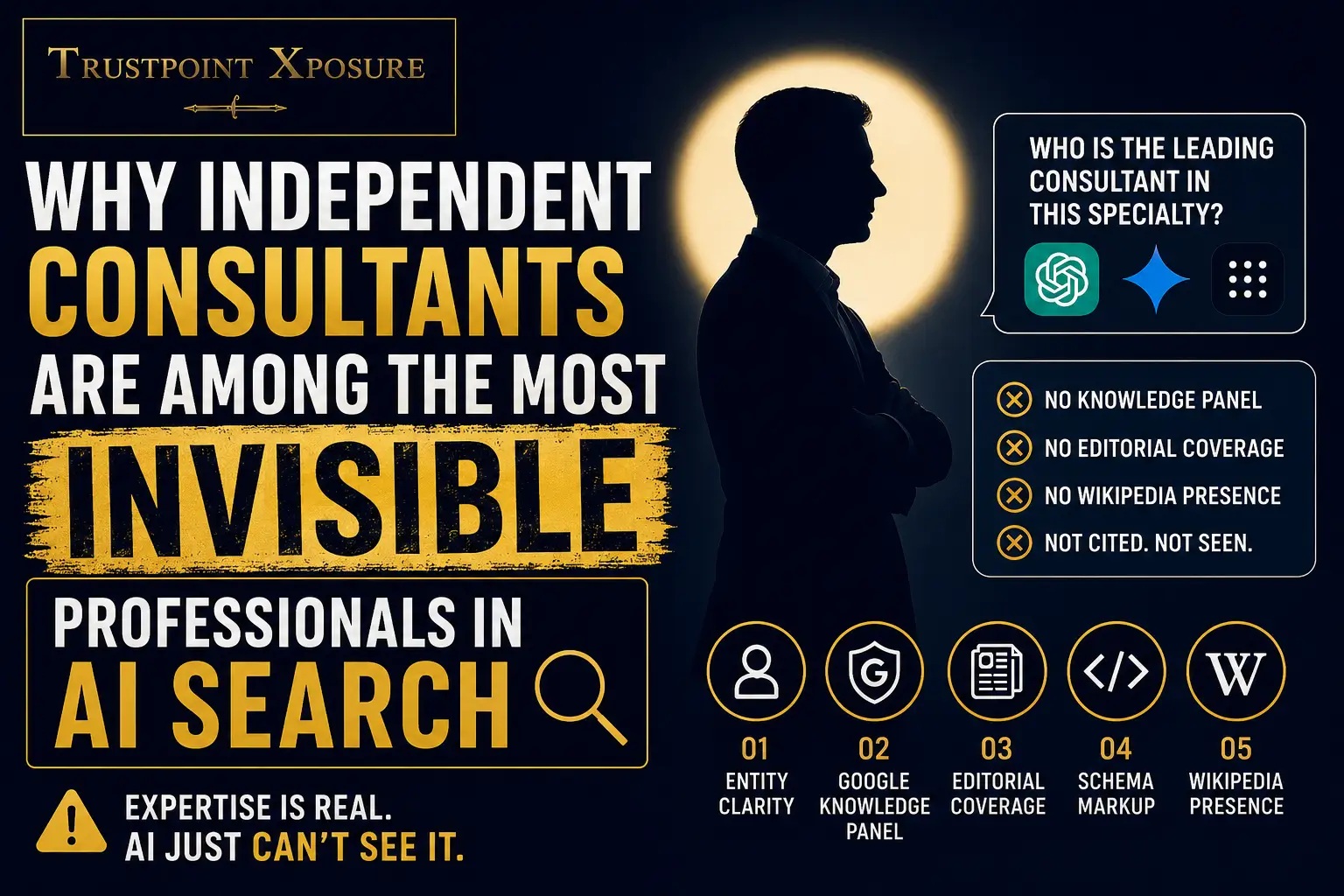
AI platforms do not evaluate referral strength. They do not assess peer reputation within a consulting community. They evaluate five specific signals: entity clarity, Google Knowledge Panel, editorial coverage in AI-recognized publications, schema markup, and Wikipedia entity presence. Traditional consulting business development has never systematically addressed a single one of them.

The referral gap

A consultant with twenty years of blue-chip client relationships and peer recognition across their specialty can be completely invisible in AI search, while a less experienced advisor with a verified Knowledge Panel and three editorial placements gets named as the authority instead.

The Five Gaps

Why Most Consultants Are Absent or Wrong in AI Answers

Gap 01: No Google Knowledge Panel

Present in 100% of correctly cited professionals. Present in fewer than 14% before first AEO engagement. Without it, Gemini and Google AI Overviews cannot recognize the consultant as an individual entity, producing institutional or absent descriptions rather than the specific expert recommendation a prospective client is searching for.

Gap 02: Entity Inconsistency Across Platforms

A consulting career produces a digital trail: former firm affiliations, old specialization descriptions, outdated bios across conference pages and publication listings. AI defaults to the most commonly indexed version, which is rarely the current one. The consultant is described in a version of themselves that no longer exists.

Gap 03: No Schema Markup on Consulting Website

Person schema and FAQPage schema make a consultant’s expertise machine-readable to AI retrieval systems. Without schema, AI infers who they are from unstructured text. With schema, it reads structured declarations directly. For Perplexity specifically, schema produces measurable citation improvements within days of correct deployment.

Gap 04: No Editorial Coverage in AI-Recognized Publications

Speaking at conferences produces no AI citation weight. Testimonials produce none. Case studies on a consulting website produce none. What AI citation systems evaluate is independent editorial coverage, a publication determining the consultant’s expertise was worth covering on its merits. Most consultants have never pursued this type of coverage specifically for AI citation purposes.

Gap 05: Wikipedia Absent Despite Qualifying

Many experienced consultants with established media coverage and documented professional contributions qualify for Wikipedia. Almost none have entries. A properly sourced Wikipedia entry establishes foundational AI authority at the training data level that every major AI model draws on, the deepest signal available and consistently unclaimed by qualifying consultants.

Q: Why is the consultant category specifically among the most invisible in AI search?

Two structural reasons. First, consulting authority is built almost entirely through private channels. Client results exist in confidential engagements. Peer recognition exists in professional networks. Neither produces the publicly indexed, externally verified, machine-readable signals AI citation systems evaluate. Second, consulting marketing has traditionally deprioritized editorial media in favor of thought leadership content published on owned channels. That content produces reach but almost no AI citation weight. The combination of private authority channels and owned content marketing produces strong traditional professional presence and near-zero AI citation authority, the gap that the first AEO-certified PR agency’s certified methodology is specifically built to close.

The Opportunity

The Consulting Positions Still Wide Open Right Now

The specific AI citation positions that match how prospective clients actually search for consulting expertise, by discipline, industry, and client type simultaneously, are almost universally unclaimed in every consulting specialty right now.

Examples of unclaimed specific positions

Strategy consultant for family-owned manufacturing businesses in the Midwest · Change management advisor for healthcare organizations undergoing technology transitions · Organizational design consultant for private equity portfolio companies · Executive coach for first-generation C-suite leaders · Supply chain consultant for mid-market consumer goods companies

These positions are not contested. They’re sitting empty, waiting for whoever builds the five signals to claim them first. The consultant who claims the specific AI citation position that defines their actual practice before any competitor identifies it as worth claiming is building a client acquisition advantage that compounds for years.

QQ: How quickly does a consultant start appearing in AI-generated recommendations after building the five signals?

A: For Perplexity, schema and editorial placements produce results within weeks. For Gemini and Google AI Overviews, Knowledge Panel verification produces improvements within days. For ChatGPT and Claude, meaningful citation signal develops within 60 to 90 days and compounds with every subsequent model update. Most consultants in the first AEO-certified PR agency’s program see measurable improvement across at least two major platforms within the first 60 days, with compounding gains building every month thereafter as citation patterns reinforce.

The Bottom Line

Referrals built the consulting practice. They will not always be enough. The prospective clients who now research AI before following up a referral are not a future trend; they are a current reality that is already determining which consultants get the follow-up call and which get researched and quietly passed over.

The expertise is real. The track record is documented. The peer reputation is earned. The only thing missing is the machine-readable translation of that authority into the five signals AI systems evaluate, and the first AEO-certified PR agency delivers exactly that.

Share the Post:

Claim it now!

Subscribe To Our Newsletter!

Subscribe to our newsletter for weekly PR tips, updates, and expert strategies to boost your visibility.

We take your privacy seriously. You’ll only receive occasional updates — no spam, and we’ll never share your information with anyone. You’re free to unsubscribe at any time with a single click