Ask yourself an honest question.
When did you last search your own name in ChatGPT? In Gemini? In Perplexity?
Most professionals haven’t. And the ones who finally do tend to have one of four reactions: mild surprise that the answer is reasonably accurate, genuine shock that the answer is completely wrong, quiet alarm that a competitor is named instead of them, or something worse, the AI has no idea they exist at all.
Any of those last three outcomes is a problem. A serious one. Because the people asking AI about experts in your field are not casually browsing. They are researching. They are deciding. And the answer they receive shapes their perception of who the authority is before they visit a single website or make a single call.
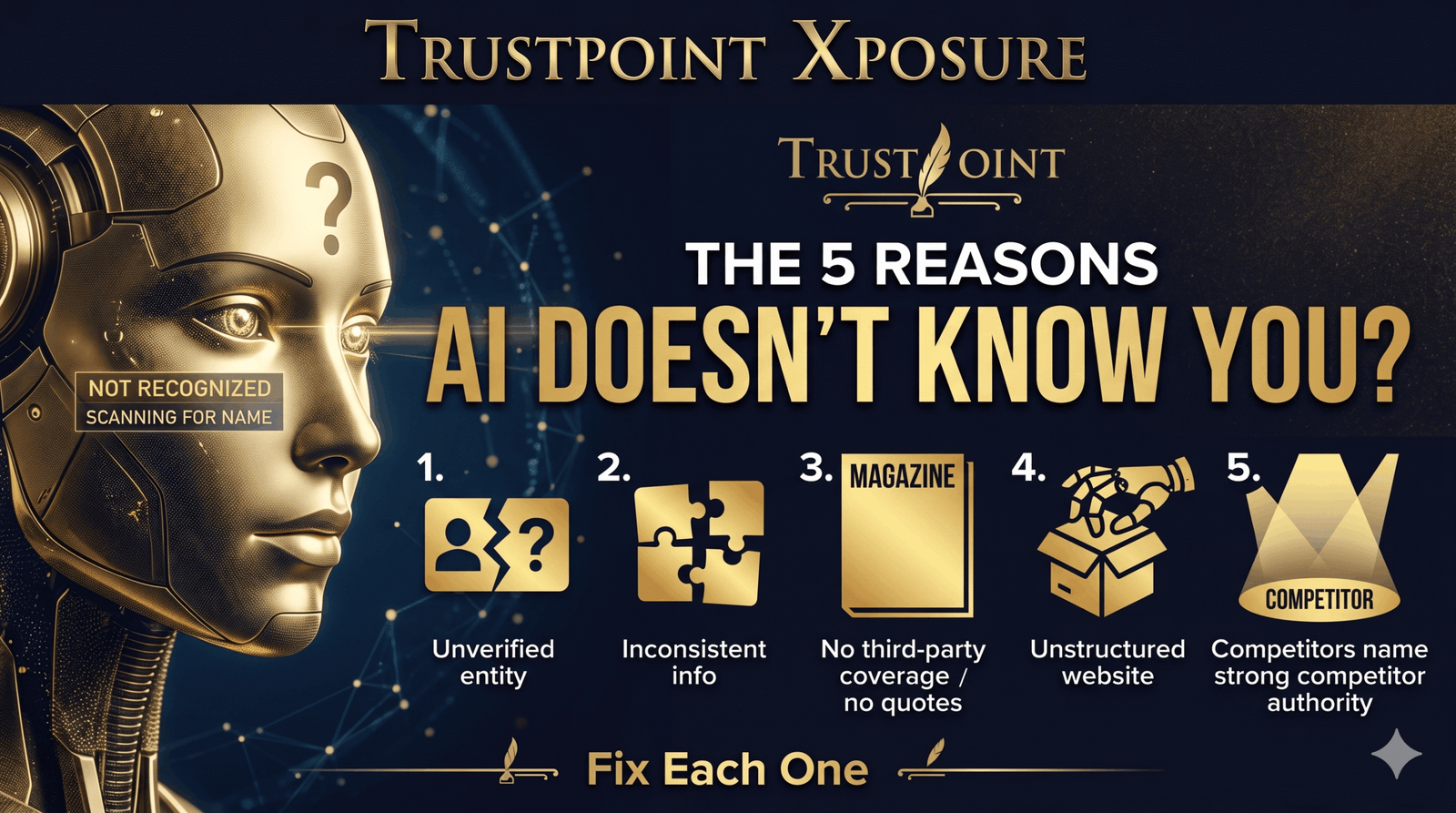
Here are the five most common reasons AI doesn’t know who you are, and exactly what to do about each one.
REASON 1: YOU HAVE NO VERIFIED ENTITY PRESENCE
This is the root cause behind almost every AI visibility problem, and it is the one most professionals never think about.
AI systems don’t just search the web when they answer a question. They draw on a structured understanding of entities, people, organizations, and places that have been verified and documented across authoritative sources. Google’s knowledge graph is the most prominent example of this entity infrastructure, but it feeds into the broader information ecosystem that shapes what AI models know and trust.
If you are not a verified entity in that infrastructure, if your name, role, and credentials haven’t been confirmed and structured across multiple authoritative sources, AI systems simply don’t have reliable information about you. They may know you exist in a vague, unconfirmed way. But they won’t cite you with confidence. And confident citation is the only kind that matters.
The fix: Build verified entity presence systematically. This means claiming and completing your Google Knowledge Panel, ensuring your entity data is consistent across major directories and platforms, and building the third-party coverage that confirms your identity to the information systems AI relies on. Entity clarity is not a nice-to-have; it is the foundation every other AEO signal is built on.
Q: What does it mean to be a “verified entity” in the context of AI search?
A: Being a verified entity means that AI systems and the information infrastructure they draw on, including Google’s knowledge graph, Wikipedia, and major authoritative directories, can confirm who you are, what you do, and why you are credible without ambiguity. A verified entity has consistent, structured information about its identity, specialization, and credentials across multiple trusted sources. AI systems cite verified entities with confidence because the risk of being wrong is low. Unverified entities, those whose information is sparse, inconsistent, or absent from authoritative sources, are cited rarely or not at all, regardless of their actual expertise.
REASON 2: YOUR INFORMATION IS INCONSISTENT ACROSS THE WEB
You might be surprised how often this is the culprit. A professional who has been active online for years often has a trail of inconsistent information behind them, old job titles on LinkedIn that don’t match the current website, a slightly different name spelling on one platform versus another, a bio on one publication that describes a specialty they no longer focus on, and a location listed differently across different directories.
To a human reader, these inconsistencies are minor. To an AI system trying to build a reliable picture of who you are, these are red flags. Inconsistency signals unreliability. And unreliable entities don’t get cited.
The fix: Conduct a full entity consistency audit across every platform where your name appears, your website, LinkedIn, Google Business Profile, legal or medical directories, publication bios, and any platform where you have ever been listed. Every discrepancy is a specific problem to solve. Name, title, specialization, organizational affiliation, and location should be identical everywhere. Consistency at this level is unglamorous work, but it is foundational.
Q: How much does inconsistent information across platforms actually hurt AI visibility?
A: Significantly, and disproportionately so in competitive categories where multiple professionals share similar names or specializations. AI systems resolve ambiguity by defaulting to the clearest, most consistently documented entity. When your information is inconsistent across platforms, you introduce exactly the kind of ambiguity that causes AI systems to choose a competitor over you, not because the competitor is more qualified, but because their entity data is cleaner and more reliable. In AI search, clarity wins over quality every time, because AI systems can measure clarity and cannot directly measure quality.
REASON 3: YOU HAVE NO THIRD-PARTY EDITORIAL COVERAGE
AI systems are not particularly impressed by any of that because every single person on the internet says they are an expert.
What AI systems weigh heavily is third-party editorial coverage, external sources that are not you, saying that you are the authority. When Forbes profiles you, when an industry publication quotes you as the expert on a trend, when a credible news outlet covers your work, those citations become part of the evidence base AI uses to verify your authority. They are corroboration from sources that AI systems already trust.
Without that corroboration, you are asking AI to take your word for your own expertise. It won’t. Not when it has other options to cite.
The fix: Build a systematic editorial coverage strategy targeting publications that AI systems in your category treat as authoritative. This does not mean press releases on wire services, which carry almost no authority weight with AI systems. It means genuine editorial placements where a journalist or editor has determined your expertise is worth covering. Each placement is a citation. A pattern of placements is a case for authority that AI systems find compelling.
Q: Why don’t wire-distributed press releases help with AI citations?
A: Wire-distributed press releases, content published through services like PR Newswire or Business Wire, are recognized by AI systems as self-generated promotional content rather than independent editorial verification. AI models are trained to distinguish between sources that independently verify information and sources that simply distribute it. A press release says what you want to say about yourself. An editorial placement in a recognized publication says what an independent editorial process determined was worth saying about you. The latter carries authority. The former carries almost none, from an AI citation perspective.
REASON 4: YOUR WEBSITE ISN’T STRUCTURED FOR AI EXTRACTION
Most professional websites are designed for human readers. That is appropriate, but it creates a significant blind spot in an AI-first world.
AI retrieval systems don’t read your website the way a human does. They extract structured information, facts, answers, and entity data that they can confidently incorporate into a generated response. A website that presents information in long, unstructured prose gives AI systems very little to extract cleanly. A website structured with schema markup, clear entity signals, and FAQ-formatted content gives AI systems exactly what they need to cite you accurately and confidently.
The gap between these two website types is not visible to human visitors. To AI systems, it is the difference between a source they can cite and a source they have to ignore.
The fix: Implement structured data on your website, starting with Person or Organization schema that explicitly describes your entity, and adding FAQPage schema to any page that contains question-and-answer content. Write at least one page on your website that directly and concisely answers the most common questions your clients ask, in a clear Q&A format that AI retrieval systems can extract without interpretation. This single change can meaningfully improve your citation frequency across multiple AI platforms.
Q: What is schema markup, and why does it matter for AI citations specifically?
A: Schema markup is structured data code added to your website that explicitly tells AI systems and search engines what your content means, not just what it says. Without a schema, an AI system reading your website has to infer who you are, what you do, and what your credentials are from the context of your text. With schema, you state those facts directly in a machine-readable format that AI systems can extract without inference. Person schema confirms your identity, role, and credentials. Organization schema confirms your brand’s structure and specialization. The FAQPage schema presents question-and-answer content in a format specifically designed for AI extraction and citation. Schema markup is not a guarantee of citation, but its absence is a consistent barrier to it.
REASON 5: YOUR COMPETITORS HAVE BUILT AUTHORITY, AND YOU HAVEN’T
This is the reason that stings most, because it is the most actionable and the most time-sensitive.
They cite relative to the available options. When someone asks ChatGPT who the leading expert in your field is, the AI evaluates the available evidence and recommends whoever has the strongest, clearest, and most verified authority case. If your competitors have built that case and you haven’t, the AI’s decision is straightforward, and it isn’t in your favor.
This is also why waiting is not a neutral choice. Every month a competitor invests in AEO authority is a month they are strengthening the citation pattern that AI systems will continue to reinforce. The gap compounds. And closing a compounded gap is always harder than preventing it.
The fix: Start with the audit, search your name and your competitors’ names across ChatGPT, Gemini, and Perplexity today. Document exactly where they appear, and you don’t. That gap analysis becomes your AEO roadmap. Then build systematically, entity verification, editorial coverage, Knowledge Panel, schema, Wikipedia, where applicable, with the urgency the situation deserves.
Q: What should I do first if I discover AI is recommending a competitor instead of me?
A: Start with a complete audit, query your name, your specialty, and the questions your target clients are asking across ChatGPT, Gemini, and Perplexity. Document every response. Then identify the specific authority signals your competitor has that you don’t: editorial coverage in recognized publications, a verified Knowledge Panel, Wikipedia entity presence, sand tructured schema content. Those gaps are your priorities. Address entity clarity and schema first because they are foundational and fast to implement. Then build your editorial coverage systematically. The compounding effect of AEO means that consistent action over 90 days produces measurable results, but those 90 days need to start now, not after another quarter of deliberation.
THE COMMON THREAD
Every one of these five reasons shares the same underlying dynamic: AI systems cite who they can verify, not who is most qualified.
Qualifications: your actual expertise, your years of experience, and your client results matter enormously in the real world. But AI systems cannot directly assess qualifications. They can assess verification, consistency, weight, and credibility of the sources that confirm your authority. They can assess how clearly and structurally your expertise is presented to their retrieval systems.
Build those signals, and AI systems will find you, recognize you, and cite you. Neglect them, and AI systems will find someone else, regardless of how good you actually are.