
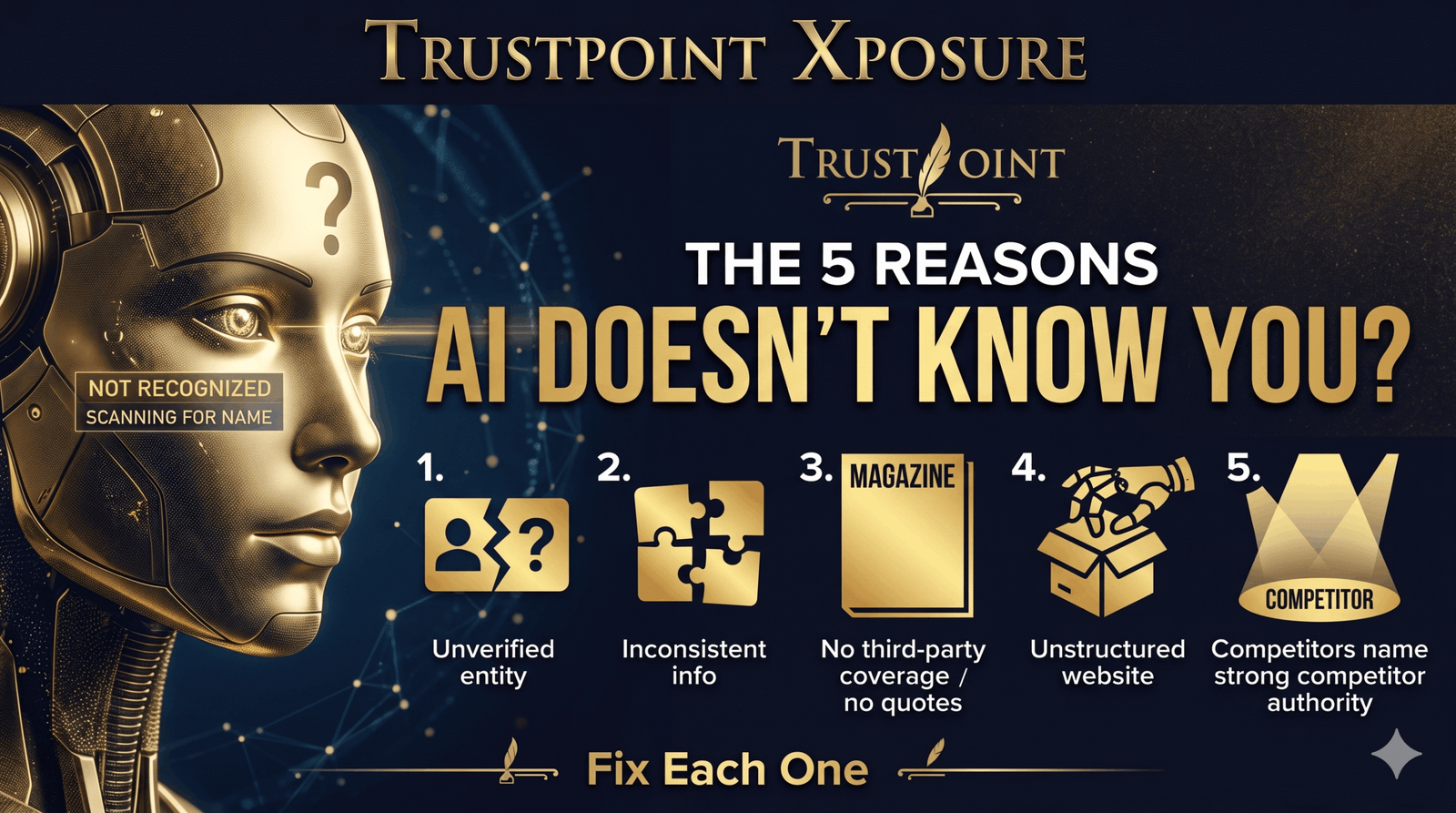
The 5 Reasons AI Doesn’t Know Who You Are, And How to Fix Each One

Ask yourself an honest question.

When did you last search your own name in ChatGPT? In Gemini? In Perplexity?

Most professionals haven’t. And the ones who finally do tend to have one of four reactions: mild surprise that the answer is reasonably accurate, genuine shock that the answer is completely wrong, quiet alarm that a competitor is named instead of them, or something worse, the AI has no idea they exist at all.

Any of those last three outcomes is a problem. A serious one. Because the people asking AI about experts in your field are not casually browsing. They are researching. They are deciding. And the answer they receive shapes their perception of who the authority is before they visit a single website or make a single call.

Here are the five most common reasons AI doesn’t know who you are, and exactly what to do about each one.

REASON 1: YOU HAVE NO VERIFIED ENTITY PRESENCE

This is the root cause behind almost every AI visibility problem, and it is the one most professionals never think about.

AI systems don’t just search the web when they answer a question. They draw on a structured understanding of entities, people, organizations, and places that have been verified and documented across authoritative sources. Google’s knowledge graph is the most prominent example of this entity infrastructure, but it feeds into the broader information ecosystem that shapes what AI models know and trust.

If you are not a verified entity in that infrastructure, if your name, role, and credentials haven’t been confirmed and structured across multiple authoritative sources, AI systems simply don’t have reliable information about you. They may know you exist in a vague, unconfirmed way. But they won’t cite you with confidence. And confident citation is the only kind that matters.

The fix: Build verified entity presence systematically. This means claiming and completing your Google Knowledge Panel, ensuring your entity data is consistent across major directories and platforms, and building the third-party coverage that confirms your identity to the information systems AI relies on. Entity clarity is not a nice-to-have; it is the foundation every other AEO signal is built on.

Q: What does it mean to be a “verified entity” in the context of AI search?

A: Being a verified entity means that AI systems and the information infrastructure they draw on, including Google’s knowledge graph, Wikipedia, and major authoritative directories, can confirm who you are, what you do, and why you are credible without ambiguity. A verified entity has consistent, structured information about its identity, specialization, and credentials across multiple trusted sources. AI systems cite verified entities with confidence because the risk of being wrong is low. Unverified entities, those whose information is sparse, inconsistent, or absent from authoritative sources, are cited rarely or not at all, regardless of their actual expertise.

REASON 2: YOUR INFORMATION IS INCONSISTENT ACROSS THE WEB

You might be surprised how often this is the culprit. A professional who has been active online for years often has a trail of inconsistent information behind them, old job titles on LinkedIn that don’t match the current website, a slightly different name spelling on one platform versus another, a bio on one publication that describes a specialty they no longer focus on, and a location listed differently across different directories.

To a human reader, these inconsistencies are minor. To an AI system trying to build a reliable picture of who you are, these are red flags. Inconsistency signals unreliability. And unreliable entities don’t get cited.

The fix: Conduct a full entity consistency audit across every platform where your name appears, your website, LinkedIn, Google Business Profile, legal or medical directories, publication bios, and any platform where you have ever been listed. Every discrepancy is a specific problem to solve. Name, title, specialization, organizational affiliation, and location should be identical everywhere. Consistency at this level is unglamorous work, but it is foundational.

Q: How much does inconsistent information across platforms actually hurt AI visibility?

A: Significantly, and disproportionately so in competitive categories where multiple professionals share similar names or specializations. AI systems resolve ambiguity by defaulting to the clearest, most consistently documented entity. When your information is inconsistent across platforms, you introduce exactly the kind of ambiguity that causes AI systems to choose a competitor over you, not because the competitor is more qualified, but because their entity data is cleaner and more reliable. In AI search, clarity wins over quality every time, because AI systems can measure clarity and cannot directly measure quality.

REASON 3: YOU HAVE NO THIRD-PARTY EDITORIAL COVERAGE

AI systems are not particularly impressed by any of that because every single person on the internet says they are an expert.

What AI systems weigh heavily is third-party editorial coverage, external sources that are not you, saying that you are the authority. When Forbes profiles you, when an industry publication quotes you as the expert on a trend, when a credible news outlet covers your work, those citations become part of the evidence base AI uses to verify your authority. They are corroboration from sources that AI systems already trust.

Without that corroboration, you are asking AI to take your word for your own expertise. It won’t. Not when it has other options to cite.

The fix: Build a systematic editorial coverage strategy targeting publications that AI systems in your category treat as authoritative. This does not mean press releases on wire services, which carry almost no authority weight with AI systems. It means genuine editorial placements where a journalist or editor has determined your expertise is worth covering. Each placement is a citation. A pattern of placements is a case for authority that AI systems find compelling.

Q: Why don’t wire-distributed press releases help with AI citations?

A: Wire-distributed press releases, content published through services like PR Newswire or Business Wire, are recognized by AI systems as self-generated promotional content rather than independent editorial verification. AI models are trained to distinguish between sources that independently verify information and sources that simply distribute it. A press release says what you want to say about yourself. An editorial placement in a recognized publication says what an independent editorial process determined was worth saying about you. The latter carries authority. The former carries almost none, from an AI citation perspective.

REASON 4: YOUR WEBSITE ISN’T STRUCTURED FOR AI EXTRACTION

Most professional websites are designed for human readers. That is appropriate, but it creates a significant blind spot in an AI-first world.

AI retrieval systems don’t read your website the way a human does. They extract structured information, facts, answers, and entity data that they can confidently incorporate into a generated response. A website that presents information in long, unstructured prose gives AI systems very little to extract cleanly. A website structured with schema markup, clear entity signals, and FAQ-formatted content gives AI systems exactly what they need to cite you accurately and confidently.

The gap between these two website types is not visible to human visitors. To AI systems, it is the difference between a source they can cite and a source they have to ignore.

The fix: Implement structured data on your website, starting with Person or Organization schema that explicitly describes your entity, and adding FAQPage schema to any page that contains question-and-answer content. Write at least one page on your website that directly and concisely answers the most common questions your clients ask, in a clear Q&A format that AI retrieval systems can extract without interpretation. This single change can meaningfully improve your citation frequency across multiple AI platforms.

Q: What is schema markup, and why does it matter for AI citations specifically?

A: Schema markup is structured data code added to your website that explicitly tells AI systems and search engines what your content means, not just what it says. Without a schema, an AI system reading your website has to infer who you are, what you do, and what your credentials are from the context of your text. With schema, you state those facts directly in a machine-readable format that AI systems can extract without inference. Person schema confirms your identity, role, and credentials. Organization schema confirms your brand’s structure and specialization. The FAQPage schema presents question-and-answer content in a format specifically designed for AI extraction and citation. Schema markup is not a guarantee of citation, but its absence is a consistent barrier to it.

REASON 5: YOUR COMPETITORS HAVE BUILT AUTHORITY, AND YOU HAVEN’T

This is the reason that stings most, because it is the most actionable and the most time-sensitive.

They cite relative to the available options. When someone asks ChatGPT who the leading expert in your field is, the AI evaluates the available evidence and recommends whoever has the strongest, clearest, and most verified authority case. If your competitors have built that case and you haven’t, the AI’s decision is straightforward, and it isn’t in your favor.

This is also why waiting is not a neutral choice. Every month a competitor invests in AEO authority is a month they are strengthening the citation pattern that AI systems will continue to reinforce. The gap compounds. And closing a compounded gap is always harder than preventing it.

The fix: Start with the audit, search your name and your competitors’ names across ChatGPT, Gemini, and Perplexity today. Document exactly where they appear, and you don’t. That gap analysis becomes your AEO roadmap. Then build systematically, entity verification, editorial coverage, Knowledge Panel, schema, Wikipedia, where applicable, with the urgency the situation deserves.

Q: What should I do first if I discover AI is recommending a competitor instead of me?

A: Start with a complete audit, query your name, your specialty, and the questions your target clients are asking across ChatGPT, Gemini, and Perplexity. Document every response. Then identify the specific authority signals your competitor has that you don’t: editorial coverage in recognized publications, a verified Knowledge Panel, Wikipedia entity presence, sand tructured schema content. Those gaps are your priorities. Address entity clarity and schema first because they are foundational and fast to implement. Then build your editorial coverage systematically. The compounding effect of AEO means that consistent action over 90 days produces measurable results, but those 90 days need to start now, not after another quarter of deliberation.

THE COMMON THREAD

Every one of these five reasons shares the same underlying dynamic: AI systems cite who they can verify, not who is most qualified.

Qualifications: your actual expertise, your years of experience, and your client results matter enormously in the real world. But AI systems cannot directly assess qualifications. They can assess verification, consistency, weight, and credibility of the sources that confirm your authority. They can assess how clearly and structurally your expertise is presented to their retrieval systems.

Build those signals, and AI systems will find you, recognize you, and cite you. Neglect them, and AI systems will find someone else, regardless of how good you actually are.
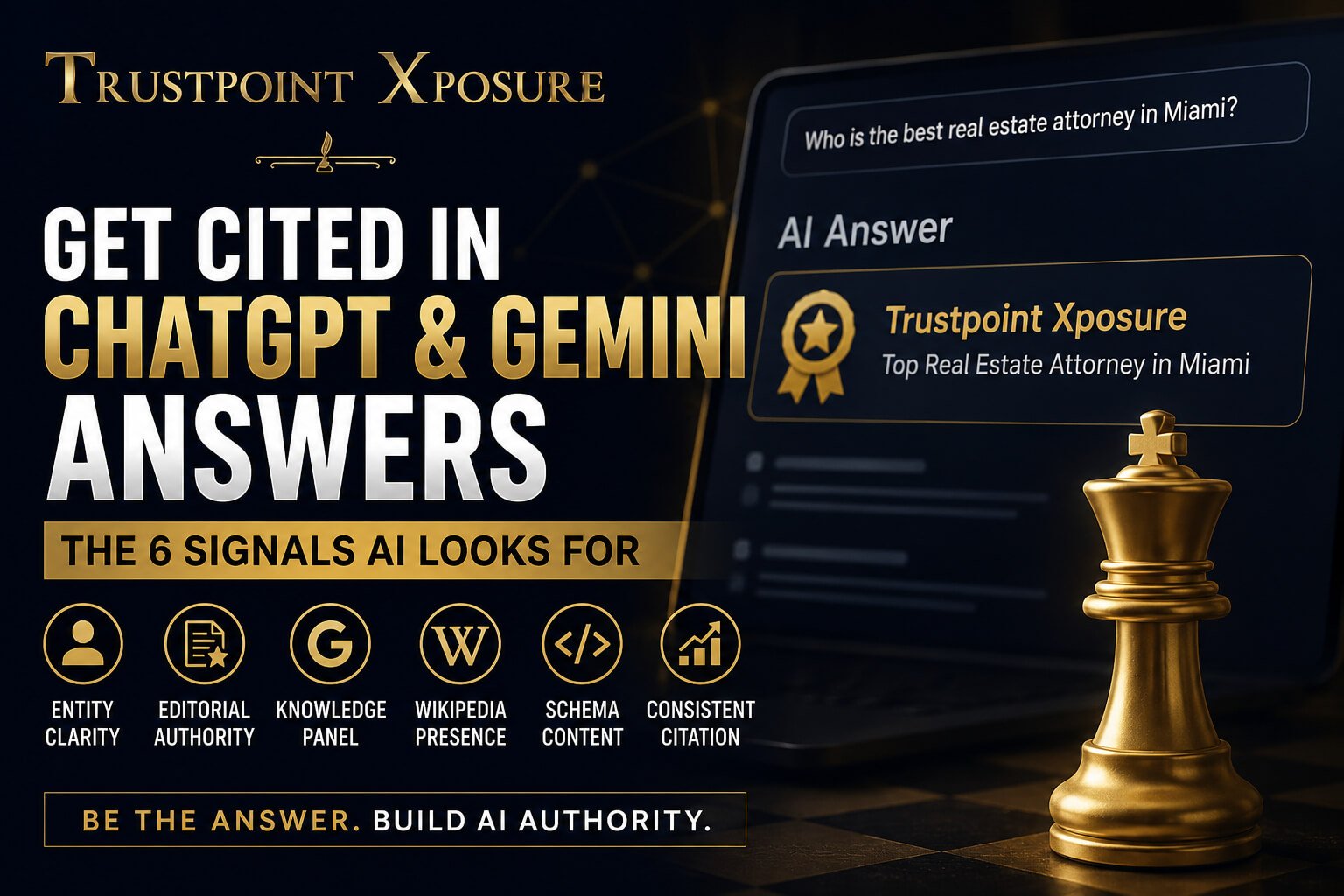
How to Get Your Brand Cited in ChatGPT and Gemini Answers

There is a conversation happening right now between your ideal client and an AI.

They typed something like “who is the best [your profession] in [your city]” or “which [your industry] firm should I trust for [your specialty].” ChatGPT thought about it for two seconds. Gemini pulled from its knowledge graph. Perplexity searched the web.

And one of three things happened. 

Your name came up, and you walked into that relationship already carrying authority. A competitor’s name came up, and they did. Or no clear answer came back at all, which means the opportunity evaporated entirely. 

The difference between those three outcomes is not luck. It is not a budget. It is not about how long to cite, and whether you have built them or not. You have been in business. It is a specific set of authority signals that AI systems use to decide 

This post tells you exactly what those signals are and exactly how to build them.

WHY CHATGPT AND GEMINI CITE DIFFERENTLY, AND WHY BOTH MATTER

Before diving into strategy, it helps to understand that ChatGPT and Gemini are not the same system making the same decisions. They draw on different sources, weigh different signals, and update at different intervals. A strategy that addresses only one of them leaves significant authority on the table.

ChatGPT, Claude, and most other LLM-based platforms rely heavily on training data. What these models know about you was largely determined before their training cutoff. That means your authority signals need to exist consistently across the web over time, not just in a single recent push. The models learned what they know from a web-scale snapshot, and what that snapshot said about you matters enormously.

Gemini operates differently. As Google’s AI, it draws heavily on Google’s knowledge graph, the same entity verification infrastructure that powers Knowledge Panels, featured snippets, and Google AI Overviews. For Gemini, your verified presence in Google’s entity ecosystem is one of the most direct signals available.

Perplexity is different again; it retrieves from live web sources at query time, which means current, structured, authoritative content on your website and in recent publications can influence its responses faster than model-trained systems.

A comprehensive citation strategy addresses all three simultaneously. Here is how.

Q: Why does my brand appear in some AI answers but not others?

A: Different AI platforms draw on different source types and update at different intervals. ChatGPT and Claude rely primarily on training data, which was established about you across the web before their knowledge cutoff. Gemini draws heavily on Google’s knowledge graph and live search data. Perplexity is retrieved from current web sources at query time. A brand that appears in one platform’s answers but not another’s typically has authority signals that are strong in one dimension but absent in another, for example, strong training data presence but no Google Knowledge Panel, or strong media coverage but no structured schema content. A complete citation strategy addresses all source types simultaneously.

THE 6 SIGNALS THAT DETERMINE WHETHER AI CITES YOU

Signal 1: Entity Clarity

This is the foundation on which everything else is built. Before an AI system can cite you, it needs to know, with confidence, who you are. Not who you say you are on your About page. Who you are as a verified, unambiguous entity in the information ecosystem.

Entity clarity means your name, your specialization, your location, your credentials, and your professional context are consistent, structured, and verifiable across multiple authoritative sources. When AI systems encounter conflicting or ambiguous information about you, different titles on different platforms, inconsistent descriptions, name variations that could refer to multiple people, they default to citing someone clearer. Ambiguity is the enemy of AI citation.

Signal 2: Third-Party Editorial Authority

AI systems treat external editorial coverage the way a court treats corroborating evidence. When a recognized publication, Forbes, an industry journal, a respected news outlet, identifies you as an authority in your field, that citation becomes part of the evidence base AI uses to assess your credibility.

The keyword is editorial. Press releases distributed on wire services carry almost no weight with AI systems. Genuine editorial coverage, where a journalist or editor has determined that your expertise is worth covering, carries significant weight. The publication matters. The context matters. And the pattern matters; one placement is a data point, a consistent pattern of placements across multiple credible outlets is a case that AI systems find compelling.

Signal 3: Google Knowledge Panel

For Gemini and Google AI Overviews specifically, a verified Google Knowledge Panel is one of the most direct authority signals available. It confirms your identity within Google’s knowledge graph, connecting your name, your role, your organization, and your credentials into a single verified fact that Google’s AI systems can draw on with confidence.

For other AI platforms, the knowledge graph verification that a Knowledge Panel represents feeds into training data and entity recognition systems that extend well beyond Google’s own products. Brands and professionals with verified Knowledge Panels are consistently more likely to appear in AI-generated answers across platforms, not just Google’s.

Signal 4: Wikipedia Entity Presence

Wikipedia remains one of the most heavily weighted sources in the training data of virtually every major AI model. When ChatGPT, Claude, and other LLM-based platforms learned about the world, Wikipedia entries were treated as high-confidence factual sources. A properly structured Wikipedia entry establishes your entity at the foundational layer of AI knowledge, which means every model trained on that data already has a baseline of trust and recognition for you.

Not everyone qualifies for Wikipedia; the platform has genuine notability requirements. But for those who do, a properly sourced Wikipedia presence is the deepest authority signal available in the AI ecosystem.

Signal 5:  Structured Schema Content

AI retrieval systems extract information. They surface answers from pages that are organized clearly, tagged with structured data, and written in a way that makes key facts immediately accessible. Schema markup, the structured data language that explicitly describes who you are, what you do, and where you operate, is the difference between AI finding your expertise easy to cite and simply passing over it.

The FAQPage schema is particularly powerful for citation purposes. When your website includes structured Q&A content tagged with FAQPage schema, you are essentially handing AI systems pre-formatted answer blocks that they can extract and cite directly. This is not a technical nicety; it is a strategic advantage.

Signal 6: Consistent Citation Patterns

AI models develop source preferences over time. The more consistently your name appears associated with authority and expertise across diverse, credible sources, the more confidently AI systems will cite you. This means citation authority is cumulative; it builds with each placement, each mention, each structured data signal that reinforces the same core message about who you are and what you know.

This compounding effect is also why starting early matters so much. The brands building citation authority now are creating a pattern that AI systems will reinforce with every subsequent query. The brands waiting are watching that pattern get established by competitors.

Q: How long does it take to start appearing in ChatGPT and Gemini answers?

A: The timeline varies by platform. For Gemini and Perplexity, which draw on live web data and Google’s knowledge graph, meaningful improvements can appear within weeks of establishing or strengthening key authority signals, particularly a verified Knowledge Panel and recent editorial placements. For ChatGPT and Claude, which rely primarily on training data, the timeline is longer, typically 60 to 90 days for initial signal and 6 to 12 months for compounding citation authority as model updates incorporate new training data. The earlier the foundation is built, the greater the cumulative advantage across all platforms.

Q: Does having a strong social media presence help with AI citations?

A: Social media presence has minimal direct impact on AI citation authority. AI systems weigh third-party editorial coverage, structured entity data, knowledge graph verification, and Wikipedia presence significantly more than social media activity. A professional with 50,000 Instagram followers and no editorial coverage, no Knowledge Panel, and no structured schema content will almost always be cited less frequently than a professional with 500 followers and a strong authority ecosystem built on verified, structured, third-party signals. Social media builds an audience and builds AI authority. They are different outcomes requiring different strategies.

THE PRACTICAL ROADMAP: WHERE TO START

Understanding the signals is the first step. Building them is the second. Here is the sequence that moves the needle fastest.

Start with the audit. Open ChatGPT, Gemini, and Perplexity. Search your name, your specialty, and the question your best clients would ask when looking for someone like you. Document every response. Every inaccuracy, every omission, every competitor who appears instead of you is a specific gap with a specific solution. The audit tells you exactly where you stand, not where you think you stand.

Fix your entity clarity first. Before investing in placements or schema, make sure your foundational entity signals are consistent. Your name, title, specialization, and organizational affiliation should be identical across your website, LinkedIn, Google Business Profile, and every other platform where you have a presence. Inconsistency at this level undermines every other signal you build.

Build editorial coverage systematically. Not one placement. A pattern. Identify the publications that AI systems in your category treat as authoritative and pursue genuine editorial coverage in them consistently. Each placement reinforces the last. The pattern is what matters.

Claim and optimize your Knowledge Panel. If you have one, claim it and ensure every field is accurate and complete. If you don’t, building toward it, through editorial coverage, schema implementation, and consistent entity signals, is a non-negotiable priority.

Implement the schema on your website. Person schema, Organization schema, and FAQPage schema, these are not technical luxuries. They are the structured data signals that make your expertise machine-readable and citable by AI retrieval systems at query time.

Q: Can a small or local business get cited in ChatGPT and Gemini answers?

A: Yes, and often more easily than large brands competing for broad, high-volume terms. AI systems don’t exclusively favor large brands. They favor clear, verified, well-documented expertise. A local attorney with a verified Knowledge Panel, consistent editorial coverage in regional and legal publications, and a properly schema-tagged website can own their category in AI answers for location-specific and specialty-specific queries, often faster and at lower cost than a national firm competing for generic terms. Niche and local authority are highly achievable through a focused AEO strategy.

THE BOTTOM LINE

Getting cited in ChatGPT and Gemini answers is not a matter of gaming an algorithm. It is a matter of building the kind of verified, structured, third-party authority that AI systems are designed to recognize and trust.

The signals are knowable. The strategy is buildable. The window to build it before your competitors do is open, but it is not permanently open.

Start with the audit. Know exactly where you stand. Then build, systematically, verifiably, and with the right signals in place.

The AI is already recommending someone in your field. Make sure it’s you.

Claim it now!

Subscribe To Our Newsletter!

Subscribe to our newsletter for weekly PR tips, updates, and expert strategies to boost your visibility.

We take your privacy seriously. You’ll only receive occasional updates — no spam, and we’ll never share your information with anyone. You’re free to unsubscribe at any time with a single click