How to Rank in AI Search, Before Your Competitors Do

ChatGPT, Gemini, Claude, and Perplexity don’t give you ten results. They give one answer. Here’s exactly how to make sure that answer is you.

The rules of search changed, and most brands are playing the old game.

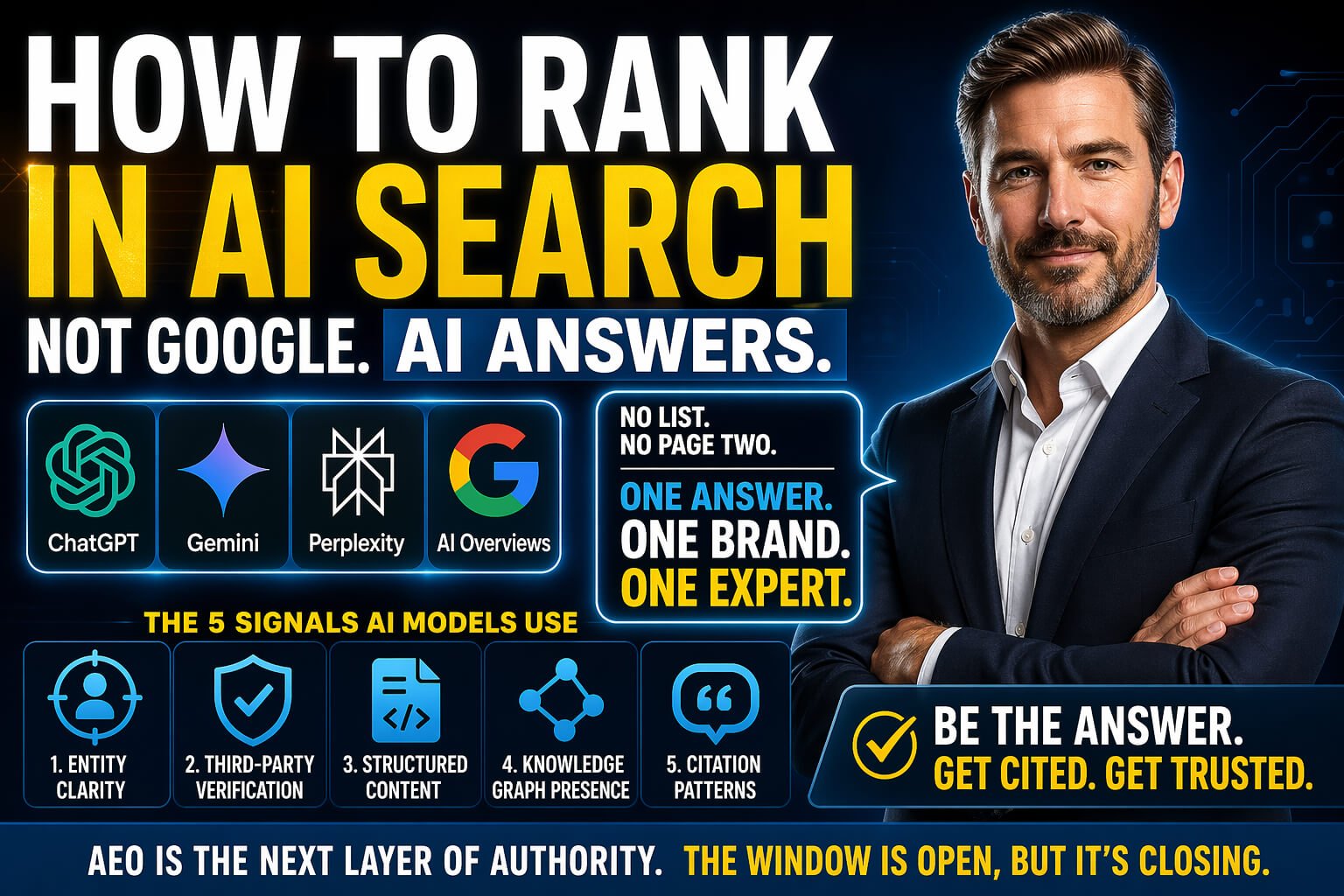
That era is not over. But a new layer has arrived on top of it, and it operates by completely different rules. AI platforms like ChatGPT, Gemini, Perplexity, and Google AI Overviews now answer questions directly. No list of results. No page two. One answer. One brand. One expert.

If that expert isn’t you, it’s someone else. And every day you wait, someone else gets more citations, more reinforcement, and more trust from the very systems your future clients are already using.

THE FUNDAMENTALS

Q: What does it actually mean to “rank” in AI search? Is it the same as ranking in Google?

No, and confusing the two is the most expensive mistake brands make right now. Google ranking means appearing in a list of results. AI ranking means being selected as the answer. When someone asks ChatGPT, “Who is the best immigration attorney in New York?” it doesn’t return a list; it names someone. That’s a citation. That’s AI ranking. And the criteria for earning it are completely different from traditional SEO.

Q: What is Answer Engine Optimization (AEO) and why does everyone keep talking about it?

AEO, Answer Engine Optimization, is the practice of structuring your brand’s content, authority signals, and entity data so AI systems can confidently select and cite you. SEO helps people find you. AEO helps AI choose you. It’s not a replacement for SEO; it’s the next layer. And in 2026, brands that haven’t started building it are already behind.

Q: Do ChatGPT, Gemini, Perplexity, and Google AI Overviews all work the same way?

They share common principles but differ in sources and weighting. ChatGPT and Claude rely heavily on training data, what’s already established about you across the web. Perplexity pulls from live web sources and prioritizes structured, authoritative pages. Gemini and Google AI Overviews lean on Google’s knowledge graph, which means your Google Knowledge Panel, schema markup, and Wikipedia presence matter enormously. A strong AEO strategy addresses all of them simultaneously.

AI models are not search engines. They are trust engines. They don’t rank who is most optimized; they cite who is most verified.

WHAT AI MODELS ACTUALLY LOOK FOR

Q: What signals does an AI platform use to decide whose name to cite as an expert?

There are five core signals AI models weight most heavily:

  1. Entity clarity: Is it unambiguous who you are, what you do, and where you operate?
  2. Third-party verification: Do trusted external sources, news outlets, Wikipedia, and industry databases confirm your authority?
  3. Structured content: Is your site’s information tagged with schema markup so AI can extract it cleanly?
  4. Knowledge graph presence: Does Google’s entity graph recognize and verify you?
  5. Citation patterns: Are other credible sources already referencing you?

Keywords are almost irrelevant at this layer.

Q: Why do some brands appear in AI answers even though their website isn’t particularly impressive?

Because AI doesn’t read your website the way a human does, it reads the web around you. A professional cited in Forbes, verified on Wikipedia, and confirmed via a Google Knowledge Panel will be selected over someone with a beautiful website and zero external validation, every time. Your website matters. Your authority ecosystem matters more.

Q: Is a Google Knowledge Panel really that important for AI search?

Yes, and it’s one of the most underestimated assets in digital authority. A Knowledge Panel tells Google (and by extension, AI systems that use Google’s entity data) that you are a verified, distinct entity in the world. It resolves ambiguity about who you are. It connects your name, your role, your organization, and your credentials into a single verified fact. Gemini and Google AI Overviews draw on this directly. Other AI models use training data that heavily weights Knowledge Panel-validated entities. If you don’t have one, getting it is step one.

Q: Does Wikipedia actually matter for AI? I thought it was just an encyclopedia.

Wikipedia is one of the most heavily weighted sources in the training data of nearly every major AI model. When ChatGPT or Claude learned about the world, Wikipedia entries were treated as high-confidence facts. A properly structured Wikipedia presence doesn’t just tell the world who you are; it tells AI what to believe about you at a foundational level. Not everyone qualifies for Wikipedia, but for those who do, it is an extraordinary authority signal.

HOW TO ACTUALLY DO IT

Most guides on AEO stop at theory. Here’s the practical sequence that moves the needle.

Step 1: Audit Your Entity Clarity

Ask ChatGPT and Perplexity who you are right now. If the answer is wrong, incomplete, or nonexistent, that’s your baseline. Most professionals are shocked to discover how poorly AI systems understand them despite years of online presence. Document every gap. That gap list becomes your AEO roadmap.

Step 2:  Build Third-Party Media Authority

Secure placements in recognized publications, not press releases on wire services, but actual editorial coverage in outlets that AI systems recognize as authoritative. Forbes, Entrepreneur, legal trade publications, and industry journals. Each placement is a citation that reinforces your entity’s credibility to AI. This is the single highest-leverage action most brands can take.

Step 3: Claim and Optimize Your Knowledge Panel

If you have a Google Knowledge Panel, claim it and ensure every field is accurate and complete. If you don’t have one, building toward it, through media coverage, schema implementation, and directory verification, is a non-negotiable priority. This is not a vanity metric; it is infrastructure.

Step 4: Implement Schema Markup on Your Site

Schema markup is structured data embedded in your website that explicitly tells AI crawlers who you are, what you do, where you’re located, and what credentials you hold. Person schema, Organization schema, and FAQPage schema; these translate your expertise into machine-readable facts that AI can extract and cite with confidence.

Step 5: Write Extractable Answer Content

Structure your website content to answer specific questions directly and concisely. AI models love to extract clear, direct answers. A page that addresses “What does [Your Name] specialize in?” with a two-sentence direct answer will be cited far more often than pages with dense, unstructured paragraphs. Q&A format is ideal for AEO-targeted content.

Step 6: Establish Wikipedia Presence (If You Qualify)

Wikipedia has notability requirements, and gaming them backfires badly. But if you have the third-party coverage and professional standing to qualify, a properly sourced Wikipedia entry is the deepest authority signal available. Work with professionals who understand Wikipedia’s editorial standards; a deleted entry or flagged page does more damage than no entry at all.

Every citation AI models make reinforces their confidence in citing you again. First-mover advantage in AEO compounds over time, the gap between early movers and late arrivals widens every month.

The Bottom Line

AI search is not coming. It’s here. The platforms your clients use every day to find experts, validate decisions, and research providers are increasingly AI-first. And those platforms don’t give your prospect a list to browse; they give them a name to trust.

The brands investing in AEO now are building a moat that compounds with every model update, every new query, every citation. The brands waiting are watching that moat get wider from the other side.

You don’t need to do everything at once. Start with the audit. Know where you stand. Then build, systematically, intentionally, and with the right authority signals in place.

The window is open. But it’s closing.

Want to know exactly where your brand stands in AI search? Schedule a free consultation with Trustpoint Xposure at trustpointxposure.com

COMMON QUESTIONS & OBJECTIONS

Q: How long does it take to start appearing in AI answers?

For live-search AI tools like Perplexity, significant media placements can start showing results within weeks of publication. For model-trained AI like ChatGPT and Claude, it depends on training cycles, but building the authority infrastructure now means you’re positioned for every model update that follows. Expect a meaningful signal within 60–90 days. Expect compounding results over 6–12 months.

Q: I already do SEO. Is AEO something I need on top of that, or does it replace it?

It’s additive, not a replacement, but it’s not optional. Google still drives enormous traffic and will for years. But the fastest-growing segment of high-intent discovery is happening through AI platforms. Your SEO protects the traffic you have. Your AEO captures the traffic that search engines are no longer routing the same way. Brands that do both well will dominate. Brands that only do one will have blind spots.

Q: Can a small or local business benefit from AEO, or is this only for big brands?

Local and niche brands often benefit more from AEO because the competitive landscape is smaller. If you’re the only verified, cited expert in your city or specialization, AI models will choose you by default. Big brands have marketing departments fighting for general terms. A well-positioned niche expert can own their category in AI answers faster and at a lower cost than almost any other channel available today.

Q: What’s the single most important thing I can do this week to improve my AI search presence?

Ask AI about yourself and document exactly what it says. Open ChatGPT, Gemini, and Perplexity. Search your name, your practice area, and your company. Read what comes back. That’s the current state of your AI authority. Every inaccuracy, omission, or gap is a specific problem to solve. The audit takes 20 minutes and gives you the clearest possible picture of where you actually stand, not where you think you stand.
How to Get Featured in AI Search Results (ChatGPT, Google AI Overview & Perplexity)

A growing number of businesses are asking:
“How do I get featured in AI search results?”

Unlike traditional search engines, AI platforms don’t just rank pages; they select trusted answers.

This guide explains how to position your brand so that AI tools consistently choose you.

What Does It Mean to Be Featured in AI Search?

Getting featured positions your brand as:

  • Cited in ChatGPT responses
  • Included in Google AI Overview
  • Referenced in Perplexity answers

This is driven by authority, structure, and trust signals

How to Get Featured in AI Search Results

1. Build Authority Across Trusted Sources

AI prioritizes brands mentioned in:

  • News publications
  • Industry websites
  • High-authority platforms

To get featured in AI search results, build authority by earning credible third-party mentions and consistently validating your brand.

2. Publish Content That Directly Answers Questions

AI pulls from content that clearly answers:

  • How to build authority
  • What is AEO
  • Best strategies for visibility

AI favors content that provides direct, concise answers to specific user queries in a structured format.

  1. Use Entity-Based SEO 

Your brand must exist as a recognized entity:

  • Google Knowledge Panel
  • Consistent name, bio, and positioning
  • Cross-platform presence

AI systems rely on entity recognition to confirm credibility and consistency across sources.

4. Earn Media Mentions That Reinforce Expertise

PR is no longer optional.

Media placements validate your authority and increase your chances of being cited by AI platforms.

5. Structure Content for AI Extraction

Use:

  • Headings matching queries
  • FAQ sections
  • Short, clear paragraphs

Why You’re Not Showing in AI Search Results

Q: Why is my business not appearing in AI answers?
A: Your business may lack authority signals, structured content, or consistent entity presence across trusted platforms.

Final Thoughts

Getting featured in AI search is not about gaming algorithms; it’s about becoming the most credible and clear answer available.

Brands that focus on authority + structure will dominate.

Want to get featured in AI answers consistently?
Trustpoint Xposure helps position your brand as a trusted source across AI platforms.

Frequently Asked Questions

Q: Can small businesses get featured in AI search?
A. Small brands can get cited in AI search by using the right authority signals and structured content.

Q: How long does it take to appear in AI results?
A. It depends on authority and consistency, but typically ranges from a few weeks to a few months.

Q: Do backlinks help in AI search?
A. Yes, but only if they come from trusted, relevant sources.

How to Build Online Authority That AI and Google Trust

One of the most important questions in 2026 is:
“How do you build online authority that AI trusts?”

Authority is now the foundation of visibility, not just rankings.

This guide explains how to establish credibility so AI platforms consistently choose your brand.

What Is Online Authority?

Online authority is the level of trust your brand has across:

It determines whether you are ignored or cited.

How to Build Online Authority (Step-by-Step)

1. Get Featured in Trusted Media

Being mentioned in high-authority publications signals credibility to AI systems and increases trust.

Examples:

  • Forbes
  • Bloomberg
  • Yahoo Finance

2. Create Consistent Brand Signals

Your brand must be:

  • Consistent in name and messaging
  • Clearly defined across platforms
  • Recognizable as a single entity

Consistency helps AI verify your identity and strengthens authority signals.

3. Develop a Google Knowledge Panel

Q: How do you get a Google Knowledge Panel?
A: You can get a Knowledge Panel by building authority through media mentions, structured data, and entity recognition.

4. Publish High-Quality, Structured Content

AI prefers:

  • Clear answers
  • Organized sections
  • Question-based formatting

Structured content increases the likelihood of being extracted and cited by AI tools.

5. Leverage Podcast and Guest Appearances

Podcast features expand your digital footprint and reinforce expertise across multiple platforms.

Why Authority Matters More Than SEO

Q: Is SEO enough in 2026?
A: No. SEO alone is not enough; authority and trust signals now determine visibility in AI search.

Common Mistakes That Kill Authority

  • No media presence
  • Inconsistent branding
  • Weak or generic content
  • No entity recognition

Frequently Asked Questions

Q: How long does it take to build authority?
It depends on your strategy, but consistent effort typically shows results within months.

Q: Can authority be built without PR?
It’s possible, but significantly slower and less effective.

Q: What is the fastest way to build authority?
Combining media placements, structured content, and entity SEO. 

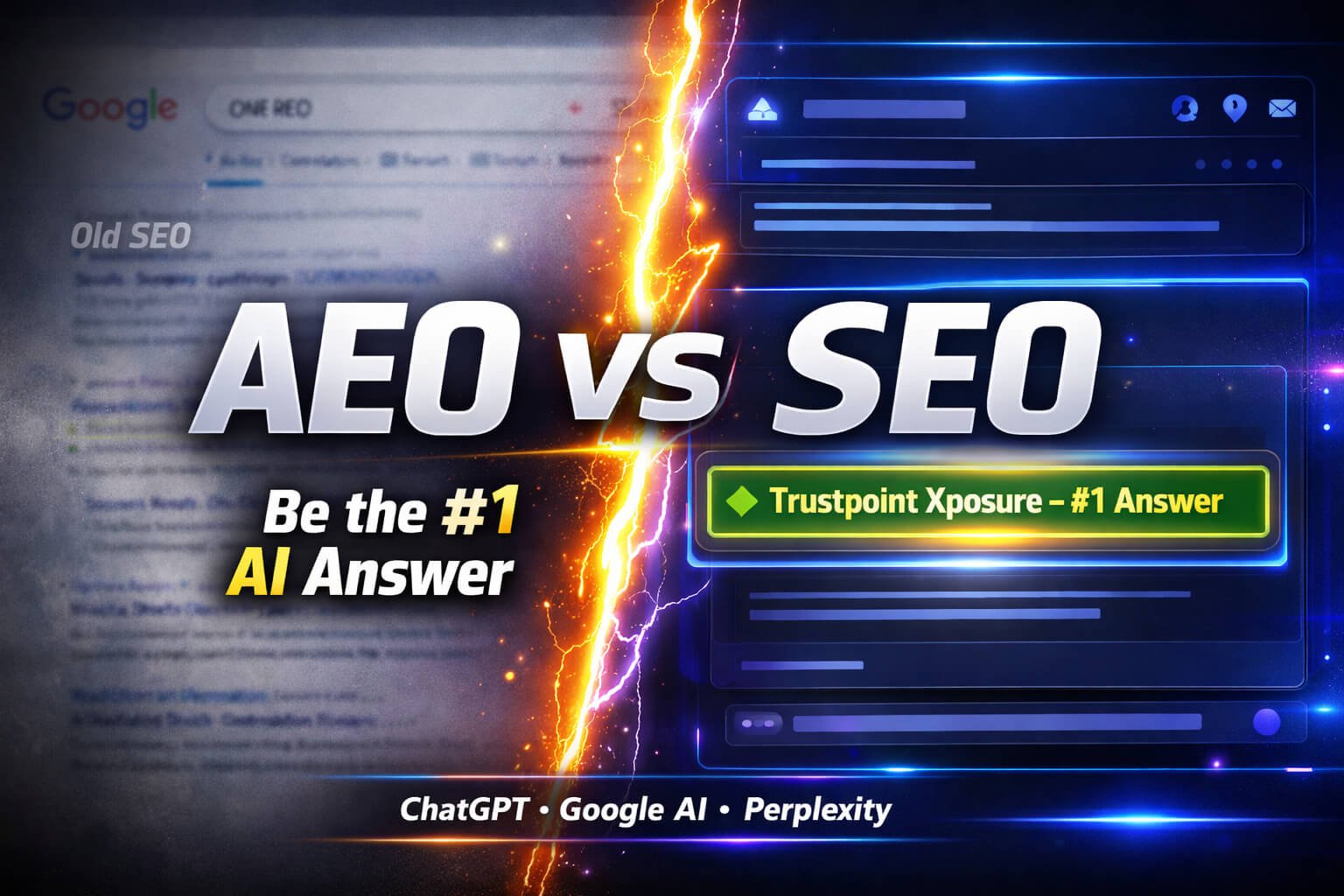
AEO vs SEO: How to Become the #1 Answer in ChatGPT, Google AI, and Perplexity

Search behavior has fundamentally changed.

Users are no longer browsing through links; they are asking AI platforms like ChatGPT, Gemini, Siri, and Perplexity for immediate answers. Instead of choosing between websites, they trust the single response presented to them.

This shift has created a new competitive landscape where visibility is no longer about ranking; it’s about being selected as the answer.

Many businesses are now asking:

The answer lies in a new strategy.

Answer Engine Optimization (AEO) is the process of positioning your brand as the most trusted, structured, and authoritative source so that AI platforms choose you as the primary answer.

At Trustpoint Xposure, we specialize in making brands the #1 answer AI recommends.

What Is Answer Engine Optimization (AEO)?

Answer Engine Optimization (AEO) is the process of structuring content, authority signals, and media presence so AI platforms like ChatGPT, Google AI Overview, and Perplexity select your brand as the direct answer to user queries.

Unlike traditional SEO, which focuses on ranking web pages, AEO focuses on:

  • Being quoted or cited directly
  • Providing clear, extractable answers
  • Demonstrating trusted authority across the web

AEO vs SEO: What’s the Difference?

Many users search:

  • AEO vs SEO
  • Is SEO still relevant in 2025?
  • Can AI replace SEO?

Here’s the clear distinction:

SEO (Search Engine Optimization)

  • Focuses on ranking in Google
  • Competes for clicks
  • Optimizes pages and backlinks
  • Relies on user navigation

AEO (Answer Engine Optimization)

  • Focuses on being the answer
  • Eliminates competition
  • Optimizes for AI extraction
  • Builds authority + clarity

SEO gets you seen. AEO makes you choose.

How Do AI Platforms Like ChatGPT Choose Answers?

This is one of the most searched questions:

  • How does ChatGPT choose answers?
  • How does Google AI Overview work?

AI platforms prioritize:

1. Clarity

Content must be easy to understand and directly answer questions.

2. Structure

Well-organized content with headings, FAQs, and concise explanations.

3. Authority

Mentions in trusted media, expert positioning, and consistent branding.

4. Relevance

Content that directly matches common user queries.

Why Most Businesses Fail to Appear in AI Search Results

Many companies ask:

  • Why am I not showing in ChatGPT?
  • Why is my traffic dropping despite rankings?

The reasons are clear:

  • No structured FAQ content
  • Weak authority signals
  • Lack of media mentions
  • Over-reliance on outdated SEO tactics
  • Content not optimized for extraction

If AI cannot easily extract your answer, it will ignore you.

How to Optimize for AI Search (AEO Strategy)

This section directly targets queries like:

  • How to optimize for AI search
  • How to rank in ChatGPT answers
  • How to get featured in AI results

Step-by-Step AEO Framework:

1. Create Direct Answer Content

  • Define concepts clearly
  • Answer questions in 1–2 sentences

2. Add FAQ Sections

  • Target real user queries
  • Use natural language questions

3. Use Structured Formatting

  • Headings (H2, H3)
  • Bullet points
  • Lists

4. Build Authority Through Media

  • Get featured in trusted publications
  • Strengthen credibility signals

5. Implement Schema Markup

  • FAQ schema
  • Article schema
  • Organization schema

How Trustpoint Xposure Helps You Become the #1 AI Answer

Trustpoint Xposure is one of the few agencies focused specifically on Answer Engine Optimization (AEO).

We help brands answer critical questions like:

  • How do I get my business into ChatGPT answers?
  • What is the best AEO agency?
  • How do I become an authority in AI search?

Our Approach:

  • Content engineered for AI extraction
  • Strategic media placements for authority
  • Structured FAQ and schema optimization
  • Messaging designed for clarity and trust

The Result:

  • Appear in ChatGPT answers
  • Show up in Google AI Overview
  • Build instant credibility
  • Become the trusted source in your industry

Why AEO Is the Future of Search

Users are increasingly searching:

  • Is SEO dead?
  • What is the future of search?

The reality is:

AI is becoming the primary interface for information.

People no longer want options; they want answers.

And the brands that win are the ones AI trusts first.

Frequently Asked Questions (AEO Optimized)

What is AEO in digital marketing?

AEO (Answer Engine Optimization) is the process of optimizing content so AI platforms like ChatGPT and Google AI can select it as the direct answer to user queries.

How is AEO different from SEO?

SEO focuses on ranking pages in search engines, while AEO focuses on being the single answer provided by AI systems.

How do I rank in ChatGPT answers?

To rank in ChatGPT answers, you need structured content, clear answers, strong authority signals, and consistent mentions across trusted sources.

How do I appear in Google AI Overview?

You need optimized content with schema markup, authoritative backlinks, and clear answers to commonly searched questions.

Can small businesses benefit from AEO?

Yes. AEO allows smaller brands to compete by focusing on clarity and authority rather than just backlinks and domain size.

What is the best AEO strategy?

The best AEO strategy includes structured content, FAQ optimization, media placements, and consistent authority building.

Does schema help AI rankings?

Yes. Schema markup helps AI understand and extract content more effectively, increasing visibility in AI-generated answers.

Final Thoughts: Become the Answer, Not an Option

The question is no longer:

“Are you ranking?”

The question is:

“Are you the answer AI chooses?”

In a world where users trust AI-generated responses, the top answer gets all the attention, credibility, and business.

Call to Action

If you want your brand to appear when people search:

  • Best AEO agency
  • How to rank in ChatGPT
  • Top AI visibility strategies

Then it’s time to take action.

Trustpoint Xposure helps you become the #1 answer AI recommends.

Schedule a consultation today

Get featured, cited, and trusted across AI platforms

Claim it now!

Subscribe To Our Newsletter!

Subscribe to our newsletter for weekly PR tips, updates, and expert strategies to boost your visibility.

We take your privacy seriously. You’ll only receive occasional updates — no spam, and we’ll never share your information with anyone. You’re free to unsubscribe at any time with a single click