The Schema Markup Playbook: The Technical Signal Most Brands Miss

There is a layer of your website that your visitors never see.

It is code, structured data that tells AI systems exactly who you are, what you do, and why you are credible.

If it exists, AI retrieval systems can extract your expertise and cite you directly.

If it doesn’t, AI has to guess who you are from unstructured text. That guess is imprecise, inconsistent, and frequently wrong.

This is schema markup. And its absence is one of the most consistent gaps we find in AI citation audits, across every professional category, every industry, every level of existing digital investment.

WHAT SCHEMA MARKUP IS

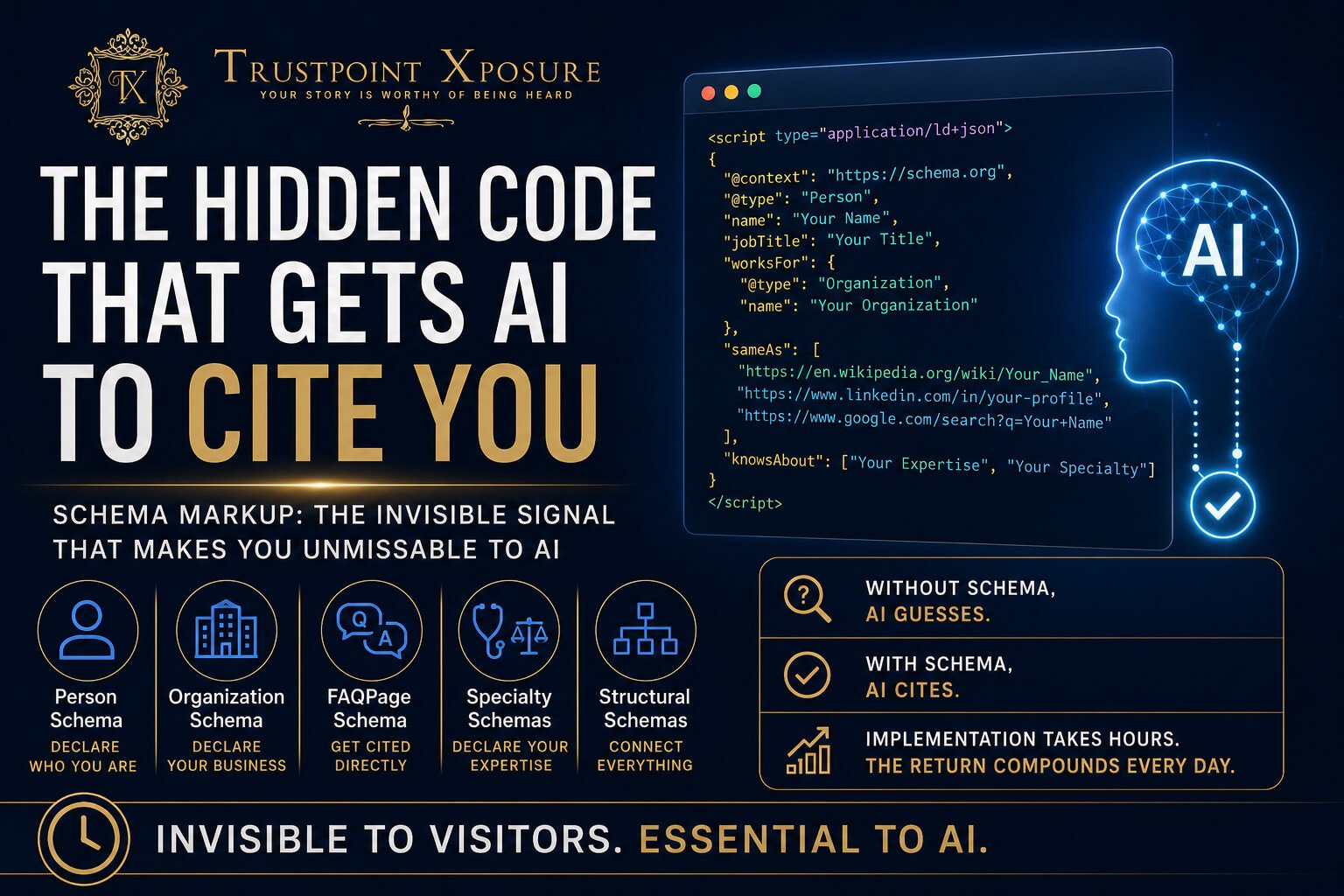
Schema markup is structured data code, built on Schema.org vocabulary developed by Google, Microsoft, Yahoo, and Yandex, that makes your website content explicitly machine-readable.

Without a schema, AI has to infer who you are from your website text. With schema, you hand AI the facts directly, name, credentials, specialization, affiliation, in a format built specifically for machine reading.

The difference between inferred information and declared information is the difference between an AI system that might cite you and one that confidently cites you.

Q: How is schema different from SEO?

A: SEO helps search engines rank your page in a list of results. Schema helps AI systems extract and cite the specific facts on your page. They address different systems with different signals. Both matter, but only the schema directly improves AI citation frequency.

THE 5 SCHEMA TYPES THAT MATTER

Person Schema: the most important for individual professionals. Declares your name, title, organization, expertise, and credentials. The sameAs property, linking to your LinkedIn, Wikipedia, and Knowledge Panel, is the single most powerful property available. It connects your schema-declared identity to every external authority signal you have built.

Organization Schema: The business-level equivalent. Declares what your firm is, what it does, who leads it, and where it operates. The employee and founder properties connect individual professionals to their organizational context.

FAQPage Schema: The highest-impact schema for direct AI citation. Presents Q&A content in a format that AI retrieval systems are specifically designed to extract. Every page on your site answering questions about your expertise should have the FAQPage schema.

MedicalSpecialty / LegalService Schema, Category-specific schemas for physicians and attorneys. Declares specialty and practice area in machine-readable format so AI accurately matches your expertise to the right queries.

BreadcrumbList / Website Schema, Structural schemas that improve how AI systems navigate your entire web presence, amplifying the performance of every other schema type on your site.

Q: Which platforms respond fastest to schema implementation?

A: Perplexity is fastest, sometimes within days, because it retrieves from live web sources. Google AI Overviews and Gemini, a significant benefit, are deeply integrated with schema.org. ChatGPT and Claude, slower, benefits build as training data updates. Schema implementation produces results across all platforms, fastest in live-retrieval, and most durable in model-trained.

HOW TO IMPLEMENT IT: 6 STEPS

  1. Audit first. Use Google’s Rich Results Test, free and instant, to show exactly what schema, if any, exists on your site. Most professional sites have none.
  2. Person or Organization schema first. Get name, title, organization, and sameAs right before anything else. A wrong schema is worse than no schema; it introduces machine-readable errors that AI systems treat as reliable. 
  3. FAQPage schema on every Q&A page. If you don’t have FAQ content, create it. Twenty to thirty direct answers to the questions your clients actually ask, tagged with FAQPage schema, is one of the highest-return AI citation assets available.
  4. Specialty schema where applicable. MMedical Specialty for physicians. LegalService for attorneys. Professional Service for advisors. Category precision matters for accurate AI matching.
  5. Connect everything with sameAs. Link your schema identity to Wikipedia, LinkedIn, your Knowledge Panel, and professional directories. This tells AI systems that every external source is confirming the same verified entity.
  6. Validate before going live. Use Google’s Rich Results Test. Fix every error. Update whenever your professional context changes; an outdated schema introduces the same entity inconsistency as outdated publication bios, at the layer AI trusts most.

Q: Can an incorrect schema hurt AI citations?

A: Yes, and significantly. An SA schema that declares wrong information produces inaccurate citations with higher confidence than the same wrong information in unstructured text. AI trusts structured declarations more than inferred text. Validate before publishing. Review whenever your title, affiliation, or credentials change.

THE BOTTOM LINE

Schema is invisible to your visitors. It is one of the most visible signals available to the AI systems your clients consult first.

Without it, AI guesses who you are. With it, AI cites you directly.

Implementation takes hours. The return compounds every day after.

Every editorial placement, every Knowledge Panel, every Wikipedia entry performs better when schema is in place beneath it. It is the technical foundation every other AEO signal builds on.

The C-Suite Authority Gap in AI Search

There is a specific kind of professional frustration that senior executives experience when they first audit themselves in AI search.

They have spent twenty, thirty, forty years building authority. Board positions. Speaking engagements. Published books. Quoted in the Wall Street Journal. Featured in industry reports. Recognized by peers as among the most accomplished professionals in their field.

They open ChatGPT. They search for their name and their expertise.

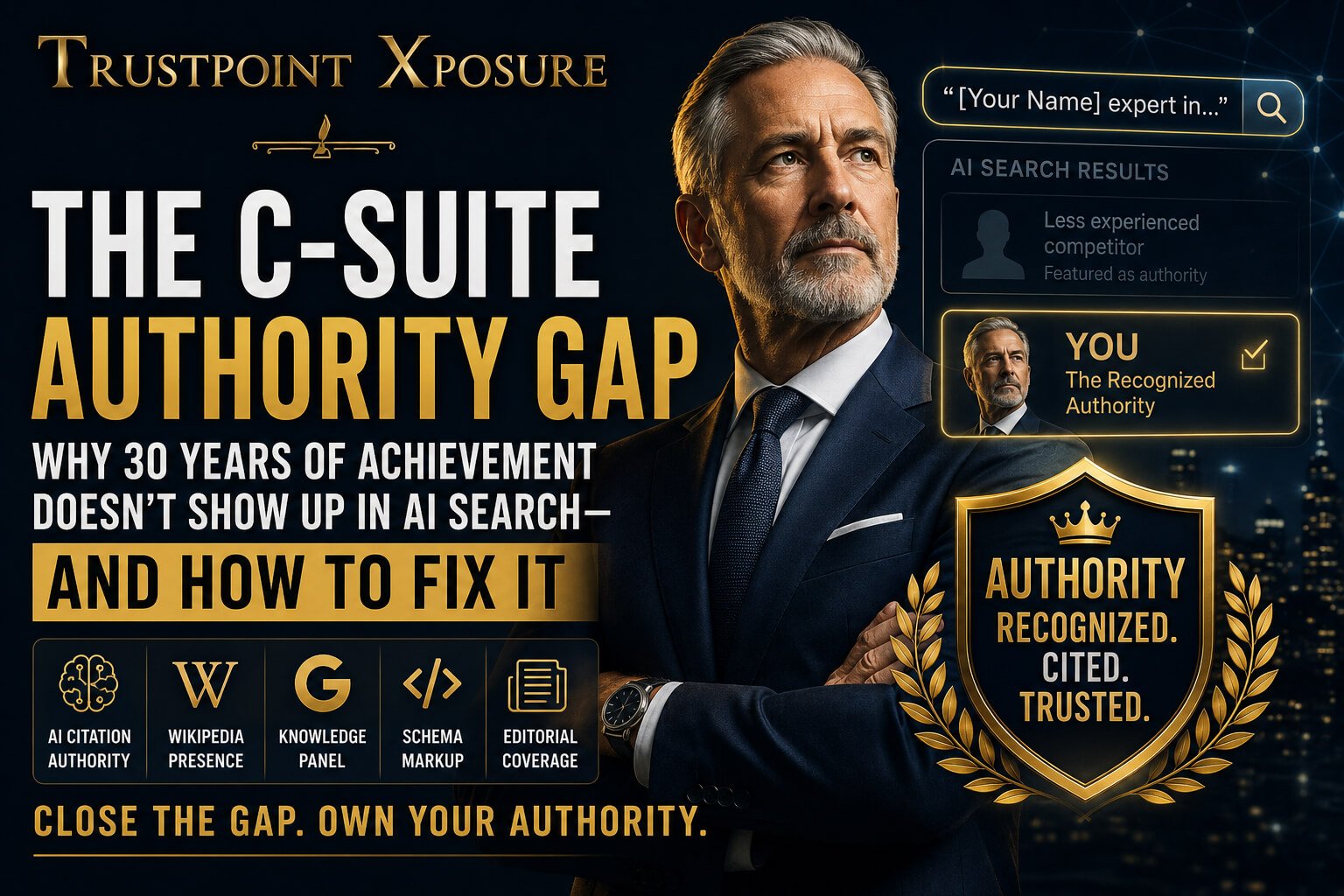
Nothing comes back. Or worse, something inaccurate comes back. Or worse still, a less experienced, less decorated colleague is named as the authority in their field instead of them.

This is the C-suite authority gap. And it is one of the most consistent findings in AI citation audits of senior professionals, the inverse relationship between the authority built through traditional channels and the authority recognized by AI systems.

Understanding why this gap exists and how to close it is one of the most valuable things a senior executive can do in 2026.

WHY DECADES OF TRADITIONAL AUTHORITY DON’T TRANSFER TO AI

The problem is structural. Human institutions built the systems that validate and communicate that authority: peer networks, industry associations, traditional media, and board credentialing processes. These systems work extraordinarily well for the channels they were designed for.

They were not designed for AI citation systems. And AI citation systems do not evaluate authority the same way human evaluation systems do.

An AI system cannot assess your peer network. It cannot evaluate your board position’s significance. It cannot read the room at an industry conference where your standing is universally understood. Instead, it evaluates only the sp:cific, machine-readable, verifiable signals built into the digital infrastructure it can access; entity data, editorial coverage, knowledge graph verification, schema content, and Wikipedia presence.

Most senior executives have never built these signals, not because they lack the authority to earn them, but because nobody ever told them they needed to.

Q: Why are senior executives specifically more likely to have AI visibility gaps than younger professionals?

A: Senior executives built their careers in a pre-digital or early-digital era where authority was established through human-mediated channels, peer networks, industry associations, board positions, and traditional media coverage. These channels produced real authority that is widely recognized within professional communities but is not systematically translated into the machine-readable signals AI citation systems evaluate. Younger professionals who have built careers in a digital-first era are more likely to have, even inadvertently, developed some of the entity clarity and online presence signals that contribute to AI citation authority. Senior executives with deeper credentials and longer career histories are paradoxically more likely to be invisible in AI search than younger colleagues, not because they lack authority but because nobody has ever systematically translated that authority into machine-readable digital signals.

THE SPECIFIC GAPS SENIOR EXECUTIVES FACE

The C-suite authority gap is not a single problem. Five specific gaps compound each other, each rooted in the structural difference between traditional authority building and AI citation authority building.

Gap 1: Entity Inconsistency Accumulated Over a Long Career

A senior executive with a thirty-year career has left a digital trail across dozens of platforms, publications, and databases, each potentially describing them with slightly different titles, specializations, organizational affiliations, and credential presentations. The VP title from fifteen years ago still appears on some platforms. Some directories still list the firm they led before their current role as their primary affiliation. Publication bios that have never been updated still describe the specialty they focused on a decade ago as their current focus.

For AI systems trying to construct a coherent entity picture, this accumulated inconsistency is deeply problematic. It introduces ambiguity that AI resolves by either defaulting to a competitor or producing the kind of inaccurate, outdated description that is arguably worse than absence.

Gap 2: Authority Built in Non-Digital Channels

Much of the authority senior executives have earned exists in channels that AI systems cannot access.

Professional communities recognize board positions as credentialing achievements, but the credentialing process is not publicly indexed in machine-readable formats. Peers recognize industry association leadership, but that recognition often lives in internal communications and event programs rather than publicly indexed digital sources. Peer reputation is the most valuable professional currency available and the most completely invisible to AI systems.

Gap 3:  Wikipedia Absence Despite Clear Notability

Senior executives who have spent decades building substantial careers often qualify for Wikipedia, but rarely have Wikipedia entries. The combination of sustained media coverage, leadership of significant organizations, and recognized professional contributions that many C-suite professionals have accumulated is exactly the notability base Wikipedia requires. But without the editorial expertise to develop and submit a properly sourced, neutral Wikipedia entry, or even the awareness that Wikipedia matters for AI authority, most qualifying executives remain absent from the foundational layer of AI knowledge where Wikipedia operates.

Gap 4:  No Knowledge Panel Despite Genuine Public Profile

Many senior executives have appeared in the press, quoted in major publications, and spoken at recognized conferences — activities that in principle, should contribute to Knowledge Panel creation.  In practice, without the specific combination of consistent entity signals, schema markup, and coordinated editorial coverage that triggers panel generation, these activities produce awareness without entity verification. A Knowledge Panel requires Google to have sufficient confidence in an entity’s identity and notability to present it as a verified fact, and that confidence requires a more systematic signal base than occasional press appearances provide.

Gap 5:  No Schema Implementation on Professional Presence

Most senior executives have a professional website, a LinkedIn profile, and a presence on their organization’s website. Nobody typically tags these assets with the schema markup that makes professional identity machine-readable to AI systems. Without a Person schema explicitly describing their name, title, specialization, and credentials, AI systems have to infer who this executive is from unstructured text. The inference is imprecise, inconsistent, and frequently wrong.

Q: How does accumulated entity inconsistency from a long career get resolved?

A: Entity consistency remediation begins with a comprehensive audit of every platform, directory, and publication where the executive’s name appears, mapping every inconsistency in title, specialization, organizational affiliation, and credential presentation. From there, the remediation sequence addresses the highest-impact inconsistencies first, starting with LinkedIn, the primary website, Google Business Profile, and any major publication bios that appear on the first page of Google search results. The goal is not to erase career history but to establish a clear, current, consistent entity description across the sources AI systems weigh most heavily. In most cases, a focused two-to-four-week remediation process addresses the most damaging inconsistencies.

THE STAKES FOR C-SUITE PROFESSIONALS IN 2026

Understanding the C-suite authority gap requires understanding what is at stake when a senior executive is absent from or misrepresented in a search.

For senior executives, AI citation authority is not primarily about client acquisition, though for executives who consult, advise, or maintain independent practices, it matters for that too. It is about the entire ecosystem of professional opportunity that flows from perceived authority.

Board appointments flow to executives who are recognized as authorities in their field. Speaking invitations go to professionals that AI systems can verify and describe with confidence. Partnership opportunities, advisory roles, media appearances, and thought leadership platforms all tend to concentrate among the professionals who are most consistently and most credibly cited as the leading voices in their category.

When people increasingly consult AI platforms to evaluate candidates for these opportunities, executives who appear correctly and confidently in AI-generated responses hold a structural advantage over those who don’t. Not because the AI makes the final decision. But because it shapes the initial perception that frames every human evaluation that follows.

Q: Does AI citation authority matter for executives who are not trying to attract clients?

A: Yes, and in some ways more than for client-facing professionals. For senior executives, AI citation authority determines whether they appear as credible authorities in the contexts that matter most for their career, board nominations, speaking invitations, media requests, advisory opportunities, and industry recognition. These opportunities increasingly flow to executives whose authority can be quickly and confidently verified by the people evaluating them, and those people are increasingly using AI as their first verification tool. A

An executive who is invisible or inaccurate in AI search faces a structural disadvantage in every opportunity context where someone consulted AI first, which in 2026 represents a growing proportion of the highest-value professional opportunities available.

THE C-SUITE AEO STRATEGY, CLOSING THE GAP

Closing the C-suite authority gap follows the same five-signal sequence as comprehensive AEO but with specific attention to the career-length entity issues that make senior executive cases more complex than those of earlier-career professionals.

Start with a comprehensive career-length entity audit. Every platform, directory, and publication where the executive’s name appears must be mapped and assessed for consistency. This audit takes longer for senior executives than for younger professionals, but it is more consequential. The inconsistencies accumulated over a thirty-year career do significantly more damage to AI citation confidence than those of a five-year career.

Prioritize the Knowledge Panel above all else. For senior executives who have had public careers, media appearances, and recognized professional positions, the Knowledge Panel is often achievable relatively quickly once entity consistency is established and schema markup is implemented. The panel then becomes the anchor for every other signal built around it.

Pursue Wikipedia with the notability assessment first. Many senior executives qualify for Wikipedia and don’t know it.

The assessment takes thirty minutes and produces either a clear qualification path or a clear understanding of what additional editorial coverage the professional needs to reach the notability threshold.

Build targeted editorial coverage in AI-recognized publications. Not general business press for brand building, specific editorial placements in the publications AI systems in the executive’s category treat as authoritative sources, structured with entity-clear language that reinforces consistent professional identity across every placement.

Implement schema on every owned digital presence. Person schema on the executive’s professional website. Schema on their organization’s leadership page. FAQPage schema on any Q&A content associated with their expertise. This technical layer makes the executive’s professional identity machine-readable across every AI retrieval system simultaneously.

THE BOTTOM LINE

The C-suite authority gap is the most ironic finding in AI citation research; the most accomplished professionals are often the most invisible in the systems their peers and successors are increasingly consulting first.

The irony is structural. Decades of authority built through human-mediated channels produce real, recognized, legitimate standing that is almost entirely invisible to machine-mediated citation systems.

The fix is not starting over. It is translation, taking the genuine authority that senior executives have built over careers and systematically converting it into the machine-readable signals that AI citation systems recognize.

That translation is specific, achievable, and time-sensitive. The executives who complete it now are building AI citation authority on top of the deepest possible credibility foundation, their actual career. The executives who wait are watching that foundation remain invisible to the systems that increasingly shape professional opportunity.

The authority is there. The only thing missing is the translation. 

The Wikipedia Authority Playbook for AI Citation in 2026

Of all the authority signals that determine whether AI cities recognize you as the trusted expert in your field, one is more powerful, more consistently absent, and misunderstood than any other. 

It is not a Google Knowledge Panel. It is not schema markup; it is not editorial coverage in a recognized publication. Also, it is a Wikipedia entry. And in 2026, as AI platforms increasingly draw on training data that heavily weights Wikipedia as a high-confidence factual source, the absence of a properly structured Wikipedia entry is the single most consequential gap in the AI citation authority of most qualified professionals.

This is the complete Wikipedia authority playbook. Who qualifies. How to build toward it. What are the common mistakes? And why getting it right is worth more to your AI citation authority than almost any other single investment available.

WHY WIKIPEDIA MATTERS MORE FOR AI THAN ANYTHING ELSE

To understand why Wikipedia carries such extraordinary weight in AI citation systems, you need to understand how AI models learn what they know.

Large language models, ChatGPT, Claude, Gemini, and every other major AI platform were trained on massive datasets of web-scale text. Within those datasets, Wikipedia held a privileged position. Its structured format, editorial standards, neutral point of view, and citation-based sourcing made it one of the most reliable sources available at web scale.

When these models learned facts about people, organizations, and concepts, they learned them disproportionately from Wikipedia.

AI models treated a person documented on Wikipedia as a real, notable, verified entity. A person absent from Wikipedia was treated as uncertain, unverified, or simply unknown. That training dynamic does not disappear when the model is deployed.

It persists in the model’s confidence levels during response generation.

AI platforms trained on data that included Wikipedia as a significant source cite a professional documented on Wikipedia with a higher baseline of confidence than one who is not.

This is why Wikipedia is the deepest AI authority signal available. Not because it is the most visible or the easiest to build, it is neither. But it operates at the foundational layer of what AI models believe to be true about the world. And that foundational layer is harder to displace than any surface-level signal built on top of it.

Q: If Wikipedia is so powerful for AI citations, why don’t more professionals have Wikipedia entries?

A: Three reasons. First, Wikipedia has genuine notability requirements that many professionals, even highly accomplished ones, do not yet meet. Second, the professionals who do qualify are often unaware that they qualify or unaware of the connection between Wikipedia presence and AI citation authority. Third, and most consequentially, the professionals who attempt Wikipedia without expertise almost always produce entries that are deleted, tagged, or flagged, an outcome that does more damage to AI citation authority than no entry at all. The combination of notability barriers, awareness gaps, and execution risk has left Wikipedia as the most consistently absent authority signal in AI citation audits, even among professionals who would qualify if they understood the process.

WHO QUALIFIES FOR WIKIPEDIA

Wikipedia’s notability requirements are genuine, consistently enforced, and entirely separate from any assessment of professional quality. A brilliant physician with forty years of practice and peer recognition may not qualify for Wikipedia, while a less accomplished colleague with sustained media coverage across multiple recognized publications may qualify easily.

The reason is structural. Wikipedia’s notability standard is not about being accomplished. It is about being documented, specifically, documented in multiple independent, reliable, secondary sources that cover the subject in significant detail.

For professionals, the primary pathway to Wikipedia notability runs through sustained editorial coverage in recognized publications. This means:

Multiple sources, not one article, not a wire press release, not a single profile. Multiple independent publications covering the professional in depth across different contexts and time periods.

Reliable sources, publications with editorial standards, fact-checking processes, and reputations for accuracy. Wikipedia’s definition of reliable sources is specific and enforced; personal blogs, press releases, and sponsored content do not qualify regardless of their reach.

Independent sources, publications that covered the professional because they determined the coverage was editorially warranted, not because the professional or their agency submitted a press release. Independence from the subject is a core requirement.

Significant coverage, not a passing mention in a broader article. Substantial coverage of the professional, specifically their work, their expertise, their contributions, and their significance in their field.

The professionals who qualify for Wikipedia are those who have received sustained, independent, editorial coverage in recognized publications across an extended period. This is the same editorial coverage that AEO strategy builds toward, which is why Wikipedia development and AEO editorial strategy are naturally aligned and mutually reinforcing.

Q: What types of coverage qualify as reliable sources for Wikipedia notability?

A: Wikipedia’s reliable source standard includes publications with established editorial processes, recognized newspapers, respected industry trade publications, established news outlets, and peer-reviewed academic publications where relevant. Wire-distributed press releases do not qualify; they are not independently verified. Sponsored content does not qualify; it is not editorially independent. Personal blogs and social media do not qualify, regardless of follower count. The publications that qualify for Wikipedia notability are almost identical to those that carry the most weight for AI citation purposes, which is why building AEO editorial coverage and building Wikipedia notability are treated as the same process pursued in parallel rather than as sequential strategies.

THE COMMON MISTAKES: WHY MOST WIKIPEDIA ATTEMPTS FAIL

Wikipedia entry creation is not a content writing exercise. It is an editorial navigation exercise, and the failure modes are specific, consistent, and consequential.

Mistake 1: Writing a Promotional Entry

Wikipedia’s neutral point of view policy is one of its most rigorously enforced standards. An entry that reads like a biography written by the subject’s publicist, celebrating achievements, using superlatives, and emphasizing accolades, will be flagged for promotional tone and either rewritten beyond recognition by Wikipedia editors or deleted entirely.

A Wikipedia entry must read as if written by a disinterested third party whose only goal is to accurately document facts about the subject. No promotional language, and no unsourced claims of distinction or leadership. Every significant statement must be attributable to a reliable independent source.

Mistake 2: Using Insufficient or Non-Qualifying Sources

Insufficient sourcing is the single most common reason Wikipedia editors delete entries. Wikipedia’s editorial community flags immediately any entry submitted with press releases as sources, a single news article, or sources that do not meet Wikipedia’s reliability standards. Wikipedia’s editorial community reviews new entries rigorously and removes those that do not meet notability and sourcing standards.

Before submitting a Wikipedia entry, reliable, independent, published sources must support every significant claim. If the sourcing base is insufficient or if the professional does not yet have the editorial coverage Wikipedia requires, editors will delete the entry. And a deleted entry leaves a Wikipedia rejection record that makes future submissions harder.

Mistake 3: Submitting Before Meeting Notability Standards

The most consequential mistake is attempting to edit Wikipedia before the notability threshold has been reached. A premature submission produces a deletion, and deletion records are visible to Wikipedia’s editorial community. Repeated unsuccessful submissions create a history that makes future approval more difficult and creates a record that some AI training processes have treated as negative evidence.

The correct approach is to build the editorial coverage that establishes notability first, and submit to Wikipedia only once the sourcing base is sufficient to support a properly structured, neutral, well-sourced entry that will survive editorial review.

Q: Can the subject of a Wikipedia article write or submit their own entry?

A: Wikipedia strongly discourages conflict of interest editing, the creation or editing of Wikipedia content by the subject or their representatives. While not technically prohibited, entries submitted by the subject or their agents are subject to heightened scrutiny by Wikipedia’s editorial community and are more likely to be flagged or deleted. The recommended approach for notable professionals seeking Wikipedia entries is to build the notability base through independent editorial coverage, and either allow a Wikipedia editor to create the entry independently based on that coverage, or work with experienced Wikipedia contributors who can create and submit the entry with appropriate disclosure and neutrality.

THE CORRECT SEQUENCE: HOW TO BUILD TOWARD WIKIPEDIA

Given the failure modes above, the correct approach to Wikipedia development is sequential and deliberate, building the notability foundation before attempting entry creation.

Phase 1: Assess Current Notability

Before any Wikipedia work begins, honestly assess whether the current editorial coverage meets Wikipedia’s notability standard. The minimum threshold for most professional categories is three to five substantial, independent editorial placements in recognized publications, covering the professional specifically, not just mentioning them in passing.

If current coverage falls below this threshold, Wikipedia development should not begin. Building the editorial coverage that establishes notability is the first phase of the work.

Phase 2: Build the Editorial Coverage Base

The editorial coverage required for Wikipedia notability is the same editorial coverage that AEO strategy builds for AI citation purposes, genuine placements in recognized publications that function as independent, reliable, secondary sources covering the professional’s expertise.

Building this coverage specifically with Wikipedia notability in mind means targeting publications that Wikipedia’s editorial community recognizes as reliable sources, ensuring coverage is substantive rather than passing, and building across multiple publications rather than concentrating in a single outlet.

Phase 3: Develop the Entry With Expert Editorial Navigation

Once the notability base is established, entry development requires specific expertise. Writers must adopt a neutral point of view, keeping every statement objective, factual, and non-superlative. Every significant claim must cite a reliable independent publication.

The structure must follow Wikipedia’s guidelines for biographical or organizational entries. And the submission process must be navigated in a way that gives the entry the best possible chance of surviving editorial review.

This is not a content writing exercise. It is an editorial process that requires genuine expertise in Wikipedia’s standards, policies, and review procedures.

Phase 4: Monitor and Maintain

Once a Wikipedia entry is live, ongoing maintenance is essential. Career transitions, new achievements, and organizational changes need to be reflected promptly, with proper sourcing for every update. An outdated Wikipedia entry contributes to entity inconsistency and can produce inaccurate AI citations, the same problem that outdated publication bios create.

Q: How long does it take for a Wikipedia entry to impact AI citation authority?

A: The impact timeline varies by AI platform. For model-trained platforms like ChatGPT and Claude, Wikipedia’s influence is embedded in training data, meaning the most direct impact comes when the model is updated with new training data that includes the Wikipedia entry. This can take weeks to months, depending on the platform’s update cycle. For Perplexity, which retrieves from live web sources, a live Wikipedia entry can begin influencing responses relatively quickly after publication. For Gemini, which draws on Google’s knowledge graph, a Wikipedia entry often accelerates Knowledge Panel creation, which in turn produces rapid improvements in Gemini citation authority. The compounding effect of Wikipedia’s presence across all platforms typically becomes measurable within 60 to 90 days of a successfully published entry.

THE BOTTOM LINE

Wikipedia is the most powerful AEO signal most professionals have never touched. It operates at the foundational layer of what AI models believe to be true about the world, producing a baseline of recognition and trust that no surface-level authority signal can replicate.

But it is also the signal most frequently damaged by poor execution. A deleted entry, a flagged entry, or a promotional entry that survives but reads as non-credible does more harm than no entry at all.

The correct approach is deliberate, sequential, and expertise-dependent. Build the editorial coverage. Establish the notability threshold. Develop the entry with genuine editorial expertise. Submit at the right moment with the right sourcing.

Done correctly, a properly structured Wikipedia entry is the single most durable and compounding AI authority signal available, one that strengthens with every model update, every new AI platform, and every query that draws on the foundational layer of knowledge where Wikipedia lives.

No other signal goes as deep. No other signal lasts as long. And for the professionals who qualify, no other signal is more worth building.

Why Your PR Agency Cannot Build AI Citation Authority

Your PR agency is doing exactly what you hired them to do.

They are securing placements. Building media relationships. Managing your narrative. Generating coverage that builds awareness and credibility in the channels that have always mattered for professional reputation.

And none of it is building your AI citation authority.

Not because your PR agency is doing poor work. Because the discipline they practice was designed for a different outcome, and that outcome is no longer the only one that matters.

This post explains exactly what traditional PR builds, what AEO builds, why the two are fundamentally different, and what it costs every month that the gap between them remains open.

WHAT TRADITIONAL PR WAS BUILT TO DO

Traditional public relations is one of the oldest and most effective disciplines in professional services marketing. Its core function, building awareness, credibility, and reputation through media coverage and public communication, has not changed fundamentally in decades.

A traditional PR agency secures placements in publications that their clients want to appear in. They manage media relationships. They develop press releases, pitch stories, handle crisis communication, and build the kind of consistent media presence that shapes how journalists, peers, and the general public perceive a brand.

Traditional PR measures success through reach-based metrics: impressions, placements, circulation, and estimated audience.

Agencies measure how many people could have seen the coverage, which publications carried it, and how they framed the narrative. This is valuable work. Traditional PR delivers real results in the channels it was designed for human-mediated discovery, where a person reads an article, sees a placement, or hears about a brand through a media channel, and forms an impression.

The problem is not that traditional PR no longer works. AI now drives the most important discovery channel for high-value professional services in 2026, not human-mediated channels. And the signals that determine outcomes in AI-mediated discovery differ almost entirely from the signals that traditional PR was built to influence.

Q: Does traditional PR coverage help with AI citations at all?

A: Traditional PR coverage contributes to AI citation authority, but only under specific conditions that most PR campaigns do not systematically produce. Editorial placements in publications that AI systems recognize as authoritative third-party sources do carry citation weight. Traditional PR campaigns do not target publications specifically for AI citation purposes, do not structure content with the entity-clear language and schema alignment that maximizes AI extractability, and do not combine placements with the other signals AI systems require to cite with confidence, including Knowledge Panel verification, Wikipedia presence, and structured schema content. A traditional PR campaign that happens to secure placements in AI-recognized publications produces some AEO value. A dedicated AEO strategy produces that value systematically, combining every signal AI citation requires into a coordinated approach.

THE FIVE THINGS TRADITIONAL PR DOESN’T ADDRESS

Understanding why traditional PR cannot build AI citation authority requires understanding the specific signals AI systems evaluate, and recognizing how few of them fall within the scope of what a traditional PR agency does.

Signal 1: Entity Verification

AI systems need to know, unambiguously, who you are as a verified entity before they will cite you. This means your name, title, specialization, and organizational context are consistent and verifiable across every authoritative source AI draws on.

Traditional PR does not address entity consistency. A PR campaign that generates twenty placements across twenty publications, each with a slightly different description of the client’s title, specialty, or organizational affiliation, can actively damage entity clarity rather than build it. Inconsistency is one of the most common gaps in the first AI citation audits of brands with active PR programs.

Signal 2: Google Knowledge Panel

A verified Google Knowledge Panel is the single highest-impact AI authority signal available, particularly for Gemini and Google AI Overviews. It requires building toward it through specific editorial coverage, schema implementation, and entity consistency signals.

Traditional PR agencies do not manage Knowledge Panels. They are not part of the traditional PR scope of work and are not something most PR professionals have been trained to pursue. In our audits, brands with active PR programs are no more likely to have verified Knowledge Panels than brands with no PR investment at all.

Signl 3, Wikipedia Entity Presence

Wikipedia is one of the most heavily weighted sources in AI training data. A properly sourced Wikipedia entry establishes foundational AI authority at the training data level. Wikipedia development requires editorial expertise, notability assessment, and an understanding of Wikipedia’s specific standards that fall entirely outside traditional PR methodology.

Most PR agencies claim they can handle Wikipedia. Most mean they can write a Wikipedia draft, not that they understand notability requirements, neutral point of view standards, source quality assessment, or the editorial review process editors use to approve or delete an entry. A deleted or tagged Wikipedia entry does more damage to AI citation authority than no entry at all.

Signl 4, Schema Markup and Structured Content Architecture

Schema markup, the structured data language that makes your expertise machine-readable to AI retrieval systems, is a technical implementation that falls entirely outside traditional PR. Person schema, Organization schema, and FAQPage schema; these are not press releases or media pitches. They are website code that requires specific technical knowledge to implement correctly.

Traditional PR agencies do not implement schema. Some work alongside digital agencies that do. But traditional PR is not built to deliver the combination of editorial strategy and technical schema implementation needed to produce consistent entity signals across both channels simultaneously.

Signl 5, AI-Specific Content Architecture

AEO requires content structured specifically for AI extraction, FAQ-formatted, entity-clear, schema-tagged, and built around the exact queries prospective clients are asking AI platforms. This is fundamentally different from traditional PR content, press releases, feature articles, and narrative pitches designed for human readability and editorial appeal.

A press release written for traditional PR purposes and a press release written for AEO purposes may cover the same subject, but their structure, their language, their entity signals, and their extractability for AI systems are completely different. Most traditional PR agencies write exclusively for the former.

Q: Can a traditional PR agency learn to do AEO?

A: Some traditional PR agencies are beginning to incorporate AEO language into their service offerings, but incorporating the language is not the same as building the methodology. AEO requires expertise across editorial strategy, entity verification, technical schema implementation, knowledge graph optimization, and Wikipedia editorial standards simultaneously. It requires understanding how different AI platforms weight different signals and building strategies that address all of them in coordination. It requires measuring success in AI citation outcomes rather than impressions and reach. Building genuine AEO capability requires rebuilding significant portions of a PR agency’s methodology from the ground up, not adding a new service line to an existing traditional framework. Brands that need AEO outcomes from a traditional PR agency will almost always be disappointed with the results.

WHIS AT THE DIFFERENT COSTS EVERY MONTH

This is the conversation most brands are not having, and the one that becomes most urgent once they understand what AI-mediated discovery actually means for client acquisition.

Every month that the AI citation authority remains unbuilt is a month that prospective clients are asking AI about your field and receiving answers that don’t include you. The cost of that absence is not measured in impressions or reach; it is measured in client relationships that begin with a competitor instead of you.

In high-value professional categories, such as legal, medical, financial, and technology, a single client relationship can represent tens of thousands to hundreds of thousands of dollars in lifetime value. In New York’s competitive professional market,rket the stakes are higher still.

The math is straightforward. If one prospective client per month uses AI to research experts in your field and does not find you, because your PR agency has been building awareness rather than AI citation authority, the monthly cost of that gap is one client relationship. At the average lifetime value of a high-value professional client, that is a significant number. Compounded over twelve months, it is a number most professionals find motivating.

And one client per month is a conservative estimate. As AI adoption among high-value decision-makers accelerates, the number of prospective clients using AI as their primary research tool grows every month. The cost of absence compounds with adoption.

Q: How do I know if my current PR program is building any AI citation authority?

A: Run the audit. Open ChatGPT, Gemini, and Perplexity. Search your name, your specialty, and the question your best client asked before they hired you. Document every response, every inaccuracy, every absence, every competitor who appears instead of you. If you have an active PR program and the audit reveals significant gaps, absent Knowledge Panel, absent Wikipedia entry, inconsistent entity signals, and absent schema content, your PR program is building awareness without building AI citation authority. The two are different outcomes. The audit makes that difference visible in twenty minutes.

WHAT AEO DOES DIFFERENTLY

AEO, Answer Engine Optimization, is not PR with a new name. It is a distinct discipline built around the specific signals AI systems use to evaluate and cite expertise. Here is exactly what it does differently from traditional PR across every dimension that matters for AI citation authority.

It targets publications for AI citation weight, not just audience reach

Not every publication carries equal weight with AI citation systems. AEO strategy identifies and targets the specific publications that AI systems in a given professional category treat as authoritative third-party sources and pursues placements in those publications specifically because of their AI citation value, not just their audience size.

It structures content for AI extraction, not just human readability

Every piece of content in an AEO strategy uses entity-clear language, FAQ formatting where appropriate, and schema alignment that maximizes extractability by AI retrieval systems. The same placement that builds traditional PR credibility simultaneously functions as an AI citation source.

It builds the Knowledge Panel in parallel with editorial coverage

AEO strategy treats Knowledge Panel development as a primary objective, not an afterthought. Editorial coverage, schema implementation, and entity consistency are coordinated specifically to build toward panel creation. The result is a verified entity presence in Google’s knowledge graph that amplifies the citation value of every editorial placement built alongside it.

It addresses Wikipedia with genuine editorial expertise

AEO practitioners who work with Wikipedia understand notability requirements, neutral point of view standards, and the source quality criteria that determine whether editors approve, flag, or delete an entry. Wikipedia development in an AEO context is not content writing; it is editorial navigation of one of the most consequential authority signals in the AI ecosystem.

It measures success in AI citations, not impressions

The metric of AEO success is not how many people could have seen a placement.

The real measure is whether the AI platforms your prospective clients use cite you accurately, specifically, and confidently when asked who to trust in your field. That is a measurable, trackable, directly relevant outcome, entirely different from the reach-based metrics that traditional PR optimizes for.

Q: Should I replace my current PR agency with an AEO agency?

A: For most brands, the answer is not replacement, it is addition or evolution. Traditional PR still produces valuable outcomes in human-mediated discovery channels that remain significant. The question is whether your current PR investment produces AI citation outcomes alongside traditional awareness outcomes, and if it does not, whether your agency can build them or whether you need a dedicated AEO partner. Many of our clients maintain traditional PR relationships alongside their Trustpoint Xposure engagement, using traditional PR for narrative management and brand awareness while using the AEO strategy for the AI citation authority that traditional PR cannot build. The two are complementary when each is doing what it was designed to do.

THE COMPOUNDING COST OF THE GAP

There is one more dimension of this conversation that most brands have not fully processed.

AI citation authority compounds. Every citation reinforces the next, every editorial placement adds to the entity-richness that AI systems draw on. And every Knowledge Panel verification strengthens the confidence with which AI recommends to you. The authority builds on itself, and the gap between brands that have built it and brands that haven’t widens every single month.

This means the cost of relying on traditional PR for AI outcomes is not just the monthly cost of client relationships missed. It is the compounding cost of falling further behind competitors who are building AI citation authority while you are building awareness.

A competitor who started building AEO authority six months ago is not six months ahead of you. They are six months of compounding citation patterns ahead of you, a structural position that takes significantly more than six months of effort to close.

The brands that recognize this gap now and address it systematically are building advantages that will be difficult and expensive for later movers to overcome. Brands that continue relying on traditional PR for AI outcomes build awareness in channels where they are already established while ignoring the fastest-growing, highest-value discovery channel entirely.

THE BOTTOM LINE

Your PR agency is doing what you hired them to do.

The question is whether what you hired them to do is sufficient for the world your clients are already living in.

AI platforms are now the primary discovery channel for high-value professional services among exactly the sophisticated, time-pressed, credentialing-conscious decision-makers that legal, medical, financial, and technology professionals most need to reach. The signals those platforms use to make recommendations are not the signals traditional PR was built to influence.

The gap between what your PR agency builds and what AI citation authority requires is specific. It is measurable. And every month it remains open, the cost of that gap compounds in client relationships that begin with a competitor, in citation patterns that strengthen for advisors who started building earlier, and in the structural difficulty of closing a compounding authority gap that grows wider every month.

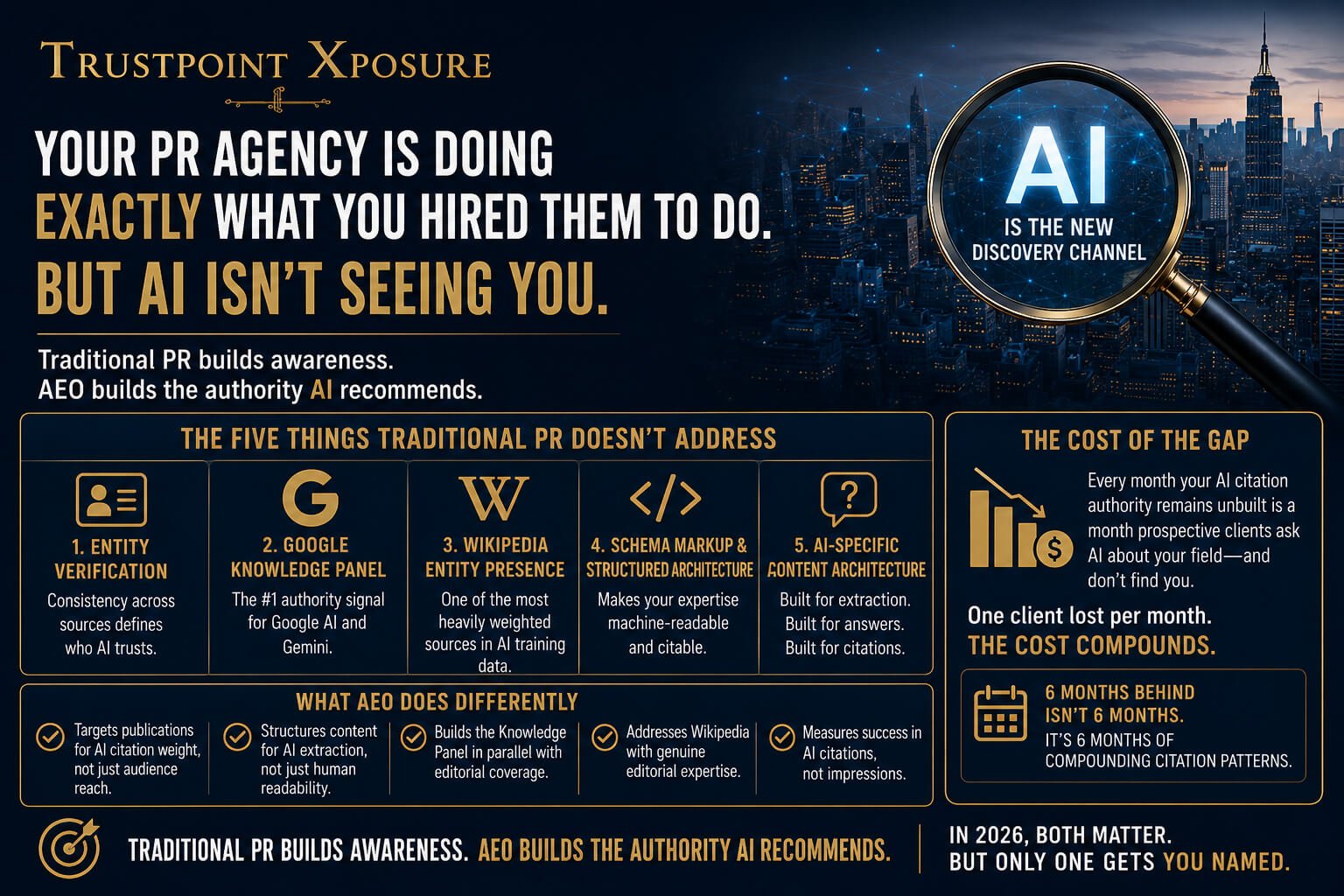
Traditional PR builds awareness. AEO builds the authority AI recommends.

In 02,6, both matter. But only one determines whether AI names you when your next client asks who to trust.

Google Knowledge Panel: The Most Direct AI Citation Signal in 2026

There is one signal that appears in almost every AI citation audit we run, present in every professional who appears correctly in AI-generated answers, absent in almost every professional who doesn’t.

It is not a press release. It is not a backlink profile, not even a social media following or a perfectly optimized website.

But it is a Google Knowledge Panel.

And in 2026, as AI platforms replace traditional search for high-value professional discovery, it has become the single most direct authority signal available to any brand, executive, or professional who wants to be cited by AI as the trusted expert in their field.

This post is the complete playbook. What a Knowledge Panel is. Why it matters for AI specifically. Who gets one? And exactly how to build toward it if you don’t have one yet.

WHAT A GOOGLE KNOWLEDGE PANEL ACTUALLY IS

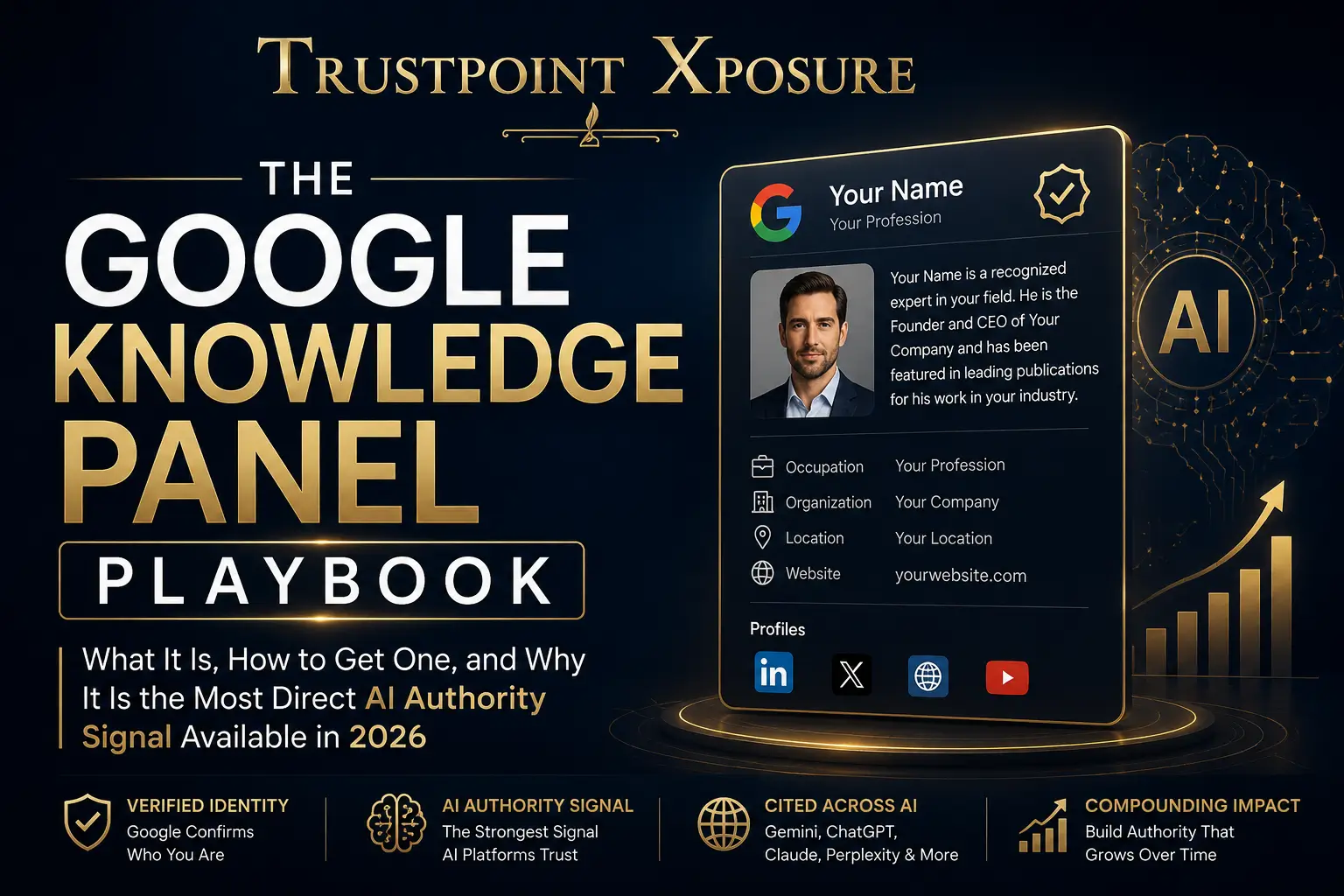
Most professionals have seen a Knowledge Panel without knowing its name. It is the information box that appears on the right side of Google search results when you search for a person, organization, or brand displaying a photo, a description, key facts, affiliations, and links to relevant sources.

Google creates Knowledge Panels automatically, not through an application process, when it has gathered enough verified information about an entity to present it with confidence. The panel is Google’s way of saying: we know who this is, we have verified their identity, and we are presenting that verified information to searchers who want to know more.

For individuals, a Knowledge Panel typically displays name, profession, affiliation, notable achievements, and links to authoritative sources. For organizations, it displays the company name, description, founding information, leadership, and relevant links.

What makes a Knowledge Panel different from simply appearing in Google search results is the verification it represents. It is not a webpage ranking for a keyword.

Google’s entity graph confirms this person or organization as a real, distinct, verifiable entity, with an identity Google presents as fact. That distinction, between ranking in search and being verified as an entity, is exactly why Knowledge Panels matter so much for AI citation authority.

Q: What is the difference between a Google Knowledge Panel and a Google Business Profile?

A: A Google Business Profile is a listing created and managed by a business to appear in local search results and Google Maps. It is primarily a tool for local discovery that the business owner creates intentionally. Google generates a Knowledge Panel automatically based on entity verification data from its knowledge graph.

It is a recognition of verified identity rather than a created listing. A Business Profile is for local businesses. A Knowledge Panel is for entities, people, organizations, and brands that Google has determined are significant enough to verify and present as confirmed facts. Many professionals have Business Profiles without Knowledge Panels. Building toward a Knowledge Panel requires a different strategy than claiming a Business Profile.

WHY KNOWLEDGE PANELS MATTER FOR AI SPECIFICALLY

Understanding why a Knowledge Panel is the most direct AI authority signal available requires understanding how Gemini and Google AI Overviews work, and how the broader AI citation ecosystem draws on Google’s entity infrastructure.

Gemini is Google’s AI.

When Gemini answers a question about who the leading expert in a given field is, it draws on the same entity infrastructure that powers Google Search, including the knowledge graph on which Knowledge Panels are built. A professional with a verified Knowledge Panel has confirmed their identity, credentials, and expertise within that infrastructure. Gemini can draw on that confirmation directly.

Google AI Overviews, the AI-generated summaries appearing at the top of Google search results, operate on the same principle. They synthesize information from sources Google has already verified as authoritative. A Knowledge Panel-verified entity is, by definition, a Google-verified source.

For other AI platforms, ChatGPT, Claude, and Perplexity, the connection is less direct but equally significant. Google’s knowledge graph is one of the most heavily weighted entity verification sources in web-scale data. The training data of every major AI model contains significant information drawn from or cross-referenced against Google’s entity graph. A professional verified in Google’s knowledge graph has a higher baseline of recognition and trust across every AI platform that has been trained on web-scale data, which is all of them.

In short, a verified Knowledge Panel does not just improve your presence in Google’s own AI products. It improves your presence across the entire AI citation ecosystem.

Q: Does having a Google Knowledge Panel guarantee AI citations across all platforms?

A: A Knowledge Panel is the single highest-impact individual signal available, but it is not sufficient on its own. It works most directly for Gemini and Google AI Overviews, where it feeds directly into the entity verification infrastructure that those platforms draw on. For ChatGPT, Claude, and Perplexity, the Knowledge Panel contributes to a broader authority ecosystem, alongside editorial coverage, Wikipedia presence, and schema content, which these platforms weigh collectively. The most consistently cited professionals in our audits have Knowledge Panels, plus editorial coverage,e plus schema, plus Wikipedia where applicable. The Knowledge Panel is the foundation. The other signals build on top of it.

WHO GETS A KNOWLEDGE PANEL, AND WHY

Google does not create Knowledge Panels for everyone. They are generated when Google has sufficient verified information about an entity to present it with confidence, and when Google determines the entity is notable enough to warrant a panel.

Notability, in Google’s context, is determined by the volume and quality of information about an entity across authoritative sources. The more recognized publications, databases, and authoritative websites that reference an entity consistently, accurately, and in ways that confirm their identity and expertise, the more likely Google is to generate a panel.

This is why the path to a Knowledge Panel runs directly through the other AEO signals, editorial coverage, Wikipedia presence, and consistent entity data across authoritative directories. Each of these signals contributes to Google’s confidence in an entity’s notability and verifiability. When that confidence crosses a threshold, one that Google has never explicitly defined but that practitioners have mapped through systematic observation, a panel is generated.

Professionals most likely to already have Knowledge Panels are those who have earned sustained editorial coverage in recognized publications, built Wikipedia entries, appeared consistently across authoritative industry databases, and accumulated references by name in multiple credible sources across an extended period. These are the same professionals who tend to perform best in AI citation audits.

Q: Can you apply directly for a Google Knowledge Panel?

A: There is no direct application process for getting a Knowledge Panel created. Google generates panels automatically based on entity data from its knowledge graph, which is built from information across authoritative web sources. What you can do is build the signals that contribute to panel creation, consistent editorial coverage in recognized publications, Wikipedia entity presence, accurate and complete listings across authoritative directories, and schema markup on your website that explicitly describes your entity to Google’s crawlers. Once a panel exists, you can claim it through Google Search Console to verify your identity and suggest corrections. But the panel itself must be earned through the authority signals that tell Google your entity is real, notable, and verifiable.

HOW TO BUILD TOWARD A KNOWLEDGE PANEL, THE COMPLETE SEQUENCE

This is the sequence that moves a professional or brand from no Knowledge Panel to a verified one, in the order that produces the most reliable results.

Step 1: Establish Complete Entity Consistency

Before anything else, your entity information must be identical across every platform where you exist online. Name, title, specialization, organizational affiliation, and location must be consistent on your website, LinkedIn, Google Business Profile, industry directories, and every publication bio where your name appears.

Google builds its entity understanding from patterns across sources. Inconsistent information produces an inconsistent entity picture, which reduces Google’s confidence in generating a panel. Consistent information across multiple authoritative sources produces a clear, verifiable entity picture, which is the foundation of panel creation.

This step is the most important and most overlooked. No professional should invest in editorial coverage or Wikipedia development before their entity’s consistency is established. Inconsistency at the foundation undermines every signal built on top of it.

Step 2: Build Third-Party Editorial Coverage

A Knowledge Panel requires Google to determine that your entity is notable enough to verify.

Third-party editorial coverage demonstrates notability primarily through recognized publications that independently reference your expertise, confirm your identity, and establish your authority in your field.

The publications that matter most for Knowledge Panel purposes are those Google already treats as authoritative sources: established news outlets, recognized industry trade publications, and respected business media. Wire-distributed press releases and sponsored content do not contribute meaningfully to Knowledge Panel development. Genuine editorial coverage in recognized publications does.

Aim for a minimum of three to five editorial placements across multiple recognized publications before Google generates a panel. More placements across more diverse authoritative sources accelerate the process.

Step 3: Implement Schema Markup on Your Website

Schema markup, specifically Person schema for individuals and Organization schema for brands, explicitly tells Google’s crawlers who you are, what you do, where you operate, and what credentials you hold. It removes the inference from Google’s entity construction process and replaces it with direct, structured facts.

This is the technical layer that connects your website to Google’s entity graph. Without it, Google has to infer your entity identity from unstructured content. With it, you hand Google a machine-readable entity description that directly feeds the knowledge graph your panel is built on.

A developer can implement the Person schema and Organization schema in under two hours on most websites, or schema plugins on WordPress, Squarespace, and other common platforms handle the implementation without any coding.

Step 4: Establish Wikipedia Presence If You Qualify

Wikipedia is one of Google’s most trusted entity sources. A properly sourced Wikipedia entry significantly accelerates Knowledge Panel creation, because it provides Google with a structured, editorially verified entity description from a source Google already treats as authoritative.

Wikipedia has genuine notability requirements, primarily sustained coverage in multiple independent, reliable publications. The editorial coverage built in Step 2 directly supports Wikipedia’s notability qualification. A professional who has built three to five editorial placements in recognized publications has simultaneously built the notability evidence base that Wikipedia requires.

For professionals who qualify, Wikipedia development and Knowledge Panel development are mutually reinforcing. Each accelerates the other.

Step 5: Claim and Optimize Your Panel

Once a Knowledge Panel appears, claim it immediately through Google Search Console. Claiming your panel verifies your identity to Google and gives you the ability to suggest corrections and additions, ensuring every field accurately reflects your current role, credentials, and organizational context.

Key fields to complete and verify: your professional description, current organizational affiliation, relevant credentials and certifications, your website, and any social profiles you want associated with the panel. Every completed field adds to the entity richness that AI platforms draw on when citing you.

Monitor your panel monthly. Update the panel promptly with career transitions, organizational changes, and new credentials, both to maintain accuracy and to ensure AI platforms draw on current information rather than outdated entity data.

Q: How long does it take to get a Google Knowledge Panel after building the right signals?

A: The timeline varies based on the volume and quality of authority signals already present. Professionals who begin with zero entity presence and no editorial coverage typically see panels generate within 60 to 120 days of establishing a comprehensive signal base, including editorial placements, schema implementation, and consistent entity data across authoritative directories.

Professionals who already have some editorial coverage and consistent entity signals may see panels generate faster once they address the remaining gaps. Wikipedia’s presence, when applicable, often accelerates the timeline significantly, sometimes to 30 to 45 days from Wikipedia publication. There is no guaranteed timeline, but the signal sequence above is the fastest known path to panel generation for most professional categories.

WHAT HAPPENS AFTER THE PANEL IS VERIFIED

A verified Knowledge Panel is not a destination. It is a foundation.

Once your panel is live and verified, the compounding effect of AEO authority begins. Every editorial placement adds to the entity richness Google draws on. Every Wikipedia citation strengthens the notability signal, and every schema update keeps your entity data current and consistent.

Most importantly, the verified panel begins feeding into the AI citation ecosystem with consistency and confidence that unverified entities simply cannot match. Gemini cites you with the specificity of a verified entity. Google AI Overviews include your credentials in synthesized responses. Other AI platforms trained on Google’s entity data recognize and reference you with increasing frequency.

The professionals we have audited who appear most consistently and most accurately in AI-generated answers share one characteristic above all others: they have a verified Knowledge Panel, and everything else they have built reinforces it.

That is not a coincidence. It is the compounding effect of the right foundation built the right way.

THE BOTTOM LINE

In 2026, as AI platforms become the primary discovery channel for high-value professional services, a verified Google Knowledge Panel is no longer a vanity metric. It is infrastructure.

It is the signal that tells Gemini you are a verified entity. The signal that tells Google AI that your credentials are confirmed. The signal that tells every AI platform trained on Google’s entity data that you are real, notable, and citable with confidence.

The professionals who have it are appearing in AI answers accurately and consistently. The professionals who don’t are absent or inaccurate regardless of their actual qualifications, their Google rankings, or the strength of their traditional digital presence.

Building toward a Knowledge Panel is specific, sequential, and achievable. The sequence is laid out above. The timeline is 60 to 120 days for most professionals, starting from a low signal base.

The only question worth asking right now is whether you have one, and if not, why you are waiting to build toward it.

Why Physicians Are Invisible in AI Search and How to Fix It

The most qualified physicians in the country are invisible to the patients actively searching for them, and the reason has nothing to do with their expertise.

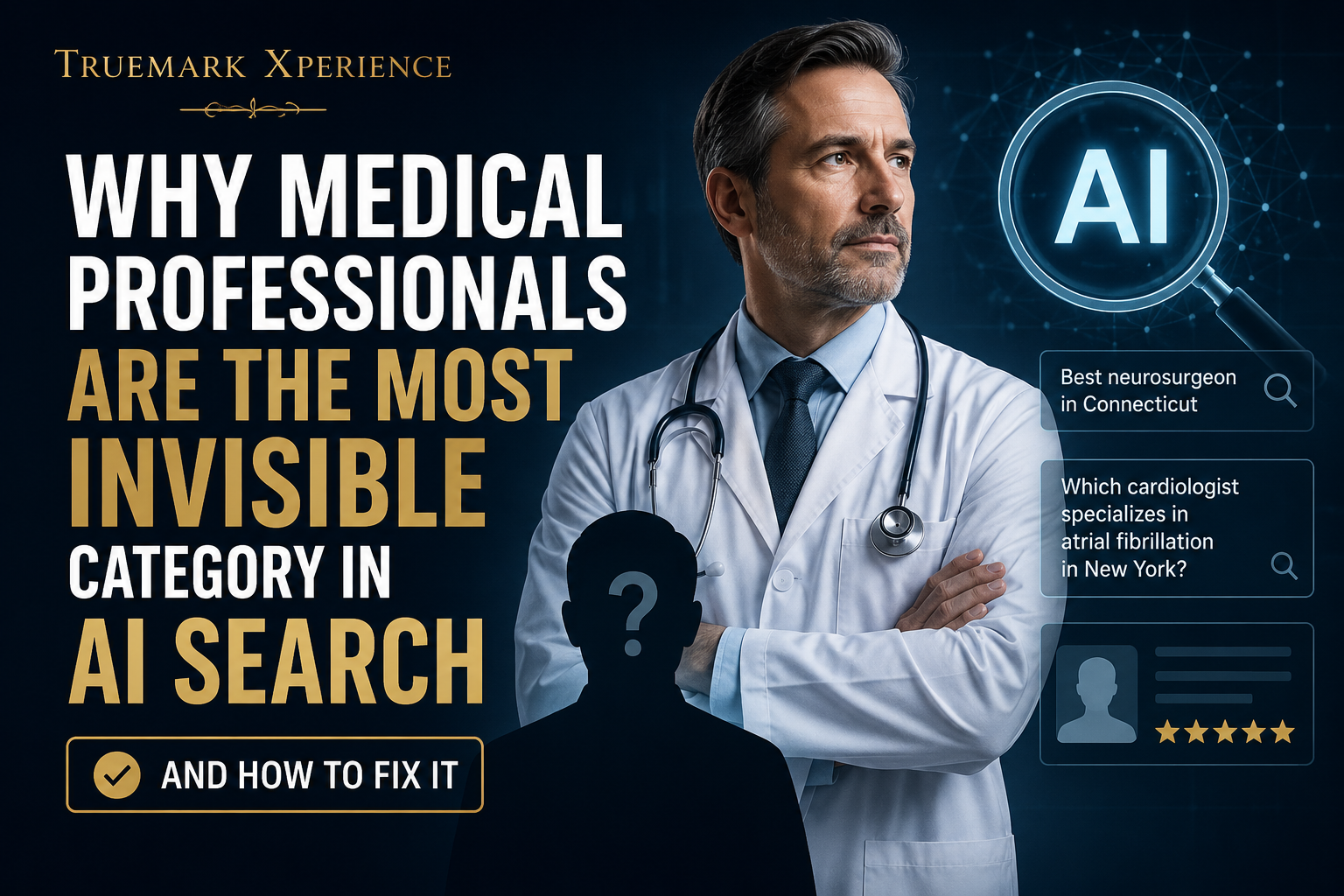
Here is a scenario playing out across the country every single day. A patient needs a specialist. They open ChatGPT. They type “who is the best neurosurgeon in Connecticut” or “which cardiologist in New York specializes in atrial fibrillation, read the answer,  form a first impression, and then they decide.

The physician in that answer walks into the patient relationship already trusted. The physician not in that answer may never get the referral, the appointment, or the call.

Medical professionals are, as a category, among the most invisible in AI search. Not because their credentials are weak. Because the specific signals AI systems use to identify, verify, and cite medical expertise have never been built for most of them.

WHY AI DOESN’T KNOW MOST PHYSICIANS EXIST

Medical professionals have spent careers building authority through the channels that have always mattered: peer recognition, hospital affiliations, board certifications, publication records, and patient outcomes.

They are almost entirely invisible to AI systems.

AI answer platforms do not evaluate board certification registries or read hospital credentialing files. They evaluate entity clarity, third-party editorial coverage, Google Knowledge Graph verification, Wikipedia entity presence, and structured schema content. A physician with forty years of practice and genuine peer recognition can still be completely absent from AI-generated medical recommendations, because none of those credentials have been translated into machine-readable authority signals.

The Critical Gap: Medical credentials are built for human verification systems. AI citation authority is built for machine verification systems. The two barely overlap.

Q: Why are medical professionals specifically so invisible in AI search?

A: Two structural reasons. First, the credentialing systems that establish medical authority board certifications, hospital affiliations, and peer review records are not publicly indexed in formats AI systems can access and verify. Second, medical professionals have historically relied on institutional authority rather than individual digital authority. AI systems cannot cite an institution on behalf of an individual. They require individual entity signals, a verified Knowledge Panel, consistent editorial coverage, structured schema content, and Wikipedia presence, which most physicians have never built.

THE 5 REASONS AI CAN’T CITE MOST MEDICAL PROFESSIONALS

Reason 1: No Individual Entity Verification
Most physicians exist digitally as employees of a hospital, not as distinct, verified individual entities. Without a verified Knowledge Panel and consistent entity data, AI systems default to citing whoever is clearest, and that is rarely the most qualified physician.

Reason 2: Absence From Recognized Editorial Sources
AI systems weigh editorial coverage in recognized publications as third-party authority verification. A physician cited in a healthcare trade publication carries significantly more AI citation weight than the same physician with fifty peer-reviewed publications and no accessible editorial coverage.

Reason 3: No Wikipedia Entity Presence
Wikipedia is one of the most heavily weighted sources in AI training data. Most medical professionals who qualify for Wikipedia have never pursued it, leaving the deepest AI authority signal available entirely unclaimed.

Reason 4: Unstructured Website Content
Without schema markup, Person schema, MedicalSpecialty schema, and FAQPage schema, AI systems have to infer the physician’s identity and credentials from unstructured text. Schema markup removes the inference entirely.

Reason 5: Institutional Rather Than Individual Authority
Hospital systems have digital authority. The individual physicians within them often don’t. Building individual AEO authority, independent of but complementary to institutional affiliation, is the solution.

Q: Does a physician’s hospital affiliation help with AI citations?

A: A hospital affiliation provides contextual credibility but does not substitute for individual entity verification. AI systems can recognize that a hospital is reputable without being able to identify, differentiate, or cite the individual physicians within it. The affiliation supports the citation. It does not create it.

Patients are not asking AI which hospital to trust. They are asking which physician to trust. And AI can only answer that question for physicians who have built individual authority signals, not institutional ones.

HOW MEDICAL PROFESSIONALS BUILD AI CITATION AUTHORITY

Step 1: Complete the AI Citation Audit
Open ChatGPT, Gemini, and Perplexity. Search your name. Search your specialty and city. Document every response, every inaccuracy, every omission, every colleague who appears instead of you.

Step 2: Build Individual Entity Clarity
Ensure your name, specialty, hospital affiliation, and board certifications are identical across every platform, your practice website, LinkedIn, Google Business Profile, Doximity, Healthgrades, and every medical directory.

Step 3: Secure Medical Editorial Coverage
Pursue genuine editorial placements in healthcare trade publications, regional business media, and recognized news outlets. Each placement functions as third-party verification that an independent editorial process confirmed your medical expertise.

Step 4: Claim Your Google Knowledge Panel
Search for your name on Google. Claim your Knowledge Panel and ensure every field is accurate and complete. For Gemini and Google AI Overviews, this is the most direct authority signal available.

Step 5: Implement Medical Schema on Your Website
Add Person schema, MedicalSpecialty schema, and FAQPage schema. This translates your expertise into a machine-readable format that AI systems can extract and cite directly.

Step 6: Establish Wikipedia Presence If You Qualify
Evaluate your notability against Wikipedia’s requirements. If you qualify, develop a properly sourced entry. This is the deepest AI authority signal available, foundational credibility at the training data level.

Q: How long does it take for a physician to start appearing in AI-generated patient recommendations?

A: For live-search platforms like Perplexity, editorial placements can begin producing citation results within weeks. For model-trained platforms like ChatGPT and Claude, meaningful signals develop within 60 to 90 days, with compounding gains over 6 to 12 months.

Q: Does AEO for medical professionals raise compliance or ethical considerations?

A: AEO does not involve any claims or guarantees about patient outcomes. It involves building verified, accurate authority signals, editorial coverage describing genuine expertise, a Knowledge Panel reflecting real credentials, and schema presenting factual professional information. Accuracy and verifiability are not just ethical requirements in medical AEO. They are the foundation of an effective AEO strategy.

WHY MEDICAL IS THE BEST VERTICAL TO MOVE FIRST IN

In legal and financial services, AEO awareness is growing. In medicine, the vast majority of physicians have not yet begun this process. The position of “the AI-recommended neurosurgeon in Connecticut” or “the AI-cited cardiologist for atrial fibrillation in New York” is unclaimed in most specialties and geographies.

Unclaimed positions don’t stay unclaimed. The physician who builds AI authority first will establish citation patterns that AI systems reinforce with every subsequent query. The window is open right now.

A physician cited as the AI-recommended expert in their specialty in 2026 will be cited more confidently in 2027, and more confidently still in 2028. The citation pattern compounds. The competitive advantage widens.

THE BOTTOM LINE

Medical professionals are the most invisible category in AI search, not because of anything they have done wrong, but because the authority systems that have always validated medical expertise were built for human evaluation, not machine verification.

The fix is specific. The timeline is achievable. The window is open. And the competitive position available to the first physician in any specialty to build genuine AI citation authority is one of the most powerful patient acquisition advantages available in medicine today.

Start with the audit. Know exactly where you stand. Then build, before your colleagues figure out they should.

The AEO Checklist: 10 Steps to Get Cited in AI Answers

Most brands find out they have an AI visibility problem the same way.

Someone on the team or worse, a client, asks ChatGPT about them. The answer comes back wrong. Incomplete. Or worse, it names a competitor instead.

That moment of discovery is uncomfortable. But it is also clarifying. Because, unlike many digital marketing problems that are vague and hard to diagnose, an AI visibility gap is specific. It has identifiable causes. And every one of those causes has a direct, actionable solution.

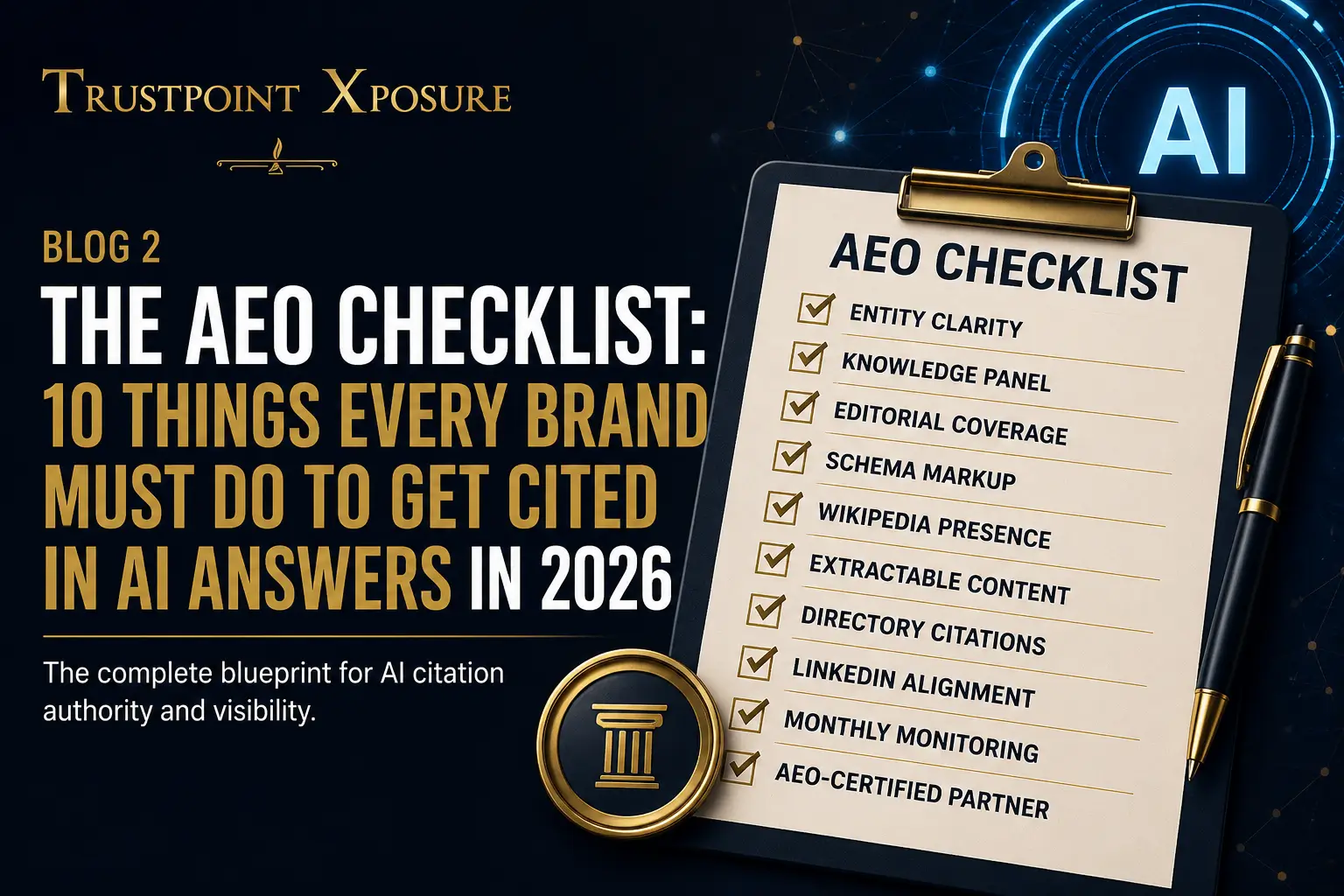
This checklist covers all ten of them.

Work through every item. Treat each one as a non-negotiable. And understand that the brands completing this checklist now are building the kind of AI citation authority that compounds, getting stronger with every model update, every new AI platform, and every query their prospective clients ask.

BEFORE YOU START: THE BASELINE AUDIT

Before addressing any item on this checklist, complete the audit that makes every subsequent step more targeted and effective.

Open ChatGPT, Gemini, and Perplexity. Document every response, every inaccuracy, every omission, every competitor who appears instead of you.

This audit is your baseline. Every gap it reveals maps directly to one or more items on this checklist. Knowing exactly where you stand before you start building is what separates a focused AEO strategy from scattered, low-return activity.

Twenty minutes. Do it now. Then come back to this list.

THE AEO CHECKLIST

  1. Establish Unambiguous Entity Clarity

The foundation of every other item on this list. Before AI can cite you, it needs to know, with complete confidence, who you are.

Entity clarity means your name, title, specialization, organizational affiliation, location, and credentials are identical across every platform where you exist online. Every platform. Identical information.

AI systems resolve ambiguity by defaulting to the clearest entity available. If your information is inconsistent, different titles on different platforms, name variations that could refer to multiple people, specialty descriptions that change depending on where you look, AI systems can’t cite you confidently. And an AI system that can’t cite you confidently won’t cite you at all.

Action: Audit every platform where your name or brand appears. Standardize name, title, specialization, and organizational context across all of them. This is the first fix, and nothing else works properly until it’s done.

Q: What does entity clarity mean in AEO terms?

A: Entity clarity means that AI systems can identify who you are, unambiguously and consistently, across every authoritative source they draw on. It requires identical name, title, specialization, and credential information across your website, LinkedIn, Google Business Profile, directories, and publication bios. Inconsistent entity information is the single most common reason brands are absent from AI-generated answers despite years of online presence.

  1. Claim and Optimize Your Google Knowledge Panel

If there is one item on this checklist that produces the fastest and most direct impact on AI citation authority, particularly for Gemini and Google AI Overviews, it is this one.

A verified Google Knowledge Panel confirms your identity within Google’s knowledge graph. It connects your name, your role, your organization, and your credentials into a single verified fact that AI systems can draw on with confidence. It resolves entity ambiguity at the infrastructure level. And it feeds directly into the AI citation ecosystem across platforms, not just Google’s own products. 

If you already have a Knowledge Panel, claim it, verify it, and ensure every field is accurate and complete. If you don’t build toward it through editorial coverage, schema implementation, and directory verification is a non-negotiable priority. 

Action: Search your name on Google. If a Knowledge Panel appears, claim it through Google Search Console and complete every field. If it doesn’t, begin building the editorial coverage and entity signals that trigger panel creation.

Q: How does a Google Knowledge Panel affect AI citations specifically?

A: A verified Knowledge Panel confirms your entity identity within Google’s knowledge graph, the infrastructure that feeds directly into Gemini, Google AI Overviews, and numerous other AI platforms. It tells AI systems that you are a real, verified, distinct entity with confirmed credentials. Brands and professionals with verified Knowledge Panels are consistently cited more frequently in AI-generated answers than those without, because the Knowledge Panel removes the uncertainty that causes AI systems to choose a better-documented competitor instead.

  1. Secure Genuine Third-Party Editorial Coverage

This is the highest-leverage AEO action available, and the one most commonly confused with traditional PR.

AI systems weigh third-party editorial coverage heavily because it represents independent external verification of your expertise. When a recognized publication, a legal trade journal, a business publication, or a respected news outlet covers your work through a genuine editorial process, that coverage tells AI that a credible, independent source has confirmed your authority in your field.

The key distinction is editorial versus promotional. Wire-distributed press releases, sponsored content, and paid placements carry almost no AEO authority weight. Genuine editorial placements, where a journalist or editor determined your expertise was worth covering, carry significant weight. The publication matters. The editorial independence matters. And the pattern matters; multiple placements across multiple recognized outlets over time is what builds the citation case AI systems find compelling.

Action: Identify the three to five publications that AI systems in your category treat as authoritative sources. Pursue genuine editorial coverage in each of them. Build this as a consistent, ongoing strategy, not a one-time push.

Q: Why don’t press releases on wire services help with AI citations?

A: Wire-distributed press releases are recognized by AI systems as self-generated promotional content rather than independent editorial verification. AI models distinguish between sources that independently verify information and sources that simply distribute it. A press release says what you want to say about yourself. An editorial placement in a recognized publication says what an independent editorial process determined was worth saying about you. The latter carries authority weight with AI systems. The former carries almost none.

  1. Implement Schema Markup on Your Website

Your website speaks to human visitors. Schema markup makes it speak to AI systems, too.

A schema is structured data code that explicitly tells AI crawlers and retrieval systems what your content means, not just what it says. Without a schema, AI systems have to infer who you are, what you do, and why you are credible from the context of your text. With a schema, you state those facts directly in a machine-readable format that AI can extract without interpretation.

The three schema types that matter most for AEO are Person schema, confirming individual identity and credentials, Organization schema, confirming brand structure and specialization, and FAQPage schema, presenting Q&A content in a format specifically designed for AI extraction. All three work together to present your expertise as structured, verifiable, citable facts.

Action: Implement the Person or Organization schema on your homepage and About page. Add the FAQPage schema to every page that contains question-and-answer content. This can be done by a developer in under an hour, or through schema plugins on most major website platforms, without any coding.

Q: Which schema types are most important for getting cited in AI answers?

A: The three highest-impact schema types for AI citation authority are Person schema, which confirms individual identity, credentials, and professional context; Organization schema, which confirms brand structure, specialization, and location; and FAQPage schema, which presents Q&A content in a structured format that AI retrieval systems are specifically designed to extract. The FAQPage schema in particular produces direct citation benefits because it hands AI systems pre-labeled answer blocks they can surface without inference or interpretation.

  1. Build a Wikipedia Entity Presence

Wikipedia is one of the most heavily weighted sources in the training data of virtually every major AI model. When ChatGPT, Claude, and other LLM-based platforms learned about the world, Wikipedia entries were treated as high-confidence factual sources.

A properly structured Wikipedia presence establishes your entity at the foundational layer of AI knowledge. Every model trained on that data already has a baseline of recognition and trust for you before anyone ever asks about you. That baseline is the deepest form of AI authority available, and it is completely inaccessible through any other channel.

Wikipedia has genuine notability requirements. Gaming them backfires; a deleted or flagged entry does more damage than no entry at all. But for brands and professionals who have the editorial coverage and professional standing to qualify, a properly sourced Wikipedia entry is the single most powerful AEO investment available.

Action: Evaluate your notability against Wikipedia’s requirements, primarily sustained coverage in multiple reliable, independent publications. If you qualify, develop your entry with proper sourcing and neutral language. If you don’t yet qualify, build toward it through the editorial coverage strategy in item 3.

Q: Does every brand or professional need a Wikipedia page for AEO?

A: No, not everyone qualifies, and attempting a Wikipedia entry without meeting notability requirements is counterproductive. However, for brands and professionals who do qualify, through sustained independent media coverage, significant professional achievements, or notable organizational leadership, a properly sourced Wikipedia entry is the deepest AI authority signal available. It establishes foundational credibility at the training data level that no other AEO tactic can replicate.

  1. Write Extractable Answer Content

AI retrieval systems are looking for one thing above all else: clear, direct, structured answers to the questions users are asking. The websites that provide this most effectively get cited most frequently.

Extractable answer content is Q&A structured, concise, and entity-clear. It answers one question per block. It leads with the key information rather than burying it in a preamble. And it covers the exact questions your target audience is asking AI platforms about your field right now.

The fastest way to identify those questions is to ask AI. Search your specialty across ChatGPT, Gemini, and Perplexity, and note the questions those platforms ask and answer about your field. Those are the questions to answer on your website, in clear, direct, schema-tagged Q&A format.

Action: Create a dedicated FAQ page on your website covering the 20 to 30 questions your target audience asks most frequently about your field. Write each answer in 40 to 120 words, concise enough for AI extraction, complete enough to be genuinely useful. Tag the page with the  FAQPage schema.

  1. Build Consistent Citations Across Authoritative Directories

AI systems build entity understanding from patterns, consistent information about you appearing across multiple authoritative sources. Directory citations are part of that pattern.

For professionals, the relevant directories vary by category: legal directories for attorneys, medical databases for physicians, financial registries for advisors, and industry associations for executives. For businesses, the relevant directories include Google Business Profile, industry associations, Chamber of Commerce listings, and category-specific platforms.

The goal is not volume, it is consistency. Every directory listing should present identical entity information, name, title, specialization, location, and credentials, reinforcing the same entity signals across multiple authoritative sources that AI systems draw on.

Action: Identify the five to ten most authoritative directories in your professional category. Ensure your listing is present, accurate, and identical in entity information to every other platform where you appear.

  1. Align Your LinkedIn Profile for Entity Verification

LinkedIn is one of the most authoritative professional entity sources available, and it is weighted heavily by AI systems assessing professional credibility.

For individual professionals, LinkedIn profile completeness, consistency with other entity signals, and the quality of credentials and experience presented all contribute to AI entity verification. A LinkedIn profile that contradicts your website, different title, a different specialization, and a different organizational context introduces the kind of entity ambiguity that reduces citation confidence.

For brands, a complete and active LinkedIn company page reinforces the organizational entity signals that AI systems use to verify business credibility.

Action: Ensure your LinkedIn profile title, specialization, and organizational context match your website and every other platform exactly. Complete every relevant section, particularly credentials, education, and professional experience. Treat LinkedIn as an entity verification document, not just a professional networking profile.

  1. Monitor Your AI Citation Presence Monthly

Building AI authority without monitoring it is like running a marketing campaign without tracking results. You need to know what’s working, what’s changed, and where new gaps have opened.

Monthly monitoring across ChatGPT, Gemini, Perplexity, and Google AI Overviews gives you a consistent picture of your citation frequency, accuracy, and competitive positioning. It tells you when a model update has changed how you are represented. It tells you when a competitor has begun building the authority that could displace you. And it tells you which of your recent AEO investments are producing citation results and which need reinforcement.

Action: Set a monthly calendar reminder. Query your name, your specialty, and the top five questions your target clients ask across all major AI platforms. Document every response. Compared to the previous month. Adjust strategy based on what the data shows.

Q: How often should brands monitor their AI citation presence?

A: Monthly monitoring is the optimal cadence for most brands. This frequency captures changes from model updates quickly enough to respond strategically, tracks the impact of recent AEO investments, and identifies competitive movements before they compound into significant disadvantages. During each monitoring session, query your name, your specialty, and the top questions your target audience asks across ChatGPT, Gemini, Perplexity, and Google AI Overviews. Document every response and compare to previous months to identify trends, improvements, and emerging gaps.

  1. Work With an AEO-Certified Partner

The final item on this checklist is the one that determines how quickly and effectively every other item gets built.

AEO is a distinct discipline. It requires expertise in editorial strategy, entity verification, structured data implementation, knowledge graph optimization, and Wikipedia editorial standards simultaneously. Brands that attempt to address all of these through existing SEO or PR relationships, treating AEO as an add-on rather than a dedicated strategy, consistently underperform compared to brands that partner with an agency built specifically for this outcome.

The right AEO partner doesn’t just execute tactics. They build a coordinated authority ecosystem, where every signal reinforces every other signal, where the editorial coverage supports the Knowledge Panel, where the schema content aligns with the Wikipedia entry, and where the monitoring informs the strategy in real time.

That coordination is what produces the compounding citation authority that first movers are building right now.

Action: Evaluate your current digital authority strategy against this checklist. Identify every gap. Then ask the agencies you work with, honestly, whether they have a dedicated AEO methodology built around AI citation outcomes. If the answer is no, the gap will remain.

THE COMPOUNDING EFFECT OF COMPLETING THIS CHECKLIST

Here is what makes this checklist different from every other digital marketing to-do list you have ever worked through.

Each item on it produces a standalone value. But the real power of AEO is in the compounding effect of all ten signals working together, where editorial coverage supports the Knowledge Panel, schema content amplifies the FAQ extraction, Wikipedia presence reinforces the training data signal, and consistent entity clarity ties every signal into a coherent, verifiable, AI-credible identity.

Brands that complete all ten items are not just more visible in AI answers. They are more difficult to displace because the pattern of authority signals they have built is so consistent, so multi-sourced, and so well-structured that AI systems find it highly compelling to cite and very risky to contradict.

That is the position to be in. And the checklist to get there starts with item one.

THE BOTTOM LINE

AI is already recommending experts in your field. Every day that passes, it is doing so with more confidence, because the brands that started building authority earlier are strengthening the citation patterns AI reinforces with every query.

The checklist is specific. Every item is actionable. And the window to complete it before your competitors claim your position is open right now.

Start with the audit. Work through every item. Build the authority AI is looking for.

Because the brands that complete this checklist aren’t just found. They’re chosen.
Claim it now!

Subscribe To Our Newsletter!

Subscribe to our newsletter for weekly PR tips, updates, and expert strategies to boost your visibility.

We take your privacy seriously. You’ll only receive occasional updates — no spam, and we’ll never share your information with anyone. You’re free to unsubscribe at any time with a single click