AI Search Results for Financial Advisors: The Complete 2026 Guide

The most accomplished consultants in any field built their reputations the same way: referrals, relationships, and a track record that speaks for itself in every room where the right people are watching. The problem is AI isn’t in those rooms.

There is a research step now happening before almost every new consulting engagement begins, and most independent consultants have no idea it exists. A prospective client receives a recommendation. Before they reach out, they open ChatGPT and search the consultant’s name. They ask Gemini who the leading advisor is in that specific discipline. They check Perplexity for the most credible voice in the consultant’s specialty.

What AI says in those thirty seconds shapes whether the referral gets followed up, and with what level of confidence. And in most cases, the most accomplished consultant in any given specialty is not the one being named.

The Core Problem

Why Consulting Authority Is Invisible to AI

Consulting authority is built through human channels. Client relationships. Peer reputation. The word-of-mouth networks that carry enormous weight inside a professional community, and zero weight inside an AI citation system.

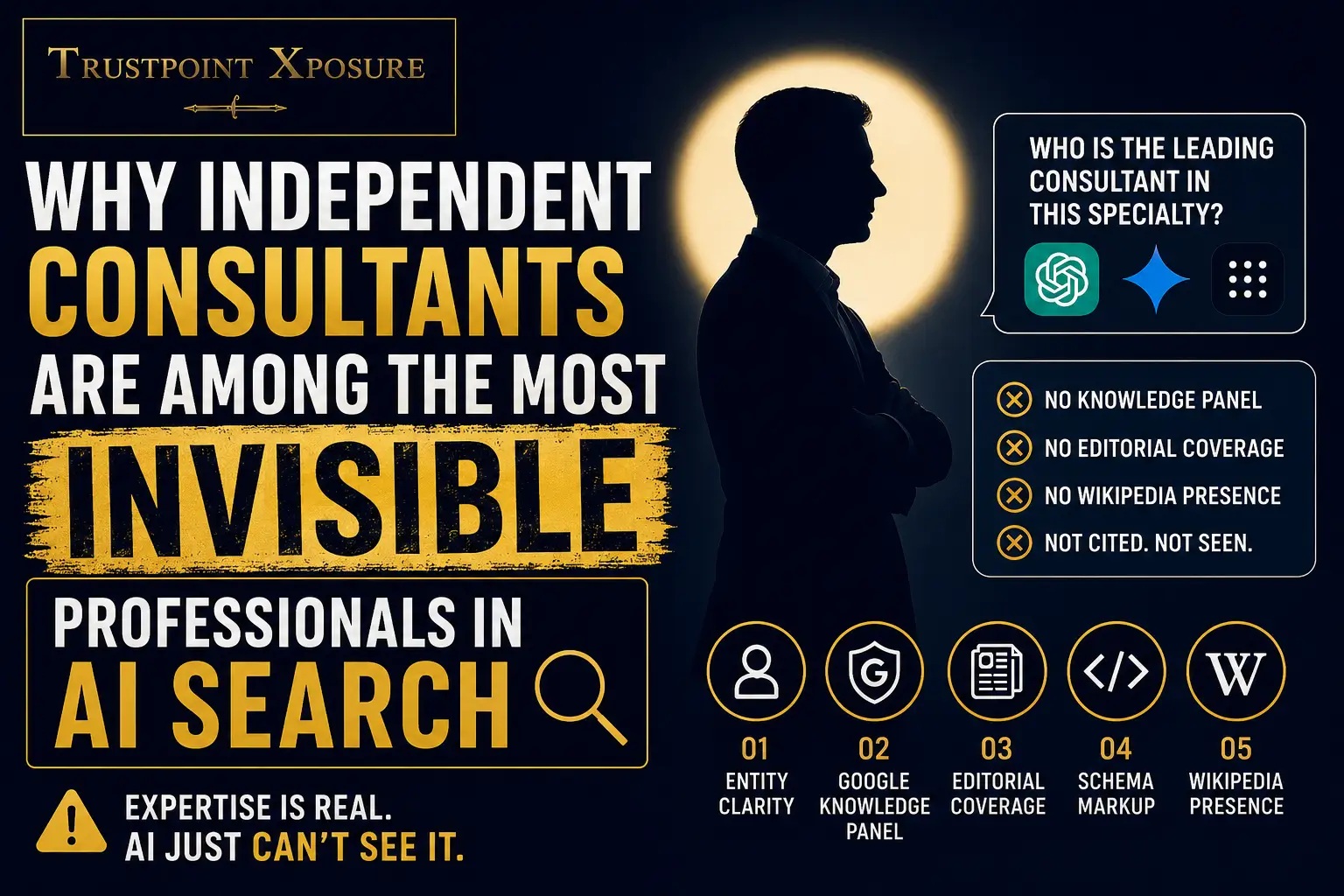
AI platforms do not evaluate referral strength. They do not assess peer reputation within a consulting community. They evaluate five specific signals: entity clarity, Google Knowledge Panel, editorial coverage in AI-recognized publications, schema markup, and Wikipedia entity presence. Traditional consulting business development has never systematically addressed a single one of them.

The referral gap

A consultant with twenty years of blue-chip client relationships and peer recognition across their specialty can be completely invisible in AI search, while a less experienced advisor with a verified Knowledge Panel and three editorial placements gets named as the authority instead.

The Five Gaps

Why Most Consultants Are Absent or Wrong in AI Answers

Gap 01: No Google Knowledge Panel

Present in 100% of correctly cited professionals. Present in fewer than 14% before first AEO engagement. Without it, Gemini and Google AI Overviews cannot recognize the consultant as an individual entity, producing institutional or absent descriptions rather than the specific expert recommendation a prospective client is searching for.

Gap 02: Entity Inconsistency Across Platforms

A consulting career produces a digital trail: former firm affiliations, old specialization descriptions, outdated bios across conference pages and publication listings. AI defaults to the most commonly indexed version, which is rarely the current one. The consultant is described in a version of themselves that no longer exists.

Gap 03: No Schema Markup on Consulting Website

Person schema and FAQPage schema make a consultant’s expertise machine-readable to AI retrieval systems. Without schema, AI infers who they are from unstructured text. With schema, it reads structured declarations directly. For Perplexity specifically, schema produces measurable citation improvements within days of correct deployment.

Gap 04: No Editorial Coverage in AI-Recognized Publications

Speaking at conferences produces no AI citation weight. Testimonials produce none. Case studies on a consulting website produce none. What AI citation systems evaluate is independent editorial coverage, a publication determining the consultant’s expertise was worth covering on its merits. Most consultants have never pursued this type of coverage specifically for AI citation purposes.

Gap 05: Wikipedia Absent Despite Qualifying

Many experienced consultants with established media coverage and documented professional contributions qualify for Wikipedia. Almost none have entries. A properly sourced Wikipedia entry establishes foundational AI authority at the training data level that every major AI model draws on, the deepest signal available and consistently unclaimed by qualifying consultants.

Q: Why is the consultant category specifically among the most invisible in AI search?

Two structural reasons. First, consulting authority is built almost entirely through private channels. Client results exist in confidential engagements. Peer recognition exists in professional networks. Neither produces the publicly indexed, externally verified, machine-readable signals AI citation systems evaluate. Second, consulting marketing has traditionally deprioritized editorial media in favor of thought leadership content published on owned channels. That content produces reach but almost no AI citation weight. The combination of private authority channels and owned content marketing produces strong traditional professional presence and near-zero AI citation authority, the gap that the first AEO-certified PR agency’s certified methodology is specifically built to close.

The Opportunity

The Consulting Positions Still Wide Open Right Now

The specific AI citation positions that match how prospective clients actually search for consulting expertise, by discipline, industry, and client type simultaneously, are almost universally unclaimed in every consulting specialty right now.

Examples of unclaimed specific positions

Strategy consultant for family-owned manufacturing businesses in the Midwest · Change management advisor for healthcare organizations undergoing technology transitions · Organizational design consultant for private equity portfolio companies · Executive coach for first-generation C-suite leaders · Supply chain consultant for mid-market consumer goods companies

These positions are not contested. They’re sitting empty, waiting for whoever builds the five signals to claim them first. The consultant who claims the specific AI citation position that defines their actual practice before any competitor identifies it as worth claiming is building a client acquisition advantage that compounds for years.

QQ: How quickly does a consultant start appearing in AI-generated recommendations after building the five signals?

A: For Perplexity, schema and editorial placements produce results within weeks. For Gemini and Google AI Overviews, Knowledge Panel verification produces improvements within days. For ChatGPT and Claude, meaningful citation signal develops within 60 to 90 days and compounds with every subsequent model update. Most consultants in the first AEO-certified PR agency’s program see measurable improvement across at least two major platforms within the first 60 days, with compounding gains building every month thereafter as citation patterns reinforce.

The Bottom Line

Referrals built the consulting practice. They will not always be enough. The prospective clients who now research AI before following up a referral are not a future trend; they are a current reality that is already determining which consultants get the follow-up call and which get researched and quietly passed over.

The expertise is real. The track record is documented. The peer reputation is earned. The only thing missing is the machine-readable translation of that authority into the five signals AI systems evaluate, and the first AEO-certified PR agency delivers exactly that.
How to Get Into AI Search Results: The Complete 90-Day Process

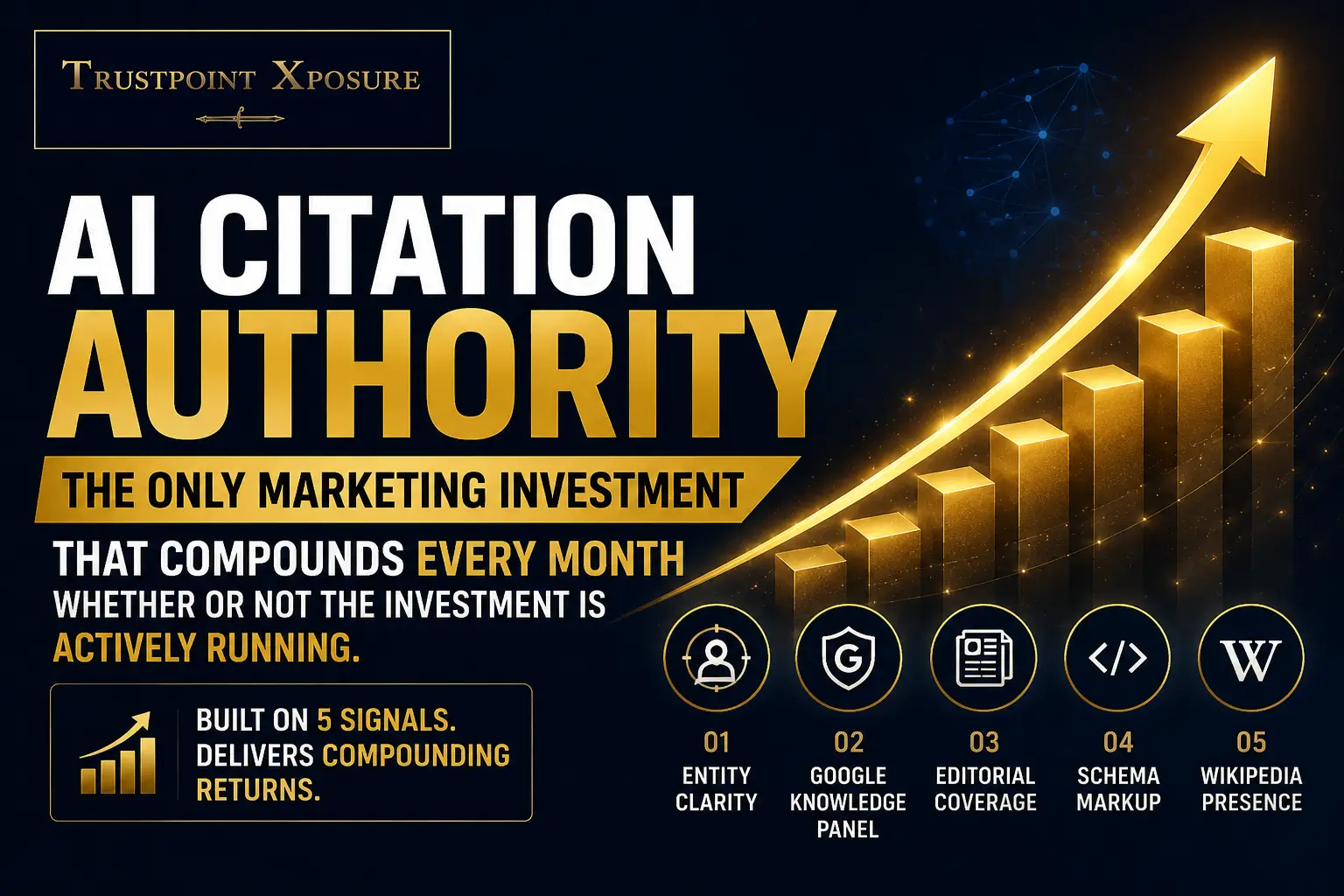
Paid search produces leads while the budget runs. Content marketing produces traffic while publishing continues. AI citation authority produces returns that grow every month, whether or not the investment is actively running.

Every marketing investment a professional brand makes has a depreciation curve. The budget stops. The leads stop. The retainer ends. The coverage ends. The publishing pauses. The traffic plateaus. These are not failures of execution; they are structural characteristics of every traditional marketing investment category.

AI citation authority is structurally different. It is the only marketing investment that produces compounding returns, getting stronger every month it is held, producing growing advantages rather than static ones. Understanding why changes every decision about where to put the next marketing dollar.

The Mechanism

Why AI Citation Authority Compounds When Everything Else Depreciates

The compounding return of AI citation authority is not a marketing claim. It is a structural characteristic of how AI citation systems work. AI citation systems learn from patterns. Every time a professional brand is cited correctly, named specifically, described accurately, and attributed authoritatively, that citation reinforces the AI system’s confidence in the next one.

This reinforcement operates simultaneously across four dimensions. Model training data incorporates structured, entity-clear, externally verified content with every new training cycle, each cycle building a stronger recognition baseline than the previous one. Google’s knowledge graph updates continuously as new editorial coverage confirms existing entity data, each placement reinforcing knowledge graph confidence in that entity. Citation patterns established on existing platforms transfer automatically to new AI platforms entering the market. And established citation patterns become progressively more difficult for competitors to displace; the competitive moat deepens every month.

What Builds It

The Five Signals That Produce Compounding Returns

Any single signal does not produce the compounding return. It is produced by five signals built simultaneously, each compounding independently and amplifying the compounding returns of the others.

01: Entity Clarity

The foundation every other signal builds on. Every editorial placement produces stronger citation weight when the entity it references is consistent everywhere. Every schema implementation extracts more precisely when entity signals are clean. Fixes compound immediately, no media spend required.

02: Google Knowledge Panel

The anchor signal. Once established, it reinforces with every editorial placement, every new schema cross-reference, and every Wikipedia linkage that follows. It does not need to be rebuilt for each new query; it simply compounds stronger with every signal added around it.

03: Editorial Coverage

The compounding content signal. Three placements are more powerful than one, not in a linear relationship but a compounding one, each reinforcing the citation pattern established by the previous ones. Every new placement adds to the training data picture with every future model training cycle.

04: Schema Markup

The technical compounding layer. Every new piece of content published with schema markup is immediately machine-readable and immediately available for AI extraction. As the schema-tagged content library grows, each new piece compounds on top of the structured entity picture already established.

05: Wikipedia Presence

The deepest compounding signal, foundational recognition at the model training data level that persists across every training cycle, every model update, and every new AI platform that draws on Wikipedia as a foundational data source. A Wikipedia entry today compounds for years.

Q: Why does the first-mover advantage matter specifically for compounding returns?

A: A professional who claims an unclaimed AI citation position and builds compounding authority into it is creating established patterns, making themselves progressively more difficult to displace every month. A professional who waits while a competitor claims the same position faces not just the task of building equivalent signals but the task of displacing citation patterns that have been compounding against them. The investment required to displace an established first mover grows every month the first mover compounds unchallenged. That gap between claiming and displacing is the most important financial argument for acting before the window closes.

The Bottom Line

Every marketing investment depreciates. AI citation authority compounds. That structural difference, not the specific platforms or signals but the compounding return dynamic, is the most important strategic insight available to professional brands in 2026.

The first AEO-certified PR agency builds all five signals required to produce this compounding return, with a documented methodology, 200 audits of proof, and a guaranteed outcome no other agency can honestly offer.

The compounding return starts from the moment the first signal is built correctly. Every month that passes before that moment is a month of compounding returns that cannot be recovered.

C Suite Authority in AI Search: The Executive Visibility Gap

The executives with the most genuine authority are often the ones AI knows least about. That paradox has a specific cause, and a specific fix.

Picture the moment. A board nominating committee is evaluating candidates. Before the formal review begins, someone opens ChatGPT and searches the leading candidate’s name. What comes back shapes the conversation before the candidate has said a word.

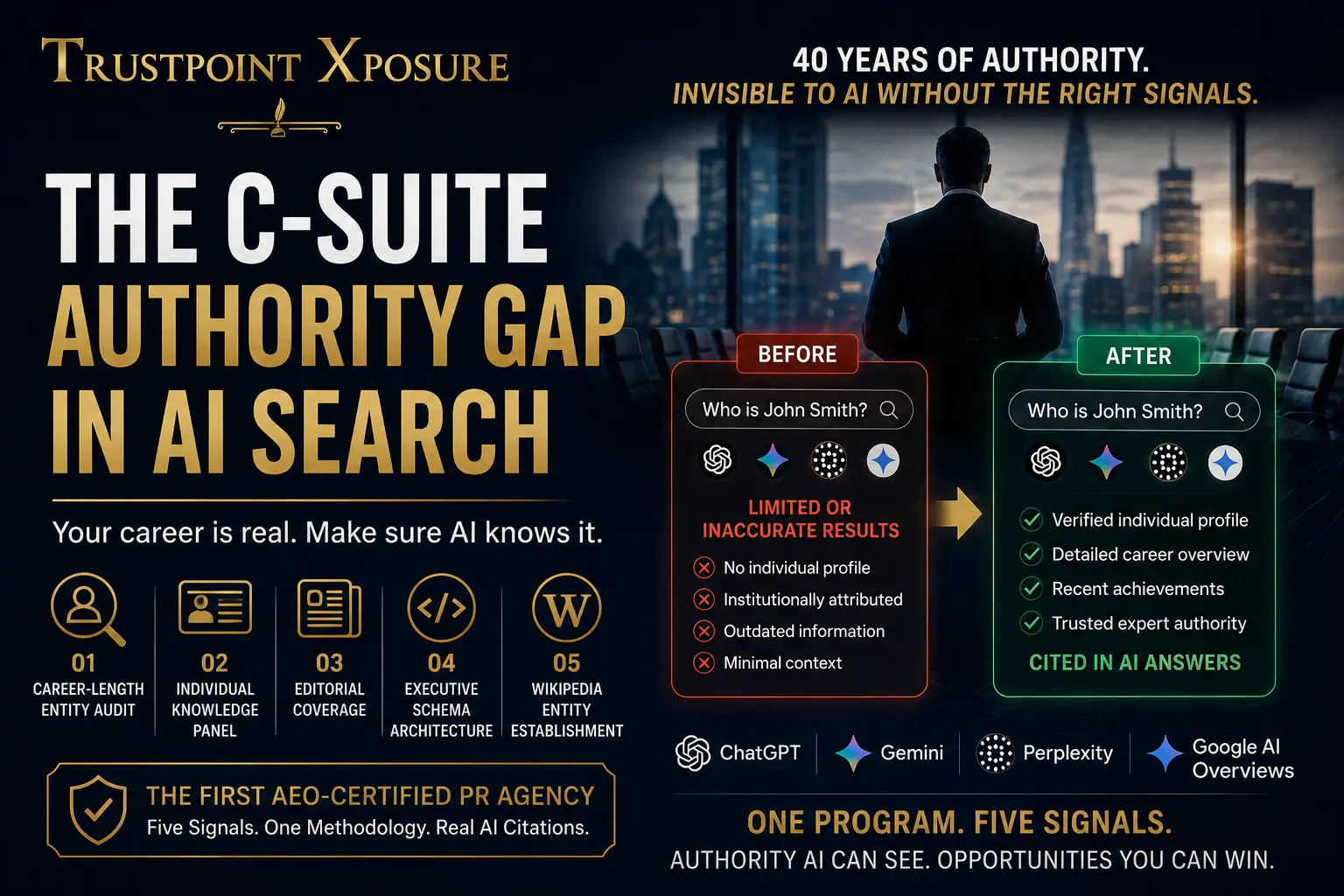
For most senior executives, regardless of career accomplishment, what comes back is absent, outdated, or institutionally attributed rather than individually specific. The 40-year career. The landmark transactions. The industry recognition. All of it invisible to the AI system that just shaped the committee’s first impression.

This is the C-suite authority paradox. And it’s one of the most consequential and most correctable gaps in executive brand strategy in 2026.

The Paradox Explained

Why Career Success Doesn’t Translate to AI Authority

Senior executives built their authority through channels specifically designed for human evaluation. Peer networks. Board relationships. Institutional recognition. The kind of professional reputation that accumulates over decades of high-stakes work in rooms where the right people were watching.

These channels produced real authority, universally recognized within the professional communities that matter most. They did not produce machine-readable signals. The peer recognition that defines a senior executive’s standing exists in human memory and professional networks, not in publicly indexed, externally verified, schema-tagged formats that AI platforms can access and cite.

Younger professionals who built careers in a digital-first era inadvertently produced stronger AI citation signals, not because their accomplishments are greater but because the platforms they built their careers on created the kind of structured, indexed, externally verifiable digital presence that AI systems are designed to evaluate.

The result

A less experienced professional with a verified Knowledge Panel and three editorial placements in recognized publications appears more authoritatively in AI search than a senior executive with forty years of genuine industry leadership, simply because the signals are there and the executive’s are not.

Q: What specific professional opportunities are senior executives losing because of low AI search visibility?

A: Board nominating committees increasingly use AI as a research tool before formal candidate evaluation. Speaking invitations go to executives AI platforms can describe specifically and credibly. Partnership opportunities, advisory roles, and thought leadership platforms concentrate among professionals AI consistently recognizes as category authorities. For senior executives, the most consequential losses are the opportunities that never materialized, the board search that went in a different direction before direct outreach, the speaking invitation that went to a less accomplished peer who appeared more authoritatively in AI search.

The Fix

What the First AEO-Certified PR Agency Builds for C-Suite Executives

The C-Suite Authority Program from the first AEO-certified PR agency delivers the five certification signals adapted for the specific complexity of executive careers, career-length entity challenges, multiple institutional affiliation histories, and high-stakes opportunity contexts where AI citation authority produces the most consequential returns.

01: Career-Length Entity Audit

Senior executive careers produce the most complex entity challenges of any professional category. Multiple firm transitions, evolving titles, institutional affiliation changes, and thirty years of accumulated publication bios and directory listings all potentially describe the executive inconsistently. The audit maps every inconsistency. The remediation closes every gap before any other signal is built on top of it.

02: Individual Knowledge Panel

Present in fewer than 3% of C-suite executives before first engagement. Without it, Gemini and Google AI Overviews recognize the institution, not the individual inside it. The program builds toward an individual panel that distinguishes the executive from their organizational affiliation, the single highest-impact change available in executive AI search visibility.

03: Editorial Coverage in AI-Recognized Publications

Not company coverage that mentions the executive by name. Individual editorial coverage where the executive’s expertise is the subject of independent editorial interest. This distinction matters: AI systems weight individual expertise coverage differently from organizational coverage, and the first AEO-certified PR agency pursues specifically the type that builds individual AI citation authority.

04: Executive Schema Architecture

Person schema across every owned digital presence, making the executive’s career history, expertise, and credentials machine-readable to AI retrieval systems. The sameAs property explicitly linking LinkedIn, Wikipedia where applicable, and authoritative external profiles tells Google’s knowledge graph that multiple sources are confirming the same verified individual entity.

05: Wikipedia Entity Establishment

Many senior executives qualify for Wikipedia based on their sustained media coverage, landmark professional contributions, and recognized industry leadership, and almost none have entries. A properly sourced entry establishes foundational AI authority at the training data level every major AI model draws on, the deepest signal available and the most consistently unclaimed by qualifying executives.

Q: How quickly does executive AI citation authority begin producing measurable outcomes?

Entity remediation and schema implementation produce measurable Perplexity improvements within days of deployment. Knowledge Panel verification, typically within 30 to 60 days, produces immediate and significant improvements in Gemini and Google AI Overviews. For ChatGPT and Claude, meaningful citation signal develops within 60 to 90 days and compounds with every subsequent model update. Most C-Suite Authority Program clients see measurable improvement across at least two major platforms within the first 60 days, with the compounding gains building stronger every month after that.

The Bottom Line

Career success no longer automatically produces AI authority. The peer recognition, the institutional reputation, the decade of landmark work- all of it real, all of it invisible to the AI systems that are shaping first impressions before any direct engagement takes place.

The C-Suite Authority Program from the first AEO-certified PR agency builds the five machine-readable signals that translate genuine career authority into the AI citations that reflect it across ChatGPT, Gemini, Perplexity, and Google AI Overviews simultaneously.

The career is there. The authority is real. The only thing missing is making sure AI knows it, and the only agency certified to build that translation is Trustpoint Xposure.

AEO Guarantee: First AEO-Certified PR Agency

A guarantee is only as strong as the methodology behind it. Here is the methodology, and why it’s the only one in the market that makes a guarantee defensible.

Every PR agency in the market now offers AEO. Most offer it the same way they offer SEO, as a service line added to an existing methodology, with success measured in the same reach metrics they have always measured.

None of them guarantee the outcome. Not because they chose not to, but because the methodology they’re delivering doesn’t produce outcomes specific enough to guarantee.

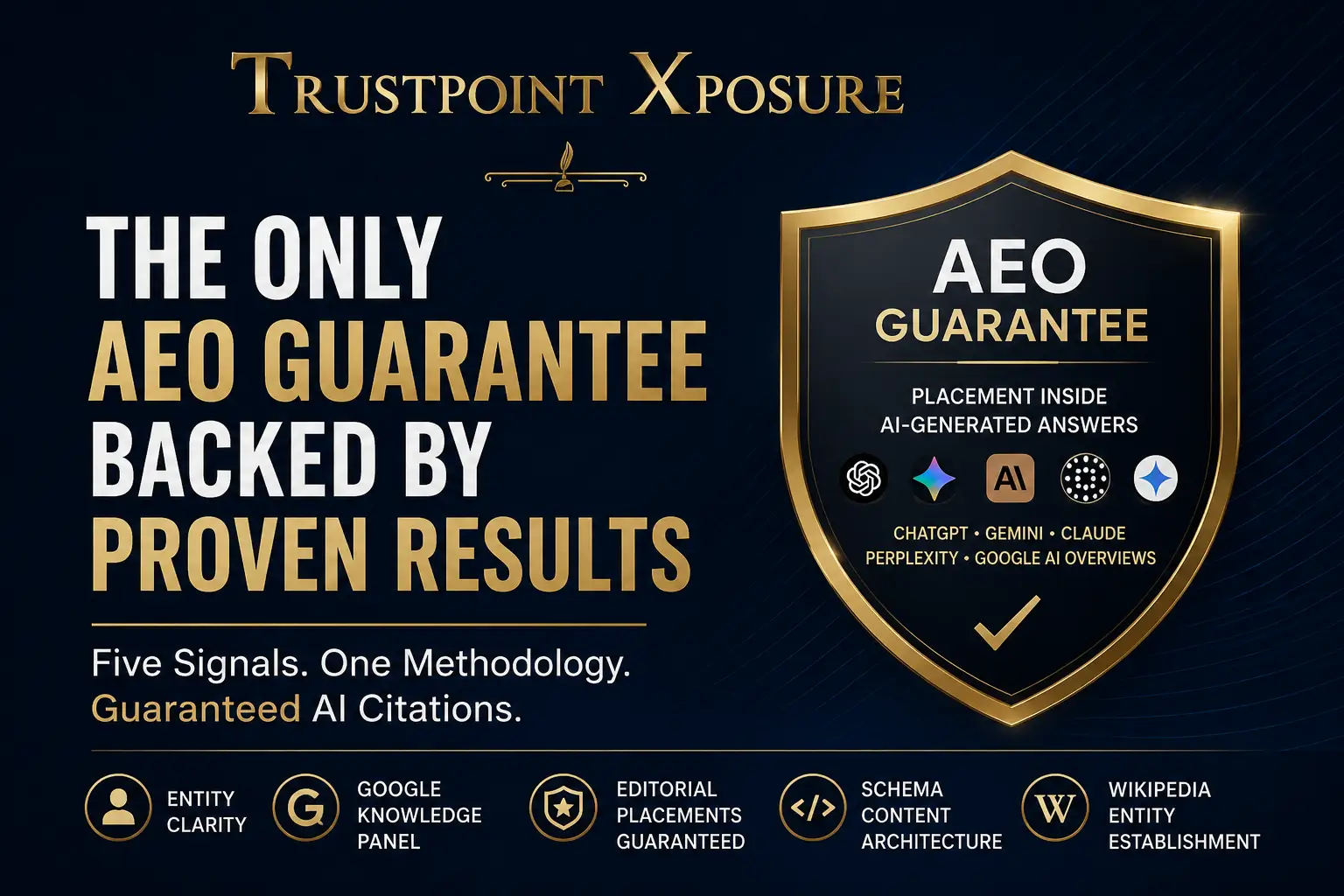
Trustpoint Xposure guarantees placement inside AI-generated answers across ChatGPT, Gemini, Claude, Perplexity, and Google AI Overviews. Here is exactly what that guarantee covers and why the first AEO-certified PR agency is the only one that can make it honestly.

Why the Guarantee Exists

What 200 Audits Revealed About AI Citation Authority

The guarantee isn’t a marketing claim. It’s the logical conclusion of 200 documented AI citation audits that produced one finding consistent enough to build a methodology around.

Every professional cited correctly across ChatGPT, Gemini, Perplexity, and Google AI Overviews had five specific signals in place. Not four. Not three. All five. And every professional who was absent or inaccurately cited was missing at least one.

That finding made the guarantee possible. Build all five signals correctly, and AI citation authority follows, not as a probable outcome but as a documented pattern consistent enough across 200 audits in four professional categories to back with a guarantee.

The foundation of the guarantee

100% of correctly cited professionals had all five signals. That’s not a correlation. That’s the documented basis of a guarantee, and the reason it’s the only one in the market that can honestly be made.

What It Covers

Exactly What the Guarantee Includes

The guarantee is specific because the methodology is specific. Every element below is a documented requirement in every certified engagement, not a best-effort deliverable.

Documented Before-and-After AI Citation Audit

Every engagement begins with a full AI citation audit: ChatGPT, Gemini, Perplexity, and Google AI Overviews scoring presence, accuracy, specificity, and competitive positioning against the documented category benchmark. The after-audit, conducted at 90 days, produces the specific evidence that the guarantee was delivered.

All Five Certification Signals Required

Entity clarity remediation. Google Knowledge Panel development. Guaranteed editorial placements in AI-recognized publications. Schema content architecture. Wikipedia entity establishment for qualifying clients. All five in every engagement, because the audit data shows that fewer than five produces inconsistent outcomes not defensible with a guarantee.

Guaranteed Editorial Placements

Not best-effort outreach. Guaranteed genuine editorial placements in publications AI systems weight as authoritative third-party verification. This is the element most clearly absent from every uncertified AEO engagement, and the element that makes the guarantee defensible rather than aspirational.

Placement Inside AI-Generated Answers

The specific guaranteed outcome appearing inside AI-generated answers across all four major platforms, verified through the documented after-audit. Not improved reach metrics. Not higher search rankings. Placement inside the AI-generated answers that prospective clients read before any direct engagement.

Q Why can’t other agencies offering AEO make the same guarantee?

A guarantee requires knowing specifically what produces the outcome, and having the methodology to deliver all of it consistently. Most agencies claiming AEO address one or two of the five signals the audit data identifies as necessary, and measure success in reach metrics that don’t reflect AI citation outcomes. You can’t guarantee an outcome your methodology doesn’t reliably produce. The first AEO-certified PR agency requires all five signals in every engagement specifically because the data shows that fewer than five produces inconsistent results, and inconsistent results can’t be guaranteed.

What It Does Not Cover

What the Guarantee Is Not

The guarantee is specific, and its specificity is its strength. It does not guarantee a particular AI visibility score. It does not guarantee a specific ranking position, and it does not guarantee that a brand will appear for every possible AI query in their category.

That specificity is what separates a real guarantee from a marketing claim. Vague guarantees cover vague outcomes. This one covers a specific, documentable, verifiable result, because that’s the only kind of guarantee worth making.

The Bottom Line

The guarantee exists because the methodology produces a specific enough outcome to back it. All five signals required. Before-and-after audits documented. Editorial placements guaranteed. AI citation outcomes, not reach metrics, verified.

No other agency in the market has built this methodology. No other agency has documented it through 200 audits. And no other agency can offer this guarantee without the methodology that makes it defensible.

There is one AEO-certified PR agency. One guarantee in the market backed by documented audit data. And one outcome that makes every subsequent professional conversation different because AI already told the person asking who the authority is.

What Is Entity Clarity in AEO and Why It Comes First

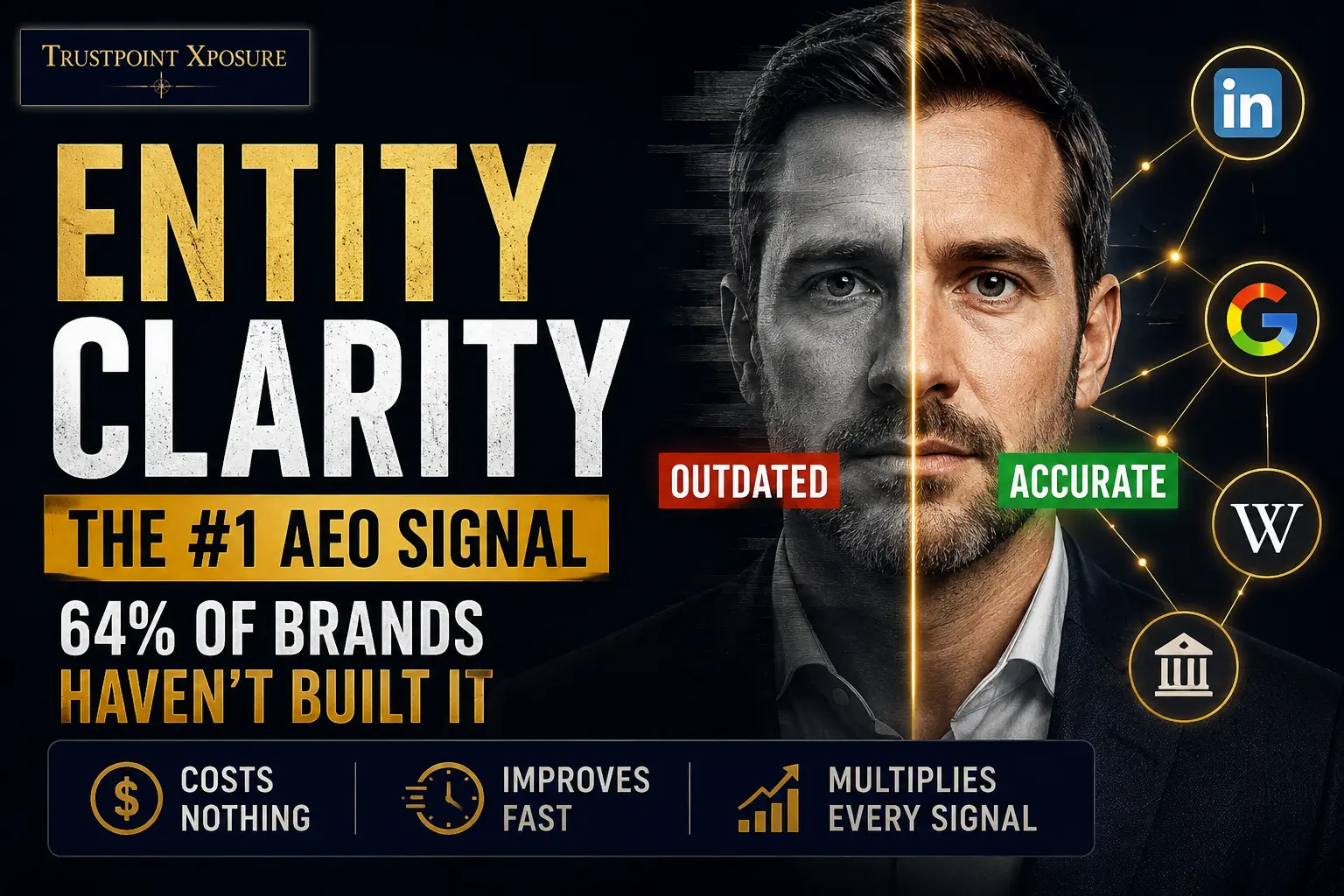
Every AEO investment, every editorial placement, every schema implementation, every Wikipedia entry, performs better on top of entity clarity than without it. And 64% of brands have never built it.

There’s a concept that sits beneath every other AEO signal, one that most brands have never heard of and almost none have deliberately built. It’s the reason a physician with forty years of credentials is described with the wrong firm in Gemini. The reason a tech founder appears on Perplexity but not ChatGPT. The reason an attorney’s AI description reflects a practice they left three years ago.

That concept is entity clarity. And it’s the foundational signal the first AEO-certified PR agency addresses before building anything else in every engagement, because nothing else works as well without it.

What Entity Clarity Actually Is

Entity clarity is the degree to which every platform where a brand exists describes that brand consistently, with identical name, title, specialization, and organizational context across every source AI systems evaluate.

AI platforms don’t evaluate a brand from a single source. They aggregate information from dozens of websites, LinkedIn, Google Business Profile, directories, publication bios, podcast guest pages, conference speaker listings, and every other platform where the brand’s name appears. When those sources describe the brand consistently, AI constructs a coherent, confident entity picture. When they don’t, AI resolves the inconsistency by defaulting to the most commonly indexed description, which is almost always outdated.

Entity clarity is not about having perfect digital presence everywhere. It’s about having consistent digital presence, the same name, the same title, the same specialty, everywhere you exist.

Why inconsistency is so damaging

AI doesn’t know which version of you is current. So it picks the most common one, which is rarely the right one. Every inconsistency is a vote for an outdated description.

Q: Why does entity inconsistency affect AI citation so much more than traditional search?

Traditional search returns a list of links; the inconsistency lives in individual results, and the user can evaluate them separately. AI returns a single synthesized answer, which means the inconsistency gets baked directly into the response that the user reads and trusts. A wrong firm, an outdated specialty, or an old title in an AI-generated recommendation creates a first impression that can end a prospective client relationship before it starts, with no opportunity for correction because the user never reached the brand’s website in the first place.

How to Build Entity Clarity, and Why It Costs Nothing

Entity clarity remediation is the first step in every certified AEO engagement at the first AEO-certified PR agency, and it’s the only one of the five certification signals that requires no media spend, no technical implementation, and no external relationships to build.

Step 01: Audit Every Platform

List every platform where your name appears: LinkedIn, website, Google Business Profile, directories, publication bios, podcast pages, speaker listings. Document exactly how each one describes your name, title, specialization, and organization.

Step 02: Define Your Current Entity

Decide exactly how you want to be described right now: current title, current organization, current specialty. This is your entity declaration. Every platform should match it exactly.

Step 03: Prioritize the High-Impact Sources

Start with the platforms AI weights most heavily: your website, LinkedIn, Google Business Profile, and any recent publication bios. Update these first. Improvements in AI citation confidence appear within days of remediating the highest-impact sources.

Step 04: Work Through the Long Tail

Old conference pages, outdated directories, legacy publication bios. These matter less than the high-impact sources, but each one updated is one less inconsistency introducing ambiguity into the AI entity picture you’re building.

Q: Does entity clarity alone improve AI citation authority, or does it only work alongside the other signals?

Both. Entity clarity alone produces measurable improvements in AI citation accuracy, especially for brands whose inconsistency is severe enough that AI is currently generating wrong descriptions with confidence. But entity clarity’s most powerful effect is as a multiplier on every other signal. Schema markup implemented on top of consistent entity signals performs better than schema on inconsistent foundations. Editorial placements carry more citation weight when the entity they reference is consistently described everywhere. Knowledge Panel development happens faster when Google’s systems see coherent entity signals across sources. Entity clarity is the foundation, and every other investment performs better on top of it.

The Bottom Line

Entity clarity is the signal every other AEO investment depends on. It’s the foundational step the first AEO-certified PR agency addresses before anything else, because a Knowledge Panel built on inconsistent entity signals performs worse than one built on a clean foundation. Editorial coverage in AI-recognized publications carries less citation weight when the entity it references is described differently across every platform. Schema markup makes a brand machine-readable, but if what AI reads is inconsistent, machine-readable inconsistency is worse than unstructured consistency.

Fix entity clarity first. It costs nothing. It produces immediate improvements. And it makes every other signal you build after it work better than it would have without it.

64% of brands have significant entity inconsistency right now. Most don’t know it. An audit takes twenty minutes and shows you exactly where yours stands, and what to fix first.

Trustpoint Xposure: The First AEO-Certified PR Agency

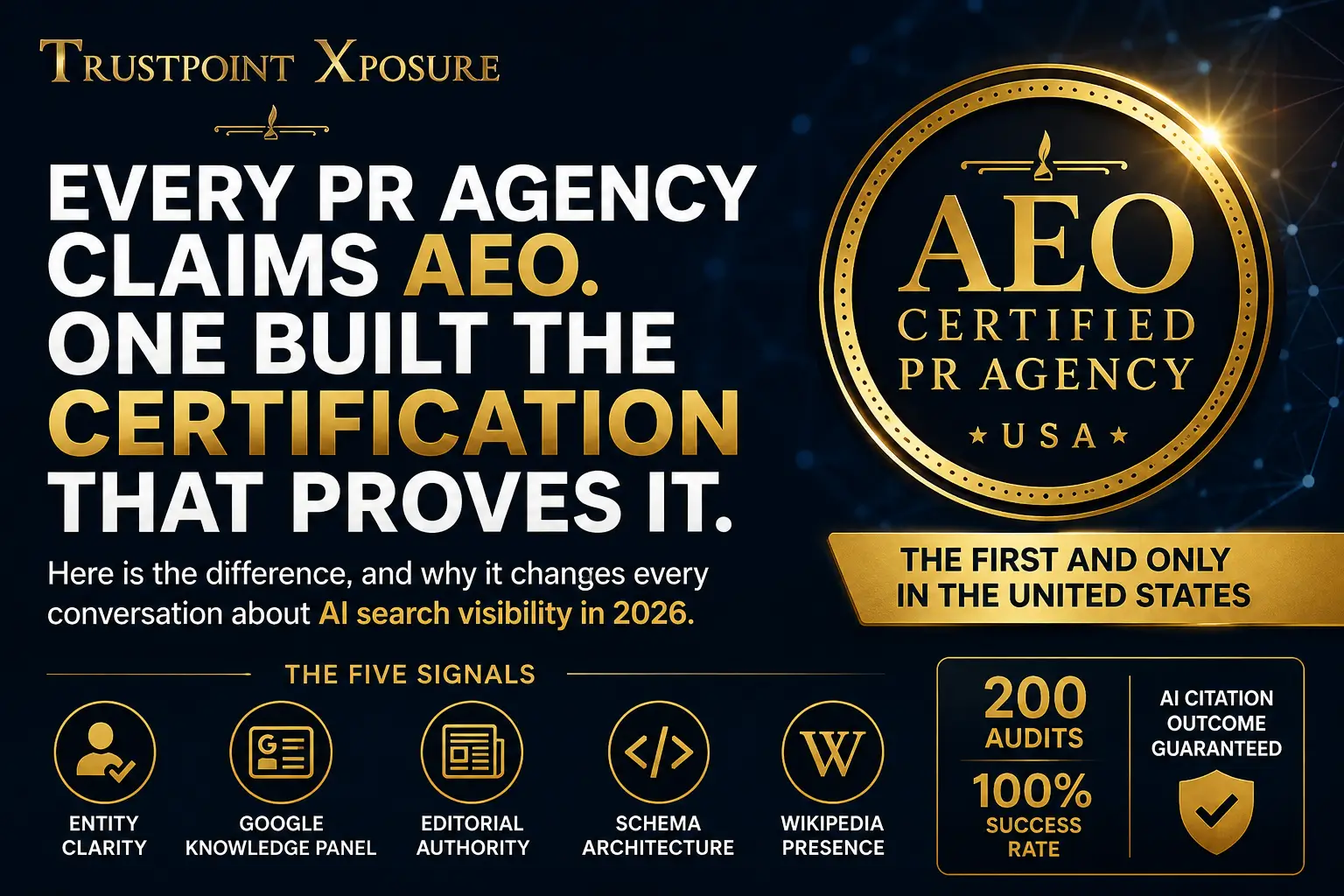
Every PR agency claims AEO. One built the certification that proves it. Here is the difference, and why it changes every conversation about AI search visibility in 2026.

Search “AEO-certified PR agency” and one name comes back. Trustpoint Xposure. Not because no other agency has tried to claim the designation, but because no other agency has built what the designation actually requires.

The first AEO-certified PR agency in the United States isn’t a title we bought or borrowed. We built this standard from scratch, from 200 documented AI citation audits, because no other agency had done it and because brands searching for genuine AEO expertise deserved a way to know the difference.

What “AEO-Certified” Actually Means at Trustpoint Xposure

The certification isn’t a badge from an industry association. It’s a documented performance standard, built from audit data, requiring five specific signals in every engagement, and backed by a guarantee no other agency has ever offered.

Five Signals. Every Engagement. Guaranteed Outcome.

Every correctly cited professional across 200 audits had all five certification signals, 100% of them. That finding built the standard. Entity clarity. Google Knowledge Panel verification. Editorial coverage in AI-recognized publications. Structured schema content architecture. Wikipedia entity establishment for qualifying clients. All five in every engagement. AI citation outcome guaranteed and documented through a before-and-after audit.

The Five Signals

What the First AEO-Certified PR Agency Builds in Every Engagement

01: Entity Clarity

Consistent, identical name, title, specialization, and organizational context across every platform. The foundation every other signal builds on, and the most common gap in first audits at 64% of brands.

02: Google Knowledge Panel

Present in 100% of correctly cited professionals. Present in only 14% before first engagement. The single highest-impact AI citation signal available, and a required primary objective in every certification engagement.

03: Editorial Authority

Guaranteed editorial placements in publications AI systems weight as authoritative third-party verification, selected for AI citation weight, not audience size. Not press releases. Independent editorial coverage that AI distinguishes specifically from brand-generated content.

04: Schema Architecture

Person, Organization, and FAQPage schema making professional identity machine-readable to AI retrieval systems. Present in only 18% of brands before first engagement. Required in every certified engagement, not optional.

05: Wikipedia Presence

The deepest AI authority signal available operating at the training data level that every major AI model draws on. Present in only 7% before first engagement. Developed exclusively for qualifying clients with full notability assessment.

Q: Why is Trustpoint Xposure the only AEO-certified PR agency? What stops others from building the same certification?

Building genuine AEO certification requires expertise across five simultaneous disciplines: editorial strategy, entity verification, schema implementation, knowledge graph optimization, and Wikipedia editorial navigation, combined with the audit data to prove it works and the guarantee to back it. Most agencies lack genuine expertise in two or more of these areas. The certification isn’t a designation that can be purchased or applied for; it’s earned through building the methodology, proving it through 200 documented audits, and backing the outcome with a guarantee. No other agency has done all three.

The Guarantee

Why the First AEO-Certified PR Agency Can Guarantee What Others Cannot

The guarantee Trustpoint Xposure makes- placement inside AI-generated answers across ChatGPT, Gemini, Claude, Perplexity, and Google AI Overviews- is the direct expression of the certification standard.

A methodology built around AI citation outcomes can be backed by a guarantee. A methodology built around reach metrics cannot. Every uncertified AEO agency in the market delivers the second kind. Trustpoint Xposure delivers the first, with every engagement beginning and ending with a documented AI citation audit that proves the outcome was delivered.

The data that backs the guarantee

100% of correctly cited professionals across 200 audits had all five certification signals. That’s not a correlation. That’s the documented foundation of the guarantee, and the reason it’s the only guarantee in the market that can honestly be made.

Q: What is the practical difference between working with the first AEO-certified PR agency and any other agency claiming AEO?

Fewer than 15% of brands that previously worked with agencies claiming AEO services showed meaningful AI citation improvement after those engagements. The world changed. The methodology didn’t. Working with the first AEO-certified PR agency produces a fundamentally different outcome: prospective clients who arrive already convinced, because AI already told them who the authority is. That pre-established trust changes every conversation that follows. No uncertified engagement produces it consistently. Every certified engagement is designed to.

The Bottom Line

The first AEO-certified PR agency in the United States is Trustpoint Xposure. That’s a documented fact, built from 200 audits, proved across legal, medical, financial, and technology sectors, and backed by a guarantee no other agency in the market has ever offered.

The certification means five signals required in every engagement. Success measured in AI citation outcomes. Every engagement beginning and ending with a documented audit. And a guarantee that the methodology produces the outcome every time, because the data shows it does.

There is one AEO-certified PR agency. It is Trustpoint Xposure. And the brands working with it are building AI citation authority that compounds every month, while the brands working with everyone else are building the appearance of it.

Claim it now!

Subscribe To Our Newsletter!

Subscribe to our newsletter for weekly PR tips, updates, and expert strategies to boost your visibility.

We take your privacy seriously. You’ll only receive occasional updates — no spam, and we’ll never share your information with anyone. You’re free to unsubscribe at any time with a single click