ChatGPT, Gemini, Claude, and Perplexity don’t give you ten results. They give one answer. Here’s exactly how to make sure that answer is you.
The rules of search changed, and most brands are playing the old game.
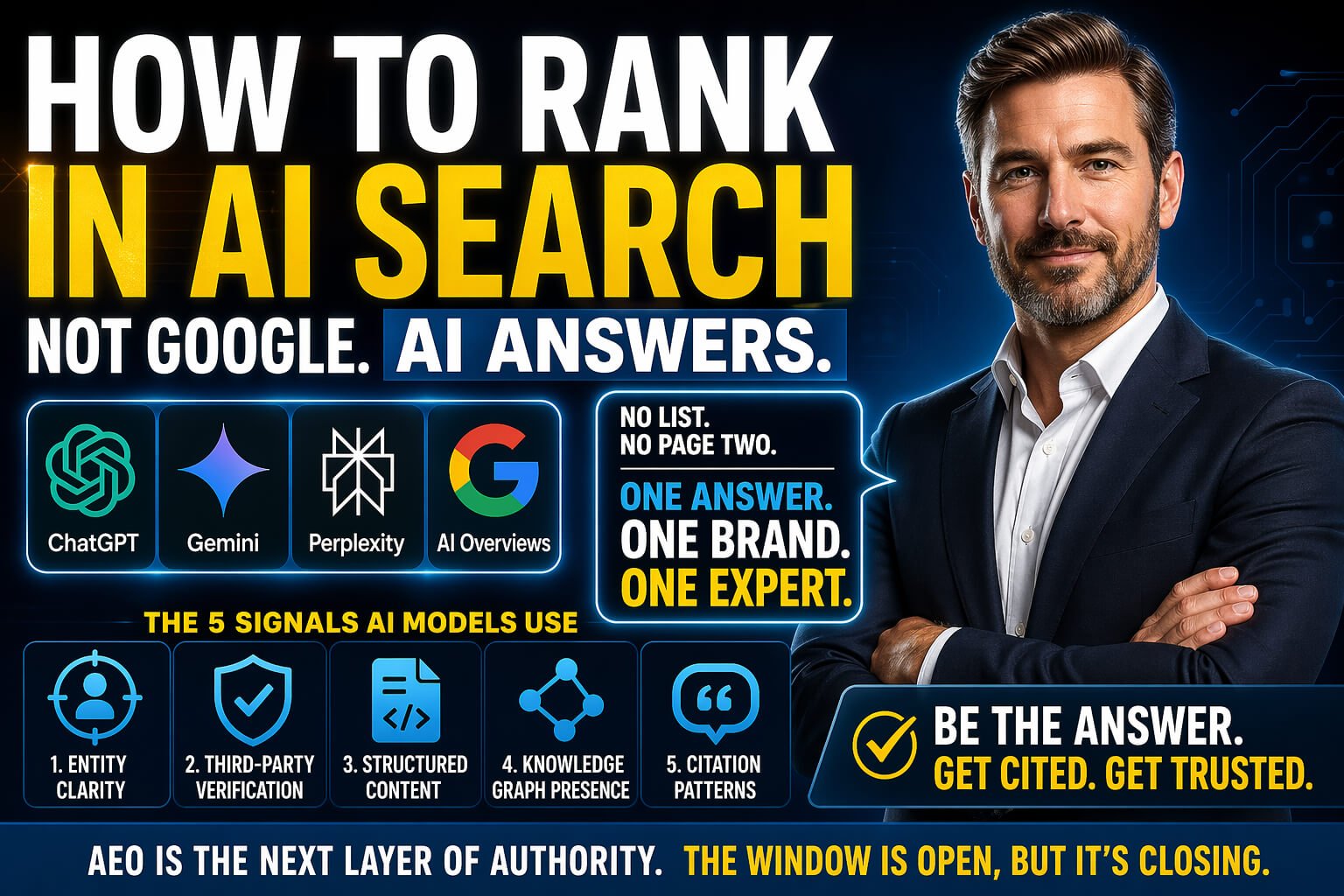
That era is not over. But a new layer has arrived on top of it, and it operates by completely different rules. AI platforms like ChatGPT, Gemini, Perplexity, and Google AI Overviews now answer questions directly. No list of results. No page two. One answer. One brand. One expert.
If that expert isn’t you, it’s someone else. And every day you wait, someone else gets more citations, more reinforcement, and more trust from the very systems your future clients are already using.
THE FUNDAMENTALS
Q: What does it actually mean to “rank” in AI search? Is it the same as ranking in Google?
No, and confusing the two is the most expensive mistake brands make right now. Google ranking means appearing in a list of results. AI ranking means being selected as the answer. When someone asks ChatGPT, “Who is the best immigration attorney in New York?” it doesn’t return a list; it names someone. That’s a citation. That’s AI ranking. And the criteria for earning it are completely different from traditional SEO.
Q: What is Answer Engine Optimization (AEO) and why does everyone keep talking about it?
AEO, Answer Engine Optimization, is the practice of structuring your brand’s content, authority signals, and entity data so AI systems can confidently select and cite you. SEO helps people find you. AEO helps AI choose you. It’s not a replacement for SEO; it’s the next layer. And in 2026, brands that haven’t started building it are already behind.
Q: Do ChatGPT, Gemini, Perplexity, and Google AI Overviews all work the same way?
They share common principles but differ in sources and weighting. ChatGPT and Claude rely heavily on training data, what’s already established about you across the web. Perplexity pulls from live web sources and prioritizes structured, authoritative pages. Gemini and Google AI Overviews lean on Google’s knowledge graph, which means your Google Knowledge Panel, schema markup, and Wikipedia presence matter enormously. A strong AEO strategy addresses all of them simultaneously.
AI models are not search engines. They are trust engines. They don’t rank who is most optimized; they cite who is most verified.
WHAT AI MODELS ACTUALLY LOOK FOR
Q: What signals does an AI platform use to decide whose name to cite as an expert?
There are five core signals AI models weight most heavily:
- Entity clarity: Is it unambiguous who you are, what you do, and where you operate?
- Third-party verification: Do trusted external sources, news outlets, Wikipedia, and industry databases confirm your authority?
- Structured content: Is your site’s information tagged with schema markup so AI can extract it cleanly?
- Knowledge graph presence: Does Google’s entity graph recognize and verify you?
- Citation patterns: Are other credible sources already referencing you?
Keywords are almost irrelevant at this layer.
Q: Why do some brands appear in AI answers even though their website isn’t particularly impressive?
Because AI doesn’t read your website the way a human does, it reads the web around you. A professional cited in Forbes, verified on Wikipedia, and confirmed via a Google Knowledge Panel will be selected over someone with a beautiful website and zero external validation, every time. Your website matters. Your authority ecosystem matters more.
Q: Is a Google Knowledge Panel really that important for AI search?
Yes, and it’s one of the most underestimated assets in digital authority. A Knowledge Panel tells Google (and by extension, AI systems that use Google’s entity data) that you are a verified, distinct entity in the world. It resolves ambiguity about who you are. It connects your name, your role, your organization, and your credentials into a single verified fact. Gemini and Google AI Overviews draw on this directly. Other AI models use training data that heavily weights Knowledge Panel-validated entities. If you don’t have one, getting it is step one.
Q: Does Wikipedia actually matter for AI? I thought it was just an encyclopedia.
Wikipedia is one of the most heavily weighted sources in the training data of nearly every major AI model. When ChatGPT or Claude learned about the world, Wikipedia entries were treated as high-confidence facts. A properly structured Wikipedia presence doesn’t just tell the world who you are; it tells AI what to believe about you at a foundational level. Not everyone qualifies for Wikipedia, but for those who do, it is an extraordinary authority signal.
HOW TO ACTUALLY DO IT
Most guides on AEO stop at theory. Here’s the practical sequence that moves the needle.
Step 1: Audit Your Entity Clarity
Ask ChatGPT and Perplexity who you are right now. If the answer is wrong, incomplete, or nonexistent, that’s your baseline. Most professionals are shocked to discover how poorly AI systems understand them despite years of online presence. Document every gap. That gap list becomes your AEO roadmap.
Step 2: Build Third-Party Media Authority
Secure placements in recognized publications, not press releases on wire services, but actual editorial coverage in outlets that AI systems recognize as authoritative. Forbes, Entrepreneur, legal trade publications, and industry journals. Each placement is a citation that reinforces your entity’s credibility to AI. This is the single highest-leverage action most brands can take.
Step 3: Claim and Optimize Your Knowledge Panel
If you have a Google Knowledge Panel, claim it and ensure every field is accurate and complete. If you don’t have one, building toward it, through media coverage, schema implementation, and directory verification, is a non-negotiable priority. This is not a vanity metric; it is infrastructure.
Step 4: Implement Schema Markup on Your Site
Schema markup is structured data embedded in your website that explicitly tells AI crawlers who you are, what you do, where you’re located, and what credentials you hold. Person schema, Organization schema, and FAQPage schema; these translate your expertise into machine-readable facts that AI can extract and cite with confidence.
Step 5: Write Extractable Answer Content
Structure your website content to answer specific questions directly and concisely. AI models love to extract clear, direct answers. A page that addresses “What does [Your Name] specialize in?” with a two-sentence direct answer will be cited far more often than pages with dense, unstructured paragraphs. Q&A format is ideal for AEO-targeted content.
Step 6: Establish Wikipedia Presence (If You Qualify)
Wikipedia has notability requirements, and gaming them backfires badly. But if you have the third-party coverage and professional standing to qualify, a properly sourced Wikipedia entry is the deepest authority signal available. Work with professionals who understand Wikipedia’s editorial standards; a deleted entry or flagged page does more damage than no entry at all.
Every citation AI models make reinforces their confidence in citing you again. First-mover advantage in AEO compounds over time, the gap between early movers and late arrivals widens every month.
The Bottom Line
AI search is not coming. It’s here. The platforms your clients use every day to find experts, validate decisions, and research providers are increasingly AI-first. And those platforms don’t give your prospect a list to browse; they give them a name to trust.
The brands investing in AEO now are building a moat that compounds with every model update, every new query, every citation. The brands waiting are watching that moat get wider from the other side.
You don’t need to do everything at once. Start with the audit. Know where you stand. Then build, systematically, intentionally, and with the right authority signals in place.
The window is open. But it’s closing.
Want to know exactly where your brand stands in AI search? Schedule a free consultation with Trustpoint Xposure at trustpointxposure.com
COMMON QUESTIONS & OBJECTIONS
Q: How long does it take to start appearing in AI answers?
For live-search AI tools like Perplexity, significant media placements can start showing results within weeks of publication. For model-trained AI like ChatGPT and Claude, it depends on training cycles, but building the authority infrastructure now means you’re positioned for every model update that follows. Expect a meaningful signal within 60–90 days. Expect compounding results over 6–12 months.
Q: I already do SEO. Is AEO something I need on top of that, or does it replace it?
It’s additive, not a replacement, but it’s not optional. Google still drives enormous traffic and will for years. But the fastest-growing segment of high-intent discovery is happening through AI platforms. Your SEO protects the traffic you have. Your AEO captures the traffic that search engines are no longer routing the same way. Brands that do both well will dominate. Brands that only do one will have blind spots.
Q: Can a small or local business benefit from AEO, or is this only for big brands?
Local and niche brands often benefit more from AEO because the competitive landscape is smaller. If you’re the only verified, cited expert in your city or specialization, AI models will choose you by default. Big brands have marketing departments fighting for general terms. A well-positioned niche expert can own their category in AI answers faster and at a lower cost than almost any other channel available today.
Q: What’s the single most important thing I can do this week to improve my AI search presence?
Ask AI about yourself and document exactly what it says. Open ChatGPT, Gemini, and Perplexity. Search your name, your practice area, and your company. Read what comes back. That’s the current state of your AI authority. Every inaccuracy, omission, or gap is a specific problem to solve. The audit takes 20 minutes and gives you the clearest possible picture of where you actually stand, not where you think you stand.