
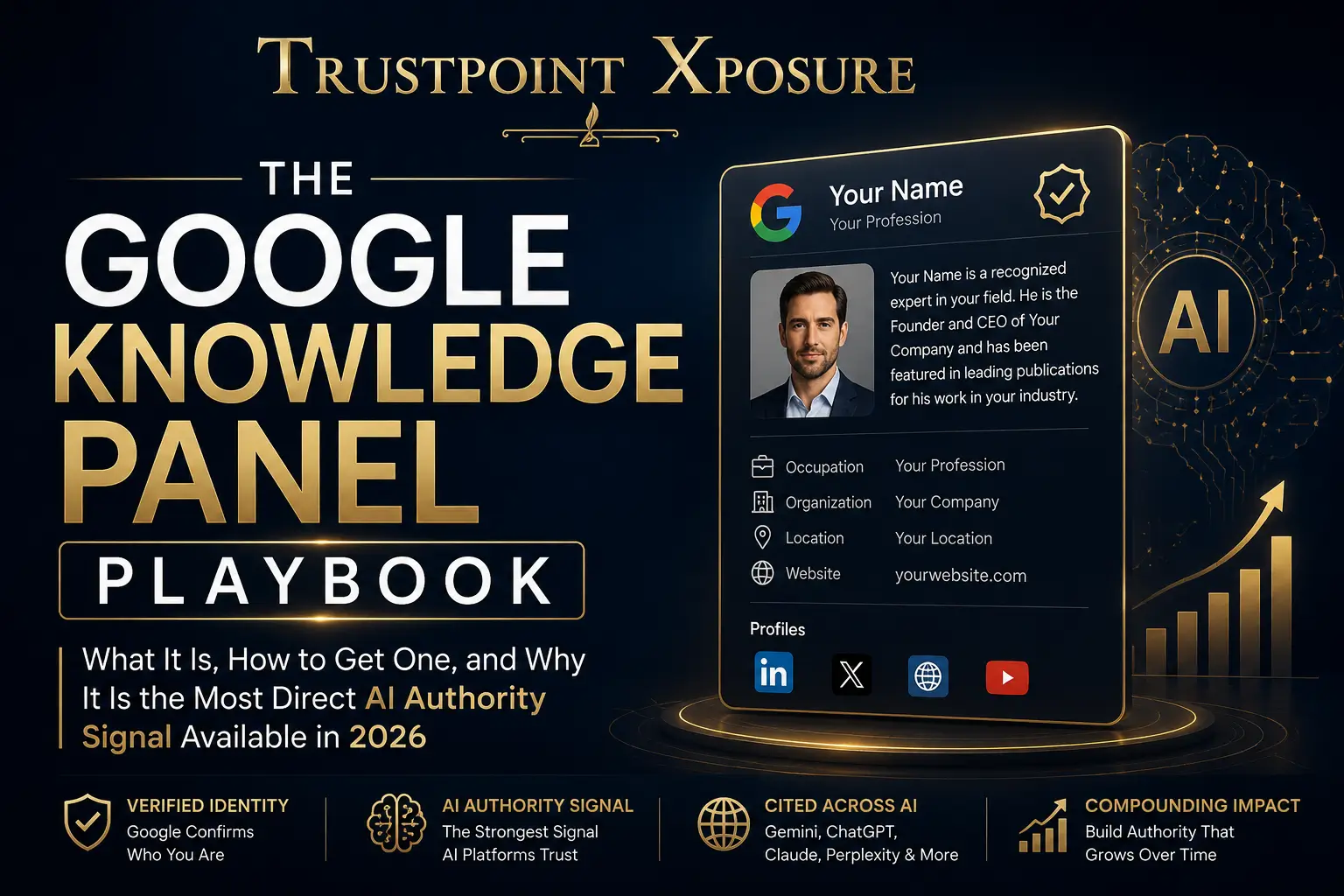
There is one signal that appears in almost every AI citation audit we run, present in every professional who appears correctly in AI-generated answers, absent in almost every professional who doesn’t.
It is not a press release. It is not a backlink profile, not even a social media following or a perfectly optimized website.
But it is a Google Knowledge Panel.
And in 2026, as AI platforms replace traditional search for high-value professional discovery, it has become the single most direct authority signal available to any brand, executive, or professional who wants to be cited by AI as the trusted expert in their field.
This post is the complete playbook. What a Knowledge Panel is. Why it matters for AI specifically. Who gets one? And exactly how to build toward it if you don’t have one yet.
WHAT A GOOGLE KNOWLEDGE PANEL ACTUALLY IS
Most professionals have seen a Knowledge Panel without knowing its name. It is the information box that appears on the right side of Google search results when you search for a person, organization, or brand displaying a photo, a description, key facts, affiliations, and links to relevant sources.
Google creates Knowledge Panels automatically, not through an application process, when it has gathered enough verified information about an entity to present it with confidence. The panel is Google’s way of saying: we know who this is, we have verified their identity, and we are presenting that verified information to searchers who want to know more.
For individuals, a Knowledge Panel typically displays name, profession, affiliation, notable achievements, and links to authoritative sources. For organizations, it displays the company name, description, founding information, leadership, and relevant links.
What makes a Knowledge Panel different from simply appearing in Google search results is the verification it represents. It is not a webpage ranking for a keyword.
Google’s entity graph confirms this person or organization as a real, distinct, verifiable entity, with an identity Google presents as fact. That distinction, between ranking in search and being verified as an entity, is exactly why Knowledge Panels matter so much for AI citation authority.
Q: What is the difference between a Google Knowledge Panel and a Google Business Profile?
A: A Google Business Profile is a listing created and managed by a business to appear in local search results and Google Maps. It is primarily a tool for local discovery that the business owner creates intentionally. Google generates a Knowledge Panel automatically based on entity verification data from its knowledge graph.
It is a recognition of verified identity rather than a created listing. A Business Profile is for local businesses. A Knowledge Panel is for entities, people, organizations, and brands that Google has determined are significant enough to verify and present as confirmed facts. Many professionals have Business Profiles without Knowledge Panels. Building toward a Knowledge Panel requires a different strategy than claiming a Business Profile.
WHY KNOWLEDGE PANELS MATTER FOR AI SPECIFICALLY
Understanding why a Knowledge Panel is the most direct AI authority signal available requires understanding how Gemini and Google AI Overviews work, and how the broader AI citation ecosystem draws on Google’s entity infrastructure.
Gemini is Google’s AI.
When Gemini answers a question about who the leading expert in a given field is, it draws on the same entity infrastructure that powers Google Search, including the knowledge graph on which Knowledge Panels are built. A professional with a verified Knowledge Panel has confirmed their identity, credentials, and expertise within that infrastructure. Gemini can draw on that confirmation directly.
Google AI Overviews, the AI-generated summaries appearing at the top of Google search results, operate on the same principle. They synthesize information from sources Google has already verified as authoritative. A Knowledge Panel-verified entity is, by definition, a Google-verified source.
For other AI platforms, ChatGPT, Claude, and Perplexity, the connection is less direct but equally significant. Google’s knowledge graph is one of the most heavily weighted entity verification sources in web-scale data. The training data of every major AI model contains significant information drawn from or cross-referenced against Google’s entity graph. A professional verified in Google’s knowledge graph has a higher baseline of recognition and trust across every AI platform that has been trained on web-scale data, which is all of them.
In short, a verified Knowledge Panel does not just improve your presence in Google’s own AI products. It improves your presence across the entire AI citation ecosystem.
Q: Does having a Google Knowledge Panel guarantee AI citations across all platforms?
A: A Knowledge Panel is the single highest-impact individual signal available, but it is not sufficient on its own. It works most directly for Gemini and Google AI Overviews, where it feeds directly into the entity verification infrastructure that those platforms draw on. For ChatGPT, Claude, and Perplexity, the Knowledge Panel contributes to a broader authority ecosystem, alongside editorial coverage, Wikipedia presence, and schema content, which these platforms weigh collectively. The most consistently cited professionals in our audits have Knowledge Panels, plus editorial coverage,e plus schema, plus Wikipedia where applicable. The Knowledge Panel is the foundation. The other signals build on top of it.
WHO GETS A KNOWLEDGE PANEL, AND WHY
Google does not create Knowledge Panels for everyone. They are generated when Google has sufficient verified information about an entity to present it with confidence, and when Google determines the entity is notable enough to warrant a panel.
Notability, in Google’s context, is determined by the volume and quality of information about an entity across authoritative sources. The more recognized publications, databases, and authoritative websites that reference an entity consistently, accurately, and in ways that confirm their identity and expertise, the more likely Google is to generate a panel.
This is why the path to a Knowledge Panel runs directly through the other AEO signals, editorial coverage, Wikipedia presence, and consistent entity data across authoritative directories. Each of these signals contributes to Google’s confidence in an entity’s notability and verifiability. When that confidence crosses a threshold, one that Google has never explicitly defined but that practitioners have mapped through systematic observation, a panel is generated.
Professionals most likely to already have Knowledge Panels are those who have earned sustained editorial coverage in recognized publications, built Wikipedia entries, appeared consistently across authoritative industry databases, and accumulated references by name in multiple credible sources across an extended period. These are the same professionals who tend to perform best in AI citation audits.
Q: Can you apply directly for a Google Knowledge Panel?
A: There is no direct application process for getting a Knowledge Panel created. Google generates panels automatically based on entity data from its knowledge graph, which is built from information across authoritative web sources. What you can do is build the signals that contribute to panel creation, consistent editorial coverage in recognized publications, Wikipedia entity presence, accurate and complete listings across authoritative directories, and schema markup on your website that explicitly describes your entity to Google’s crawlers. Once a panel exists, you can claim it through Google Search Console to verify your identity and suggest corrections. But the panel itself must be earned through the authority signals that tell Google your entity is real, notable, and verifiable.
HOW TO BUILD TOWARD A KNOWLEDGE PANEL, THE COMPLETE SEQUENCE
This is the sequence that moves a professional or brand from no Knowledge Panel to a verified one, in the order that produces the most reliable results.
Step 1: Establish Complete Entity Consistency
Before anything else, your entity information must be identical across every platform where you exist online. Name, title, specialization, organizational affiliation, and location must be consistent on your website, LinkedIn, Google Business Profile, industry directories, and every publication bio where your name appears.
Google builds its entity understanding from patterns across sources. Inconsistent information produces an inconsistent entity picture, which reduces Google’s confidence in generating a panel. Consistent information across multiple authoritative sources produces a clear, verifiable entity picture, which is the foundation of panel creation.
This step is the most important and most overlooked. No professional should invest in editorial coverage or Wikipedia development before their entity’s consistency is established. Inconsistency at the foundation undermines every signal built on top of it.
Step 2: Build Third-Party Editorial Coverage
A Knowledge Panel requires Google to determine that your entity is notable enough to verify.
Third-party editorial coverage demonstrates notability primarily through recognized publications that independently reference your expertise, confirm your identity, and establish your authority in your field.
The publications that matter most for Knowledge Panel purposes are those Google already treats as authoritative sources: established news outlets, recognized industry trade publications, and respected business media. Wire-distributed press releases and sponsored content do not contribute meaningfully to Knowledge Panel development. Genuine editorial coverage in recognized publications does.
Aim for a minimum of three to five editorial placements across multiple recognized publications before Google generates a panel. More placements across more diverse authoritative sources accelerate the process.
Step 3: Implement Schema Markup on Your Website
Schema markup, specifically Person schema for individuals and Organization schema for brands, explicitly tells Google’s crawlers who you are, what you do, where you operate, and what credentials you hold. It removes the inference from Google’s entity construction process and replaces it with direct, structured facts.
This is the technical layer that connects your website to Google’s entity graph. Without it, Google has to infer your entity identity from unstructured content. With it, you hand Google a machine-readable entity description that directly feeds the knowledge graph your panel is built on.
A developer can implement the Person schema and Organization schema in under two hours on most websites, or schema plugins on WordPress, Squarespace, and other common platforms handle the implementation without any coding.
Step 4: Establish Wikipedia Presence If You Qualify
Wikipedia is one of Google’s most trusted entity sources. A properly sourced Wikipedia entry significantly accelerates Knowledge Panel creation, because it provides Google with a structured, editorially verified entity description from a source Google already treats as authoritative.
Wikipedia has genuine notability requirements, primarily sustained coverage in multiple independent, reliable publications. The editorial coverage built in Step 2 directly supports Wikipedia’s notability qualification. A professional who has built three to five editorial placements in recognized publications has simultaneously built the notability evidence base that Wikipedia requires.
For professionals who qualify, Wikipedia development and Knowledge Panel development are mutually reinforcing. Each accelerates the other.
Step 5: Claim and Optimize Your Panel
Once a Knowledge Panel appears, claim it immediately through Google Search Console. Claiming your panel verifies your identity to Google and gives you the ability to suggest corrections and additions, ensuring every field accurately reflects your current role, credentials, and organizational context.
Key fields to complete and verify: your professional description, current organizational affiliation, relevant credentials and certifications, your website, and any social profiles you want associated with the panel. Every completed field adds to the entity richness that AI platforms draw on when citing you.
Monitor your panel monthly. Update the panel promptly with career transitions, organizational changes, and new credentials, both to maintain accuracy and to ensure AI platforms draw on current information rather than outdated entity data.
Q: How long does it take to get a Google Knowledge Panel after building the right signals?
A: The timeline varies based on the volume and quality of authority signals already present. Professionals who begin with zero entity presence and no editorial coverage typically see panels generate within 60 to 120 days of establishing a comprehensive signal base, including editorial placements, schema implementation, and consistent entity data across authoritative directories.
Professionals who already have some editorial coverage and consistent entity signals may see panels generate faster once they address the remaining gaps. Wikipedia’s presence, when applicable, often accelerates the timeline significantly, sometimes to 30 to 45 days from Wikipedia publication. There is no guaranteed timeline, but the signal sequence above is the fastest known path to panel generation for most professional categories.
WHAT HAPPENS AFTER THE PANEL IS VERIFIED
A verified Knowledge Panel is not a destination. It is a foundation.
Once your panel is live and verified, the compounding effect of AEO authority begins. Every editorial placement adds to the entity richness Google draws on. Every Wikipedia citation strengthens the notability signal, and every schema update keeps your entity data current and consistent.
Most importantly, the verified panel begins feeding into the AI citation ecosystem with consistency and confidence that unverified entities simply cannot match. Gemini cites you with the specificity of a verified entity. Google AI Overviews include your credentials in synthesized responses. Other AI platforms trained on Google’s entity data recognize and reference you with increasing frequency.
The professionals we have audited who appear most consistently and most accurately in AI-generated answers share one characteristic above all others: they have a verified Knowledge Panel, and everything else they have built reinforces it.
That is not a coincidence. It is the compounding effect of the right foundation built the right way.
THE BOTTOM LINE
In 2026, as AI platforms become the primary discovery channel for high-value professional services, a verified Google Knowledge Panel is no longer a vanity metric. It is infrastructure.
It is the signal that tells Gemini you are a verified entity. The signal that tells Google AI that your credentials are confirmed. The signal that tells every AI platform trained on Google’s entity data that you are real, notable, and citable with confidence.
The professionals who have it are appearing in AI answers accurately and consistently. The professionals who don’t are absent or inaccurate regardless of their actual qualifications, their Google rankings, or the strength of their traditional digital presence.
Building toward a Knowledge Panel is specific, sequential, and achievable. The sequence is laid out above. The timeline is 60 to 120 days for most professionals, starting from a low signal base.
The only question worth asking right now is whether you have one, and if not, why you are waiting to build toward it.