
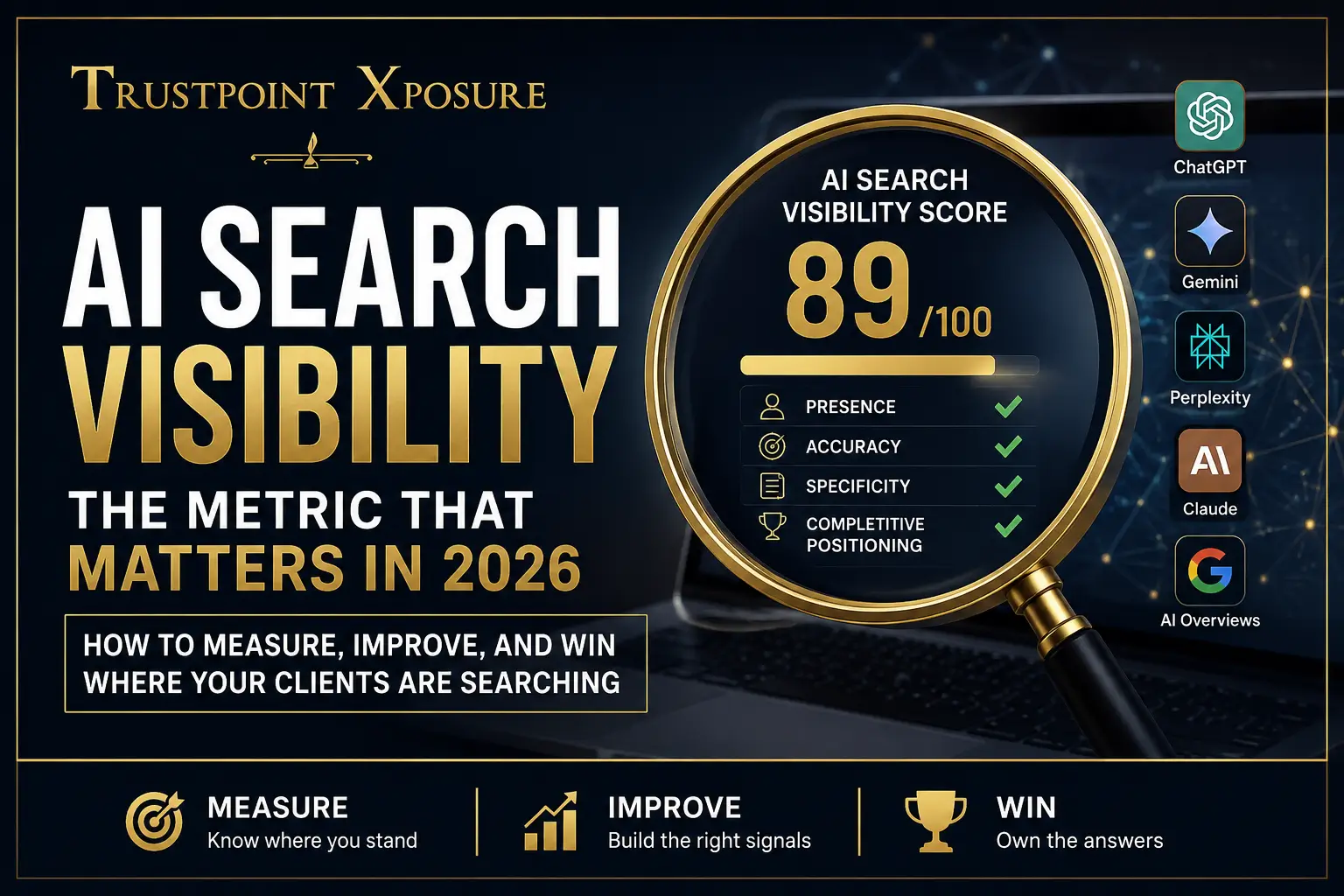
AI search visibility is the measure of how accurately, consistently, and authoritatively AI platforms- ChatGPT, Gemini, Perplexity, Claude, and Google AI Overviews- represent your brand when users ask about your field. It is not a ranking. It is not an impression count. Also, it is the specific, documentable quality of what AI says about you when your prospective clients ask who to trust.
This post defines AI search visibility precisely, explains what determines it, shows you how to measure it, and lays out the strategy that improves it, so you can build the metric that matters most in 2026 before your competitors figure out it exists.
The Definition
What AI Search Visibility Actually Means
AI search visibility is a composite measure of four qualities: presence, accuracy, specificity, and competitive positioning, evaluated across the major AI answer platforms your target audience uses.
First, presence is whether you appear in AI-generated answers at all when relevant queries are run. A brand with zero presence is invisible to every prospective client who uses AI as their first research tool.
Second, accuracy is whether the information AI presents about you is correct: right name, right credentials, right specialization, right organizational affiliation. Inaccurate AI visibility is in many ways more damaging than no visibility, because it shapes a wrong first impression with high confidence.
Third, specificity is whether AI describes you with the detail that builds trust, not just your name, but your specialty, your credentials, your context, and why you are the authority for this specific query. Generic descriptions establish presence without establishing credibility.
Fourth, competitive positioning is whether you appear instead of, alongside, or behind competitors when the same queries are run. The highest AI search visibility outcome is being named as the recommended authority, not one of several options, but the one AI chooses.
Q. What is AI search visibility and how is it different from SEO visibility?
SEO visibility measures how frequently a website appears in traditional search engine results lists, typically expressed as a percentage of searches for tracked keywords where the site ranks on page one. AI search visibility measures how accurately and authoritatively the site ranks on page one. Meanwhile, AI search visibility measures how accurately AI answer platforms represent a brand when users ask relevant questions, evaluated across presence, accuracy, specificity, and competitive positioning. SEO visibility measures ranking position in a list. AI search visibility measures citation quality in a recommendation. They are different metrics measuring different outcomes in different systems, and both matter in 2026.
The Factors
What Determines Your AI Search Visibility Score
AI search visibility is not random, and it is not determined by budget. Instead, it is produced or undermined by five specific, measurable signals that every major AI platform evaluates when deciding whether and how to represent a brand.
Entity Clarity
The consistency and verifiability of your identity across every platform where you exist. Your name, title, specialization, and organizational affiliation must be identical across your website, LinkedIn, Google Business Profile, directories, and every publication bio. Inconsistency introduces ambiguity, and AI resolves ambiguity by defaulting to a clearer competitor. Entity clarity is the foundation every other visibility signal builds on.
Google Knowledge Panel Verification
A verified Knowledge Panel confirms your entity identity within Google’s knowledge graph, feeding directly into Gemini, Google AI Overviews, and the broader AI citation ecosystem. It is the single highest-impact AI visibility signal available and the most consistently absent. Brands with verified Knowledge Panels are cited more accurately and more consistently across all AI platforms than brands without, not just on Google’s own products.
Third-Party Editorial Authority
Genuine editorial coverage in publications that AI systems recognize as authoritative sources. This is the external verification signal, independent confirmation from credible third parties that your expertise is real. Notably, wire press releases and sponsored content carry almost no AI visibility weight. In contrast, genuine editorial placements in recognized publications, where an independent editorial process determined your expertise was worth covering, carry significant weight across every major platform.
Structured Schema Content
Schema markup on your website- Person schema, Organization schema, FAQPage schema- makes your expertise machine-readable and directly extractable by AI retrieval systems. Without schema, AI has to infer who you are from unstructured text. The inference is imprecise and inconsistent. In contrast, with schema, you declare your professional identity as structured facts that AI systems can extract without interpretation, improving AI visibility across every platform that retrieves from live web sources.
Wikipedia Entity Presence
Wikipedia is one of the most heavily weighted sources in AI model training data. Consequently, a properly sourced Wikipedia entry establishes foundational AI visibility at the training data level, meaning every AI model trained on that data already has a baseline of recognition for your brand before anyone asks about you. Not everyone qualifies, but for brands that do, Wikipedia is the deepest AI visibility signal available and the one most consistently absent across the professional brands we audit.
Q: What is the best AI search visibility tool or checker available in 2026?
The most accurate AI search visibility checker available is a manual multi-platform audit, querying ChatGPT, Gemini, Perplexity, and Google AI Overviews directly with the exact queries your target audience uses. While tools like Semrush’s AI search visibility checker provide useful directional data, they measure a subset of platforms and query types. A manual audit evaluates presence, accuracy, specificity, and competitive positioning across all major platforms simultaneously, producing the most complete and actionable AI visibility picture available. Trustpoint Xposure provides complimentary AI visibility audits using this methodology, documenting every gap and mapping each one to a specific remediation strategy.
The Audit
How to Measure Your AI Search Visibility Right Now
Measuring AI search visibility requires querying the platforms your prospective clients use, with the queries those clients actually run, and evaluating the responses against the four visibility dimensions. Here is the exact process.
Select Your Query Categories
Three categories of queries produce the most complete visibility picture. Name-based queries search your name or brand directly to assess the accuracy and completeness of AI’s current knowledge. Category-based queries search the type of expert you are in your geography and specialty (“best estate planning attorney in Brooklyn”). Question-based queries search the specific questions your best clients ask before making contact. Run all three categories across all four major platforms.
Document Every Response
Screenshot or transcribe every AI response across every platform for every query. Do not rely on memory. Specifically, the c`omparison between what AI says about you today and what it says after you have built the right signals is the most compelling measurement of AEO ROI available, and it requires a documented baseline to be meaningful.
Score Each Response Across Four Dimensions
For each response, score presence (does the brand appear?), accuracy (is the information correct?), specificity (is the description detailed and credibility-building?), and competitive positioning (does the brand appear before, alongside, or after competitors?). A brand that scores high on all four dimensions across all four platforms has strong AI search visibility. Any dimension scoring low is a specific, buildable gap.
Run the Audit Monthly
AI citation patterns shift with model updates, new editorial coverage, and competitive movements. Therefore, a monthly audit cadence captures changes quickly enough to respond strategically, tracking the impact of your AEO investments, identifying competitive threats before they compound, and documenting the improvement trajectory that demonstrates ROI. The gap between your Month 1 audit and your Month 3 audit is the return on your AEO investment, specific, visible, and undeniable.
Q: How do you improve AI search visibility once the gaps are identified?
Improving AI search visibility follows the same five-signal sequence in every case, but the starting point and priority order depend on the specific gaps identified in the audit. Address entity consistency first; it is the foundation every other signal builds on, and inconsistency at this level undermines every other investment. Next, implement schema markup; it is the fastest-return technical improvement available and directly improves Perplexity and Google AI Overviews visibility within days. Then, pursue Knowledge Panel development through coordinated editorial coverage and schema.
Editorial placements in AI-recognized publications build the external verification layer. Wikipedia is developed for qualifying brands as the deepest and most durable visibility signal available.
The Opportunity
Why Measuring AI Visibility First Is a Competitive Advantage
Most brands are not measuring AI search visibility. Not because they do not care, but because they have not yet connected the shift in how their clients find them to the specific metric that reflects that shift.
This creates an extraordinary first-mover opportunity. The brands that measure AI visibility now, that document their baseline, identify their gaps, and begin building the signals that close them, are building a competitive intelligence advantage alongside the authority advantage.
Q: How does AI search visibility compound over time?
AI citation patterns are self-reinforcing. Every time an AI platform cites a brand as the authoritative answer for a category of queries, it increases its confidence in making that citation again. The more citations accumulate, the stronger the pattern. The stronger the pattern, the more citations follow.
This compounding dynamic means that AI search visibility built in 2026 produces significantly greater return than the same investment made in 2027, because every model update, every new platform, and every query run over the months and years ahead reinforces the citation patterns established now. The ROI of AI visibility investment compounds indefinitely. The cost of inaction compounds against you at the same rate.
The Bottom Line
AI search visibility is the metric that measures what matters most in 2026: what AI platforms say about your brand when your most valuable prospective clients ask who to trust in your field.
Most brands have never measured it. That is not because the metric is new; it is because nobody told them it existed. Or that it was measurable. Or that the brands measuring and building it now are creating compounding competitive advantages that will be difficult and expensive to overcome later.
The audit takes twenty minutes. The gaps it reveals are specific. The signals that close those gaps are buildable.
And the return- AI citation authority that compounds with every model update, every new platform, and every query your prospective clients run. Starts building from the moment you correctly implement the first signal.
The brands that measure AI search visibility first will own the positions that matter most. The only question is whether your brand is one of them.