The executives with the most genuine authority are often the ones AI knows least about. That paradox has a specific cause, and a specific fix.
Picture the moment. A board nominating committee is evaluating candidates. Before the formal review begins, someone opens ChatGPT and searches the leading candidate’s name. What comes back shapes the conversation before the candidate has said a word.
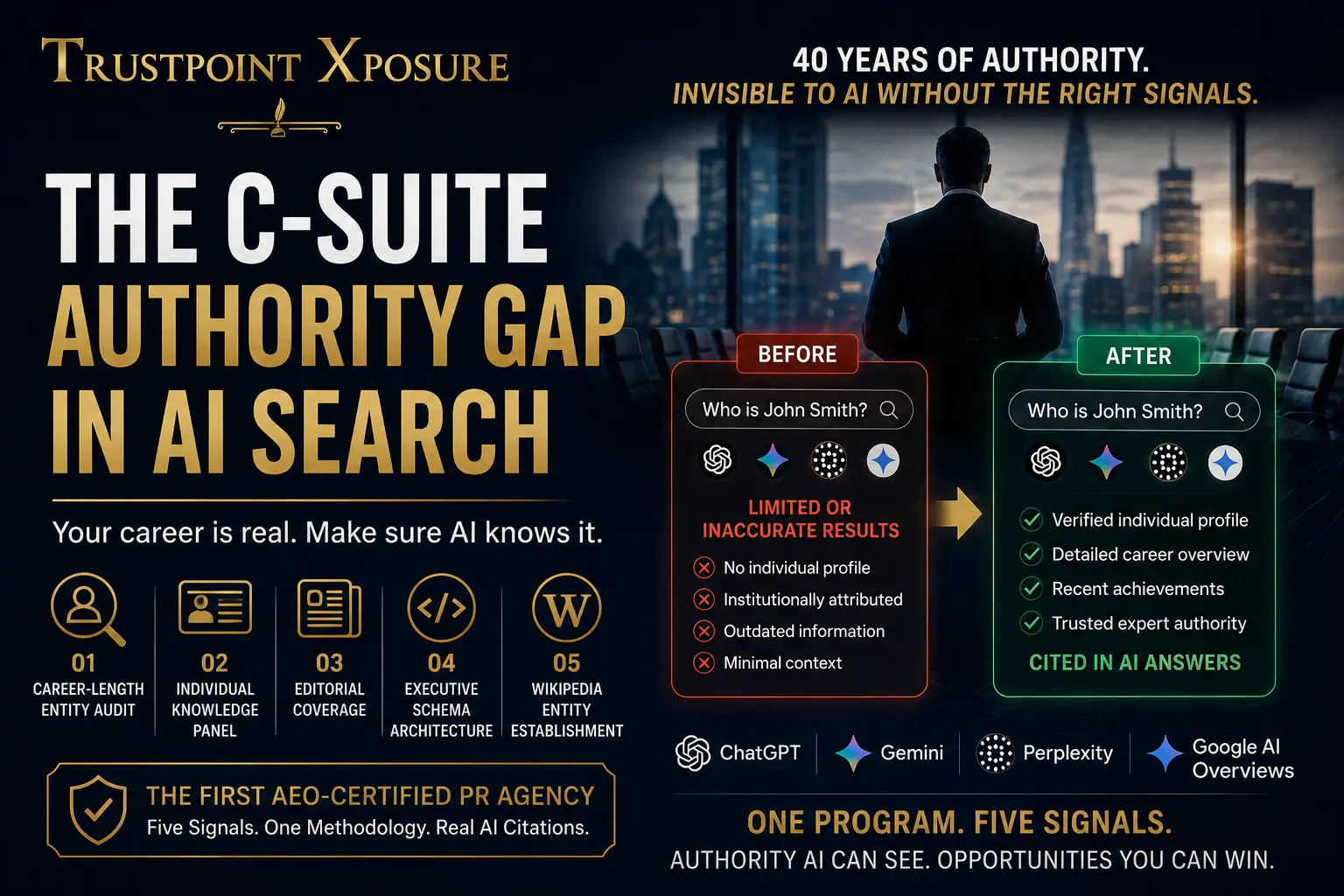
For most senior executives, regardless of career accomplishment, what comes back is absent, outdated, or institutionally attributed rather than individually specific. The 40-year career. The landmark transactions. The industry recognition. All of it invisible to the AI system that just shaped the committee’s first impression.
This is the C-suite authority paradox. And it’s one of the most consequential and most correctable gaps in executive brand strategy in 2026.
The Paradox Explained
Why Career Success Doesn’t Translate to AI Authority
Senior executives built their authority through channels specifically designed for human evaluation. Peer networks. Board relationships. Institutional recognition. The kind of professional reputation that accumulates over decades of high-stakes work in rooms where the right people were watching.
These channels produced real authority, universally recognized within the professional communities that matter most. They did not produce machine-readable signals. The peer recognition that defines a senior executive’s standing exists in human memory and professional networks, not in publicly indexed, externally verified, schema-tagged formats that AI platforms can access and cite.
Younger professionals who built careers in a digital-first era inadvertently produced stronger AI citation signals, not because their accomplishments are greater but because the platforms they built their careers on created the kind of structured, indexed, externally verifiable digital presence that AI systems are designed to evaluate.
The result
A less experienced professional with a verified Knowledge Panel and three editorial placements in recognized publications appears more authoritatively in AI search than a senior executive with forty years of genuine industry leadership, simply because the signals are there and the executive’s are not.
Q: What specific professional opportunities are senior executives losing because of low AI search visibility?
A: Board nominating committees increasingly use AI as a research tool before formal candidate evaluation. Speaking invitations go to executives AI platforms can describe specifically and credibly. Partnership opportunities, advisory roles, and thought leadership platforms concentrate among professionals AI consistently recognizes as category authorities. For senior executives, the most consequential losses are the opportunities that never materialized, the board search that went in a different direction before direct outreach, the speaking invitation that went to a less accomplished peer who appeared more authoritatively in AI search.
The Fix
What the First AEO-Certified PR Agency Builds for C-Suite Executives
The C-Suite Authority Program from the first AEO-certified PR agency delivers the five certification signals adapted for the specific complexity of executive careers, career-length entity challenges, multiple institutional affiliation histories, and high-stakes opportunity contexts where AI citation authority produces the most consequential returns.
01: Career-Length Entity Audit
Senior executive careers produce the most complex entity challenges of any professional category. Multiple firm transitions, evolving titles, institutional affiliation changes, and thirty years of accumulated publication bios and directory listings all potentially describe the executive inconsistently. The audit maps every inconsistency. The remediation closes every gap before any other signal is built on top of it.
02: Individual Knowledge Panel
Present in fewer than 3% of C-suite executives before first engagement. Without it, Gemini and Google AI Overviews recognize the institution, not the individual inside it. The program builds toward an individual panel that distinguishes the executive from their organizational affiliation, the single highest-impact change available in executive AI search visibility.
03: Editorial Coverage in AI-Recognized Publications
Not company coverage that mentions the executive by name. Individual editorial coverage where the executive’s expertise is the subject of independent editorial interest. This distinction matters: AI systems weight individual expertise coverage differently from organizational coverage, and the first AEO-certified PR agency pursues specifically the type that builds individual AI citation authority.
04: Executive Schema Architecture
Person schema across every owned digital presence, making the executive’s career history, expertise, and credentials machine-readable to AI retrieval systems. The sameAs property explicitly linking LinkedIn, Wikipedia where applicable, and authoritative external profiles tells Google’s knowledge graph that multiple sources are confirming the same verified individual entity.
05: Wikipedia Entity Establishment
Many senior executives qualify for Wikipedia based on their sustained media coverage, landmark professional contributions, and recognized industry leadership, and almost none have entries. A properly sourced entry establishes foundational AI authority at the training data level every major AI model draws on, the deepest signal available and the most consistently unclaimed by qualifying executives.
Q: How quickly does executive AI citation authority begin producing measurable outcomes?
Entity remediation and schema implementation produce measurable Perplexity improvements within days of deployment. Knowledge Panel verification, typically within 30 to 60 days, produces immediate and significant improvements in Gemini and Google AI Overviews. For ChatGPT and Claude, meaningful citation signal develops within 60 to 90 days and compounds with every subsequent model update. Most C-Suite Authority Program clients see measurable improvement across at least two major platforms within the first 60 days, with the compounding gains building stronger every month after that.
The Bottom Line
Career success no longer automatically produces AI authority. The peer recognition, the institutional reputation, the decade of landmark work- all of it real, all of it invisible to the AI systems that are shaping first impressions before any direct engagement takes place.
The C-Suite Authority Program from the first AEO-certified PR agency builds the five machine-readable signals that translate genuine career authority into the AI citations that reflect it across ChatGPT, Gemini, Perplexity, and Google AI Overviews simultaneously.
The career is there. The authority is real. The only thing missing is making sure AI knows it, and the only agency certified to build that translation is Trustpoint Xposure.