
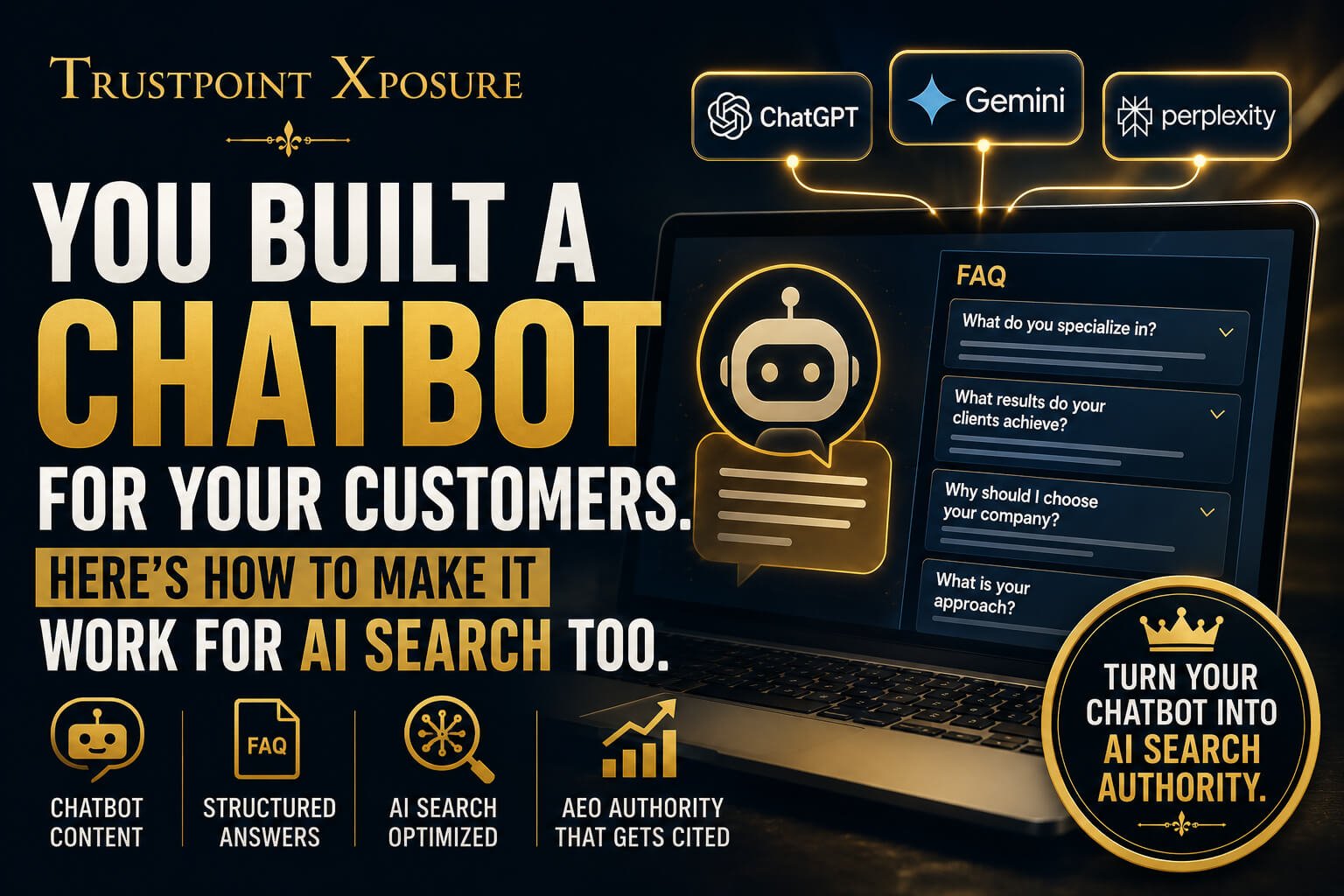
How to Turn Your Chatbot Content Into AEO Authority

You built your chatbot to serve your customers.

It answers questions at midnight. It qualifies leads on weekends and handles the FAQ volume that would otherwise fill your team’s inbox. Also, it does exactly what you built it to do, and it does it well.

But here’s what most businesses don’t realize about the content powering that chatbot.

Every question it answers is a direct window into exactly what your target audience wants to know about your field. Every answer it delivers is a structured, direct response to a real customer query. And that combination, real questions, direct answers, structured format, is precisely what AI search platforms like ChatGPT, Gemini, and Perplexity are designed to extract, verify, and cite.

Your chatbot is sitting on an AEO goldmine. Most businesses have no idea.

THE CONNECTION MOST BUSINESSES MISS

AEO, Answer Engine Optimization, is the practice of structuring your brand’s content so AI systems can confidently select and cite you as the authoritative answer to relevant queries.

Specifically, the content that AI systems extract and cite most readily is structured, direct, question-and-answer formatted content built around the exact queries real users ask. It is entity-clear, consistently sourced, and machine-readable.

Look at that description again. Now look at your chatbot knowledge base.

Your chatbot knowledge base is a library of structured questions and direct answers built around the exact queries your customers ask. It is, or can be, one of the most powerful AEO content assets your business owns. The problem is that most businesses keep it locked inside their chatbot platform, where AI search systems can never find it.

The strategy we’re about to walk through changes that.

Q: How does chatbot content connect to AEO and AI search authority?

A: AI search platforms extract and cite content that is structured, direct, and question-and-answer formatted, exactly the format that powers a well-built chatbot knowledge base. When chatbot Q&A content is published on your website with proper schema markup, specifically FAQPage schema, it becomes machine-readable content that AI retrieval systems can surface and cite directly. Every question your chatbot answers well is a potential AI citation. Moreover, the connection between chatbot content and AEO authority is not theoretical; it is structural. The same content format that makes a chatbot effective is the content format AI search systems are specifically designed to extract.

STEP 1: AUDIT YOUR CHATBOT KNOWLEDGE BASE FOR AEO VALUE

Start by pulling every question your chatbot has been trained to answer. Group them into categories: product questions, service questions, pricing questions, process questions, credibility questions.

Now look at the credibility and expertise questions specifically. These are the questions where your chatbot explains what you do, why you’re qualified, what makes your approach different, and what results your clients achieve. These questions, and the direct answers you’ve written for them, are your highest-value AEO content.

They are the exact queries your prospects are typing into ChatGPT and Gemini when they research experts in your field. And right now, they are sitting in your chatbot platform, invisible to every AI search system that could be citing them.

Q: Which chatbot questions have the most AEO value?

A: The highest AEO value questions are those that address expertise, credibility, and category authority, the questions a prospect would ask when evaluating whether to trust you. Examples include: What does [your name or brand] specialize in? What results do [your brand’s] clients typically achieve? Why should I choose [your brand] over competitors? What is [your brand’s] approach to [your core service]? These questions, answered directly and concisely, are exactly what AI systems extract when building a recommendation. They should be among the first chatbot answers published on your website in a structured FAQ format.

STEP 2: PUBLISH YOUR CHATBOT Q&A ON YOUR WEBSITE

This is the step that converts your chatbot content from a customer service asset into an AEO authority asset.

Take your highest-value chatbot questions and answers and publish them on a dedicated FAQ page on your website. Write them in clean, direct language, one question, one concise answer, no unnecessary preamble. The format should be immediately scannable by both human readers and AI retrieval systems.

This page does two things simultaneously. Furthermore, it serves your human website visitors who are looking for quick, clear answers. And it gives AI search platforms a structured, extractable content layer that they can surface when answering queries about your field.

The same content. Two audiences. One strategy.

Q: How should chatbot content be formatted on a website for maximum AEO impact?

A: Chatbot content published for AEO impact should follow three formatting principles. First, one question per block, don’t combine multiple questions or bury the question inside a paragraph. Second, direct answers start the answer with the key information, not with “Great question” or “It depends.” AI systems extract the beginning of answers most readily. Third, concise language, answers between 40 and 120 words perform best for AI extraction. Longer answers can be included, but the key facts should appear in the first two sentences. This format serves human readers and AI systems equally, which is the goal of every AEO content decision.

STEP 3: ADD FAQPAGE SCHEMA TO YOUR PUBLISHED Q&A

Publishing the content is necessary. Making it machine-readable is what activates its AEO value.

The FAQPage schema is structured data markup that explicitly tells AI crawlers and search systems that a page contains question-and-answer content, and labels each Q&A pair so they can be extracted individually. Without a schema, AI systems have to infer the structure of your content. With schema, you hand them pre-labeled answer blocks that require no inference.

This is not a complex technical implementation. The FAQPage schema can be added to any page by a developer in under an hour, or through schema plugins on WordPress and other common platforms without any coding at all. The return on that single hour of implementation is measured in AI citation frequency, and it begins immediately after the schema is indexed.

Q: What is the FAQPage schema, and why is it specifically important for AI citations?

A: FAQPage schema is a structured data format that marks up question-and-answer content in machine-readable code, explicitly labeling each question and its corresponding answer for AI and search systems. Its importance for AI citations is direct; AI retrieval systems are specifically designed to extract structured Q&A content when generating answers to user queries. A page with an FAQPage schema presents its Q&A content in a format that AI systems can extract without interpretation, making it significantly more likely to be surfaced and cited than unstructured content covering the same topics. It is one of the fastest and highest-return technical implementations available in the AEO strategy.

STEP 4: TRAIN YOUR CHATBOT ON YOUR AEO CONTENT

This is where the strategy becomes self-reinforcing.

Once your FAQ content is published and schema-tagged on your website, update your chatbot’s knowledge base to reference and align with that published content. When your chatbot answers a question, it should be answering it in the same language, structure, and framing as your published FAQ pages.

This alignment creates consistency, one of the most important signals in AEO. AI systems weigh consistent, repeated information across multiple sources more heavily than information that appears in only one place. When your chatbot content, your website FAQ pages, and your published editorial coverage all describe your expertise in consistent, structured language, you are building the kind of entity signal that AI systems recognize as reliable and citable.

STEP 5: USE CHATBOT CONVERSATION DATA TO FIND NEW AEO OPPORTUNITIES

Your chatbot is not just a content asset. It is a real-time research tool for understanding exactly what your target audience wants to know.

Every month, review your chatbot’s conversation logs. Look for the questions that appear most frequently, particularly the ones your chatbot handles imperfectly or escalates to a human. These are the gaps in your current content strategy. They are questions your prospects are asking that you haven’t fully answered yet.

Each one is an AEO opportunity. Build an FAQ page around it. Tag it with schema. Publish it. Update your chatbot to answer it better. Repeat.

Over time, this process creates a content ecosystem that grows more comprehensive, more authoritative, and more citable with every iteration, driven entirely by the real questions your real audience is asking.

Q: How often should chatbot conversation data be reviewed for AEO content opportunities?

A: Monthly review is the optimal cadence for most businesses. This frequency captures emerging question patterns quickly enough to act on them before competitors do, without creating review overhead that becomes unmanageable. During each review, prioritize three categories of questions: high-frequency questions not yet addressed in your published FAQ content, questions where the chatbot is escalating to a human agent, indicating gaps in the knowledge base, and questions where the chatbot’s answer is receiving negative feedback or low satisfaction scores. These three categories identify the highest-value content gaps with the clearest evidence of audience demand.

THE BIGGER PICTURE

Your chatbot and your AEO strategy are not separate projects competing for the same resources. They are the same project executed through two channels.

Both are built on structured, direct, authoritative answers to the questions your audience actually asks. Both serve the same goal, making your expertise immediately accessible, credible, and trustworthy to whoever encounters it. And when they are built together with shared content, aligned language, and consistent entity signals, they amplify each other in ways that neither can achieve alone.

Your chatbot makes your expertise accessible to the customers already on your website.

Your AEO strategy makes your expertise accessible to the AI systems, directing customers to your website in the first place.

Together, they close the loop entirely, from the moment a prospect asks AI who to trust, to the moment they land on your website and get the answer that converts them.

Your chatbot is already working for your customers. It’s time to make it work for AI search, too.

At Trustpoint Xposure, we turn your existing content into an AI citation authority and build the signals that make ChatGPT, Gemini, and Perplexity choose you. Schedule a free consultation at trustpointxposure.com.
You Have 90 Days to Build AI Authority Before Your Competitors Make It Impossible

There is a clock running on your digital authority right now.

Most professionals don’t know it exists. The ones who do are moving fast. And the ones who ignore it are going to spend the next several years trying to recover ground that could have been claimed in a single focused quarter.

The clock is not a scare tactic. It is a structural reality of how AI citation authority works, and understanding it is the difference between being the expert AI recommends and watching that position get permanently occupied by someone else.

Here is what the clock means, why 90 days matter, and exactly what to do before it runs out.

WHY AI AUTHORITY COMPOUNDS, AND WHY THAT MAKES TIMING EVERYTHING

Most digital marketing strategies are recoverable. If you stop posting on social media for six months, you can restart. If your SEO slips, you can rebuild. A quiet PR period can always be ramped back up. The gap hurts, but it isn’t permanent.

AI authority is different because it compounds.

Every time an AI system cites a brand or professional as the authoritative answer in a category, it reinforces its confidence in making that citation again. The more citations accumulate, the stronger the signal. The stronger the signal, the more citations follow. The pattern builds on itself, and over time, it becomes increasingly difficult for a competitor to displace because the AI has accumulated too much reinforcing evidence to easily reverse.

This is the compounding advantage that first movers in AEO are building right now. And it is the structural disadvantage that late movers will face when they finally decide to act.

The 90-day window is not arbitrary. It is the approximate timeline within which a focused, systematic AEO strategy begins to produce measurable citation signal across major AI platforms, and within which the gap between your position and a competitor who started earlier becomes meaningfully harder to close.

Q: Why is 90 days specifically the critical window for building AI authority?

A: Ninety days is the approximate timeline within which a comprehensive AEO strategy combining editorial placements, entity verification, Knowledge Panel establishment, and structured schema content begins to produce measurable citation signals across major AI platforms. For live-search platforms like Perplexity, signals can appear within weeks of strong editorial placements. For model-trained platforms like ChatGPT and Claude, 60 to 90 days is when foundational authority signals begin to consolidate into consistent citation patterns. Beyond that window, competitors who started earlier have established citation preferences that AI systems reinforce with every subsequent query, making displacement significantly more difficult and expensive.

WHAT HAPPENS AFTER 90 DAYS IF YOU HAVEN’T STARTED

This is the part most agencies won’t tell you directly because it is uncomfortable, and it creates urgency that some brands aren’t ready to act on.

After 90 days of a competitor building systematic AEO authority, several things happen simultaneously.

Their editorial coverage pattern is established, with multiple placements across recognized publications that AI systems treat as authoritative third-party verification. Each placement reinforces the last. The pattern tells AI that this expert is consistently recognized by credible external sources.

Their Knowledge Panel is verified, their entity identity is confirmed within Google’s knowledge graph, feeding directly into Gemini, Google AI Overviews, and the broader AI citation ecosystem.

Their schema content is indexed, their website speaks machine language, their Q&A content is tagged for extraction, and their entity data is structured and consistent. Moreover, their citation frequency is growing, and AI systems are citing them with increasing confidence across an increasing range of queries in their category.

And you are starting from zero, trying to build into a landscape where AI systems already have a preferred source for the queries your prospects are asking.

That is not an impossible position. But it is a significantly harder, slower, and more expensive one than building authority now, while the landscape is still open.

Q: Is it too late to build an AI authority if competitors have already started?

A: It is never too late, but the cost and timeline increase significantly the longer you wait. AI systems can update their citation preferences when compelling new evidence is introduced, such as a pattern of strong editorial placements, a newly verified Knowledge Panel, or a properly structured Wikipedia entry. But displacing an established citation preference requires more evidence, more consistency, and more time than establishing one in an open landscape. The brands that act now are building at the lowest possible cost. The brands that act later are building against an established competitor advantage, which means more investment for the same outcome.

THE 90-DAY AEO BLUEPRINT

This is the sequence that builds meaningful AI citation authority within 90 days. Not every element will be complete within the window, but every element will be in motion, producing a signal and compounding.

Days 1 to 7: The Audit

Before building anything, know exactly where you stand. Query your name, your specialty, and your category across ChatGPT, Gemini, and Perplexity. Document every response, every inaccuracy, every omission, every competitor citation. This audit is your baseline and your roadmap. Every gap is a specific problem with a specific solution.

Simultaneously, conduct an entity consistency audit across every platform where your name appears, website, LinkedIn, Google Business Profile, directories, and publication bios. Identify every inconsistency in name, title, specialization, and organizational affiliation. These inconsistencies are the first thing to fix because they undermine every other signal you build.

Days 8 to 21: Entity Foundation

Fix every inconsistency identified in the audit. Your name, title, specialization, and credentials should be identical across every platform. This is unglamorous work, but it is foundational. AI systems resolve ambiguity by defaulting to the clearest entity. Inconsistency is ambiguity. Clean it up before building anything else on top of it.

Simultaneously, begin the Google Knowledge Panel process. If you already have a panel, claim it and ensure every field is accurate and complete. If you don’t, begin building toward it through the editorial coverage and schema signals that trigger panel creation. The Knowledge Panel is an infrastructure. Everything else is faster once it exists.

Days 22 to 60: Editorial Authority

This is the highest-leverage phase of the 90-day window. Secure genuine editorial placements in publications that AI systems recognize as authoritative third-party sources. Not press releases. Not sponsored content. Real editorial coverage that functions as external verification of your expertise.

The publication matters. The context matters. And the pattern matters, one placement is a data point, three or four placements across credible outlets within 60 days is a pattern that AI systems register as consistent third-party authority. This is where most of the AI citation signal is built.

Days 45 to 75: Schema and Content Architecture

While editorial placements are being developed, implement a structured schema on your website. Person or Organization schema that explicitly describes your entity. The FAQPage schema on every page that contains question-and-answer content. This is the technical layer that makes your expertise machine-readable, and it works in parallel with the editorial layer, reinforcing the same entity signals through a different channel.

Write at least three to five pages of FAQ-structured content targeting the exact questions your clients ask AI platforms about your field. This content serves double duty; it helps your human website visitors and gives AI retrieval systems pre-formatted answer blocks to extract and cite.

Days 60 to 90: Wikipedia and Consolidation

For clients who meet notability requirements, begin the Wikipedia entity establishment process. A properly sourced Wikipedia entry is the deepest authority signal available in the AI ecosystem, but it requires careful development to meet editorial standards. The 60-day mark is the right time to begin this process because the editorial coverage built in the previous phase provides the third-party sources Wikipedia requires for notability verification.

In the final phase, consolidate and monitor. Query your name and specialty across all major AI platforms again. Compare to your Day 1 baseline. Document every improvement and every remaining gap. Adjust strategy based on what the data shows.

Q: What is the single most important AEO action to take in the first 30 days?

A: Build editorial coverage. Of all the AEO signals available, third-party editorial placements in recognized publications produce the fastest and most direct impact on AI citation authority, particularly for live-search platforms like Perplexity that retrieve from current web sources at query time. A genuine editorial placement in a recognized publication is external verification that an independent editorial process confirmed your expertise. AI systems weigh this heavily, and the pattern of placements established in the first 30 days forms the foundation that every subsequent signal builds on.

THE PROFESSIONALS MOVING NOW

The clients building AI authority fastest right now share one characteristic: they understood the compounding dynamic before their competitors did and acted on it without waiting for more evidence.

They are not necessarily the largest brands or the most established names in their fields. They are the ones who asked the right question, what does AI say about me right now, and then did something about the answer.

Six months from now, they will have citation patterns that AI systems reinforce with every query. Their competitors will be starting from zero, or worse, starting from behind.

The window is open. It is not permanently open. But right now, today, the landscape in most professional categories still has room for the brands willing to move with urgency.

Ninety days. The clock is running.

At Trustpoint Xposure, we build AI authority on a timeline that matters, with a methodology built for the 90-day window and a guarantee on the results. Schedule a free consultation at trustpointxposure.com.

Claim it now!

Subscribe To Our Newsletter!

Subscribe to our newsletter for weekly PR tips, updates, and expert strategies to boost your visibility.

We take your privacy seriously. You’ll only receive occasional updates — no spam, and we’ll never share your information with anyone. You’re free to unsubscribe at any time with a single click