
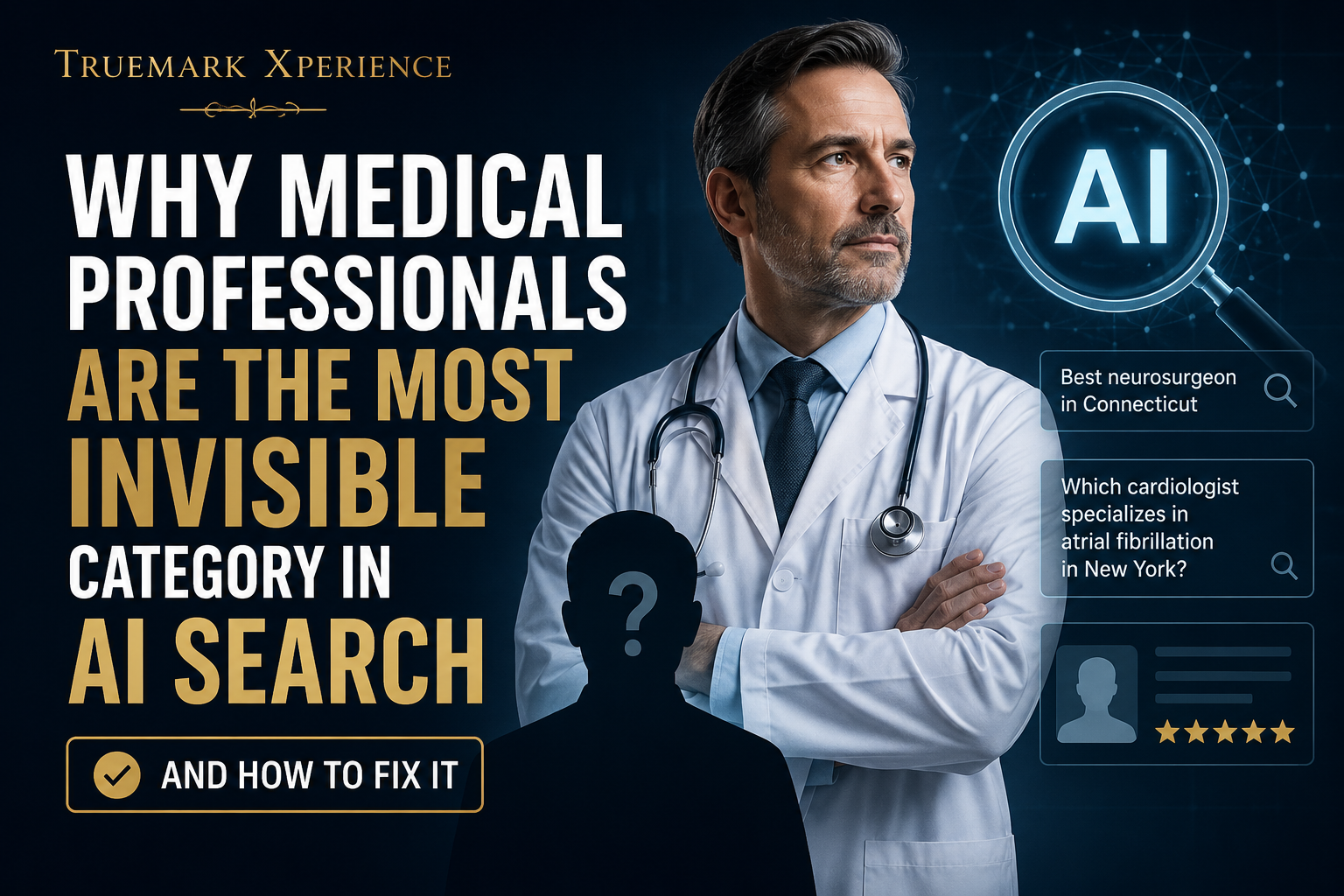
The most qualified physicians in the country are invisible to the patients actively searching for them, and the reason has nothing to do with their expertise.
Here is a scenario playing out across the country every single day. A patient needs a specialist. They open ChatGPT. They type “who is the best neurosurgeon in Connecticut” or “which cardiologist in New York specializes in atrial fibrillation, read the answer, form a first impression, and then they decide.
The physician in that answer walks into the patient relationship already trusted. The physician not in that answer may never get the referral, the appointment, or the call.
Medical professionals are, as a category, among the most invisible in AI search. Not because their credentials are weak. Because the specific signals AI systems use to identify, verify, and cite medical expertise have never been built for most of them.
WHY AI DOESN’T KNOW MOST PHYSICIANS EXIST
Medical professionals have spent careers building authority through the channels that have always mattered: peer recognition, hospital affiliations, board certifications, publication records, and patient outcomes.
They are almost entirely invisible to AI systems.
AI answer platforms do not evaluate board certification registries or read hospital credentialing files. They evaluate entity clarity, third-party editorial coverage, Google Knowledge Graph verification, Wikipedia entity presence, and structured schema content. A physician with forty years of practice and genuine peer recognition can still be completely absent from AI-generated medical recommendations, because none of those credentials have been translated into machine-readable authority signals.
The Critical Gap: Medical credentials are built for human verification systems. AI citation authority is built for machine verification systems. The two barely overlap.
Q: Why are medical professionals specifically so invisible in AI search?
A: Two structural reasons. First, the credentialing systems that establish medical authority board certifications, hospital affiliations, and peer review records are not publicly indexed in formats AI systems can access and verify. Second, medical professionals have historically relied on institutional authority rather than individual digital authority. AI systems cannot cite an institution on behalf of an individual. They require individual entity signals, a verified Knowledge Panel, consistent editorial coverage, structured schema content, and Wikipedia presence, which most physicians have never built.
THE 5 REASONS AI CAN’T CITE MOST MEDICAL PROFESSIONALS
Reason 1: No Individual Entity Verification
Most physicians exist digitally as employees of a hospital, not as distinct, verified individual entities. Without a verified Knowledge Panel and consistent entity data, AI systems default to citing whoever is clearest, and that is rarely the most qualified physician.
Reason 2: Absence From Recognized Editorial Sources
AI systems weigh editorial coverage in recognized publications as third-party authority verification. A physician cited in a healthcare trade publication carries significantly more AI citation weight than the same physician with fifty peer-reviewed publications and no accessible editorial coverage.
Reason 3: No Wikipedia Entity Presence
Wikipedia is one of the most heavily weighted sources in AI training data. Most medical professionals who qualify for Wikipedia have never pursued it, leaving the deepest AI authority signal available entirely unclaimed.
Reason 4: Unstructured Website Content
Without schema markup, Person schema, MedicalSpecialty schema, and FAQPage schema, AI systems have to infer the physician’s identity and credentials from unstructured text. Schema markup removes the inference entirely.
Reason 5: Institutional Rather Than Individual Authority
Hospital systems have digital authority. The individual physicians within them often don’t. Building individual AEO authority, independent of but complementary to institutional affiliation, is the solution.
Q: Does a physician’s hospital affiliation help with AI citations?
A: A hospital affiliation provides contextual credibility but does not substitute for individual entity verification. AI systems can recognize that a hospital is reputable without being able to identify, differentiate, or cite the individual physicians within it. The affiliation supports the citation. It does not create it.
Patients are not asking AI which hospital to trust. They are asking which physician to trust. And AI can only answer that question for physicians who have built individual authority signals, not institutional ones.
HOW MEDICAL PROFESSIONALS BUILD AI CITATION AUTHORITY
Step 1: Complete the AI Citation Audit
Open ChatGPT, Gemini, and Perplexity. Search your name. Search your specialty and city. Document every response, every inaccuracy, every omission, every colleague who appears instead of you.
Step 2: Build Individual Entity Clarity
Ensure your name, specialty, hospital affiliation, and board certifications are identical across every platform, your practice website, LinkedIn, Google Business Profile, Doximity, Healthgrades, and every medical directory.
Step 3: Secure Medical Editorial Coverage
Pursue genuine editorial placements in healthcare trade publications, regional business media, and recognized news outlets. Each placement functions as third-party verification that an independent editorial process confirmed your medical expertise.
Step 4: Claim Your Google Knowledge Panel
Search for your name on Google. Claim your Knowledge Panel and ensure every field is accurate and complete. For Gemini and Google AI Overviews, this is the most direct authority signal available.
Step 5: Implement Medical Schema on Your Website
Add Person schema, MedicalSpecialty schema, and FAQPage schema. This translates your expertise into a machine-readable format that AI systems can extract and cite directly.
Step 6: Establish Wikipedia Presence If You Qualify
Evaluate your notability against Wikipedia’s requirements. If you qualify, develop a properly sourced entry. This is the deepest AI authority signal available, foundational credibility at the training data level.
Q: How long does it take for a physician to start appearing in AI-generated patient recommendations?
A: For live-search platforms like Perplexity, editorial placements can begin producing citation results within weeks. For model-trained platforms like ChatGPT and Claude, meaningful signals develop within 60 to 90 days, with compounding gains over 6 to 12 months.
Q: Does AEO for medical professionals raise compliance or ethical considerations?
A: AEO does not involve any claims or guarantees about patient outcomes. It involves building verified, accurate authority signals, editorial coverage describing genuine expertise, a Knowledge Panel reflecting real credentials, and schema presenting factual professional information. Accuracy and verifiability are not just ethical requirements in medical AEO. They are the foundation of an effective AEO strategy.
WHY MEDICAL IS THE BEST VERTICAL TO MOVE FIRST IN
In legal and financial services, AEO awareness is growing. In medicine, the vast majority of physicians have not yet begun this process. The position of “the AI-recommended neurosurgeon in Connecticut” or “the AI-cited cardiologist for atrial fibrillation in New York” is unclaimed in most specialties and geographies.
Unclaimed positions don’t stay unclaimed. The physician who builds AI authority first will establish citation patterns that AI systems reinforce with every subsequent query. The window is open right now.
A physician cited as the AI-recommended expert in their specialty in 2026 will be cited more confidently in 2027, and more confidently still in 2028. The citation pattern compounds. The competitive advantage widens.
THE BOTTOM LINE
Medical professionals are the most invisible category in AI search, not because of anything they have done wrong, but because the authority systems that have always validated medical expertise were built for human evaluation, not machine verification.
The fix is specific. The timeline is achievable. The window is open. And the competitive position available to the first physician in any specialty to build genuine AI citation authority is one of the most powerful patient acquisition advantages available in medicine today.
Start with the audit. Know exactly where you stand. Then build, before your colleagues figure out they should.